
Best Supplements for Exercise Recovery: Boost Gains 2026

You finish a hard training session feeling good, then the next morning your legs feel like they belong to someone else. Stairs become a negotiation. Sitting down is slow. Getting back under the bar, onto the bike, or out for another run suddenly feels less heroic and more questionable.
That moment is where most athletes start looking at supplements for exercise recovery. Some grab protein because that's what lifters do. Others chase anti-inflammatory blends because soreness is the problem they can feel. Both instincts make sense. But they solve different problems.
The useful way to think about recovery supplements is simple. Some help rebuild and refuel. Others help manage soreness and the inflammatory response so you can train consistently. If you mix those goals together, you end up spending money on products that sound good but don't match what your body needs.
Table of Contents
Why Post-Workout Aches Are More Than Just Annoying
The usual mistake is treating soreness like a badge of honor. It isn't. It's feedback.
When your quads are wrecked after split squats, or your upper back aches after a heavy pulling session, your body is telling you repair work is underway. That soreness can be normal, especially after hard training, a new movement, or a jump in volume. But normal doesn't mean irrelevant. If soreness is bad enough to change how you move, delay your next session, or make you train around pain, it stops being a trophy and starts becoming a training problem.
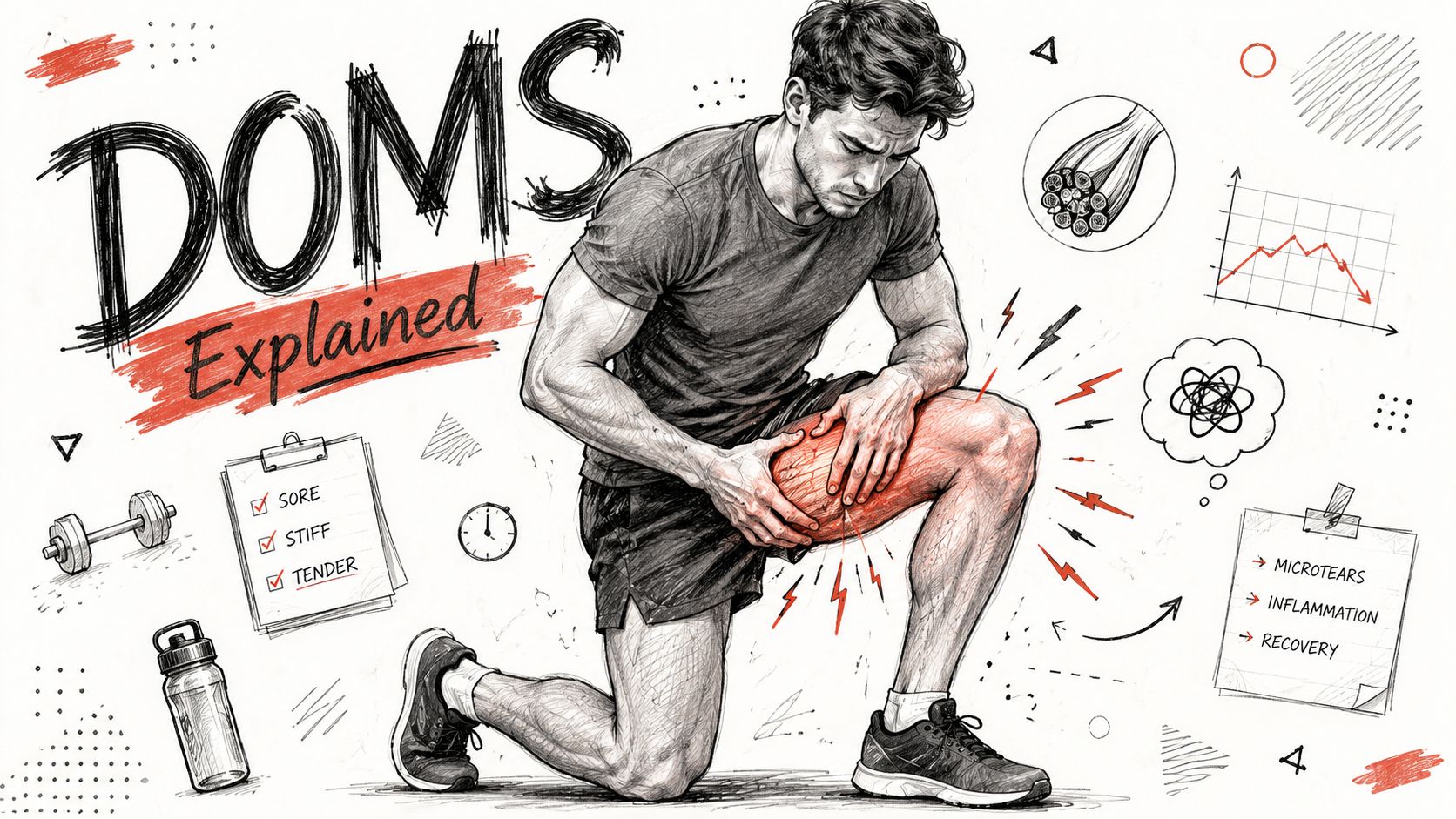
I see this all the time with motivated athletes. They don't usually need more motivation. They need less friction between one good workout and the next one. Recovery support matters because consistency builds progress. If soreness or fatigue keeps interrupting consistency, your program looks good on paper and underdelivers in real life.
Recovery is a management job
Supplements for exercise recovery don't create adaptation out of thin air. Training creates the signal. Food, sleep, hydration, and time handle most of the repair. Supplements can make that process smoother when they're chosen for the right reason.
A practical way to frame it is this:
Muscle damage needs raw materials. Your body has to rebuild tissue.
Hard training drains fuel. Your muscles need to restore energy.
Inflammatory stress can linger. If it stays high, training quality drops.
Soreness isn't proof that a session worked better. It's proof that your body has cleanup to do.
The real goal isn't zero soreness
Aiming to feel nothing after every workout is the wrong target. A better target is recovering well enough to train again with quality.
That changes how you choose supplements. If you're under-eating protein, a turmeric capsule won't solve the main problem. If your protein intake is solid but your joints and muscles stay cranky during a hard block, adding targeted support for soreness may help you hold training volume without feeling beat up all week.
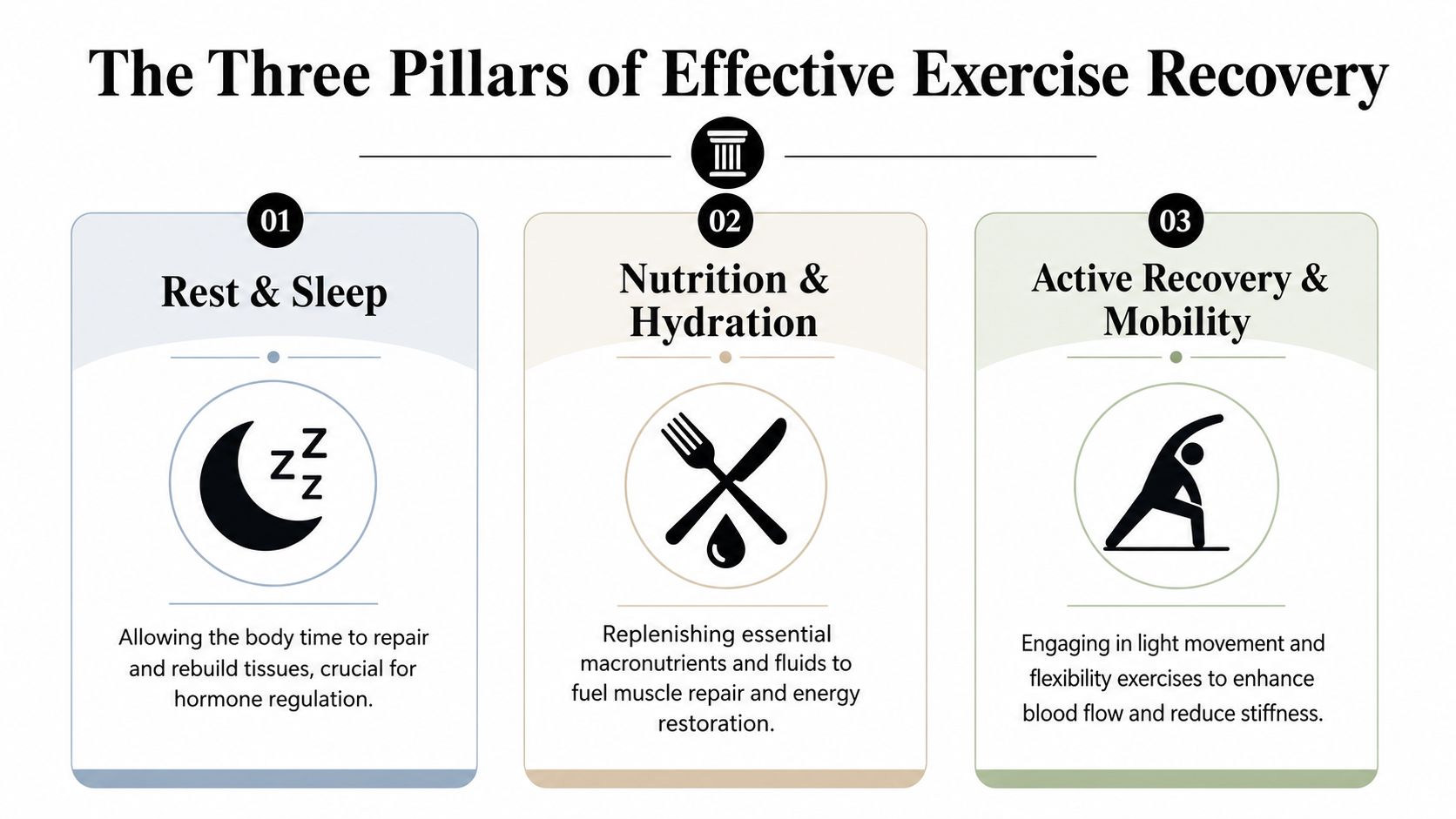
The Three Pillars of Effective Exercise Recovery
Most athletes think of recovery as one blurry thing. It isn't. It has a few clear jobs.
I like to explain it like rebuilding a house after a storm. First, you repair damaged structure. Second, you restock the pantry. Third, you calm down the noise and disruption so the house can function normally again. Recovery works the same way.
Muscle repair
Training creates stress in muscle tissue. That stress isn't bad. It's the reason adaptation happens. But the body still has to rebuild.
Protein is the nutrient often considered here, and for good reason. It supplies the amino acids your body uses to repair muscle tissue after training. If your intake is inconsistent, recovery usually feels inconsistent too.
This is also why the muscle-building category and the soreness-management category shouldn't be lumped together. Repair supplements help you rebuild. They don't necessarily make you feel less sore right away.
Fuel restoration
A lot of athletes focus only on protein and forget that hard training also empties the tank.
Immediate post-exercise intake of protein plus carbohydrates can speed muscle recovery, glycogen replenishment, and fatigue reduction compared with delayed intake, especially after intense sessions, according to this review on post-exercise nutrient timing. That matters most when training is vigorous, frequent, or layered with demanding sessions close together.
Here is the practical read on that:
After easy training, missing the perfect post-workout snack usually isn't catastrophic.
After brutal sessions, eating promptly helps your body start repair and refueling sooner.
If you train again soon, this matters even more because the next session arrives before full recovery does.
A tired athlete often assumes they need a stimulant. Sometimes they just need carbs and protein at the right time.
A quick visual primer helps if you want to see the broader picture of non-supplement recovery habits too.
Inflammation control
Exercise creates inflammation. That's part of the response to training stress. You don't want to erase that signal completely. You want to stop it from becoming excessive and disruptive.
Supplements for exercise recovery can also be divided into a second category. Omega-3s, tart cherry, bromelain, turmeric, and similar ingredients don't build muscle the way protein does. They support the environment around recovery by helping manage soreness, inflammatory signaling, and the drag that follows hard training.
Practical rule: Ask one question before buying anything. Do you need more building material, more fuel, or better soreness control?
If you answer that truthfully, your supplement choices get much simpler.
Foundational Fuel for Muscle Repair and Energy
If your basics are weak, the rest is decoration.
For most athletes, the first layer of supplements for exercise recovery is not exotic. It's protein and creatine monohydrate. These two have the strongest case as the foundation because they directly support the work your body has to do after training.
Protein does the repair work
Protein is the building crew. Without enough of it, recovery drags.
A recent review found that protein supplementation benefits both performance and post-exercise recovery, and that adding about 1 g/kg/day from supplements for a total daily intake around 2 g/kg/day appears most effective for enhancing performance. The same review notes that pure protein supplements improve strength and endurance versus placebo, reduce fatigue, and support glycogen resynthesis more efficiently than carbohydrate alone. It also reports that protein with adequate carbohydrate may reduce muscle damage markers and feelings of soreness. You can read that review in this sports nutrition paper.
That doesn't mean everyone needs a shaker bottle after every session. It means total intake has to be high enough and regular enough. Whey is convenient because it's easy to digest and simple to measure. Casein can be useful when you want slower digestion. Plant proteins can work too if the amino acid profile and total daily intake are strong.
Creatine helps you recover energy faster
Creatine isn't just a performance supplement. It also belongs in the recovery conversation.
Creatine monohydrate at about 20 g/day for 5 days raises muscle creatine stores by about 20%, and the International Society of Sports Nutrition classifies it as highly effective for increasing high-intensity work capacity and lean mass. A maintenance dose of 3 to 5 grams daily, paired with 1.6 to 2.2 g/kg/day of protein, forms a foundational recovery stack for most athletes according to this review in the International Journal of Sport Nutrition and Exercise Metabolism.
That last point matters. Creatine helps the athlete who wants to train hard again tomorrow. It supports repeated high-quality effort. It doesn't work like a painkiller. It works more like better backup batteries for demanding work.
What matters more than fancy add-ons
Most recovery success still comes from the plain stuff done consistently. The same review notes that the biggest wins usually come from:
Consistent protein intake
Daily creatine monohydrate
Planned hydration with sodium
Sleep quality
Magnesium can have a situational role for sleep or soreness support, and tart cherry or curcumin can make sense during heavy training blocks when soreness starts affecting compliance. But if an athlete asks me where to spend money first, the answer is almost never a trendy recovery blend.
Build the floor before you buy the chandelier.
If protein is low, fix that. If creatine is missing, add it. If sleep is terrible, no capsule is going to outwork that problem.
Targeted Relief for Soreness and Inflammation
This is the part most labels blur on purpose.
Protein and creatine help you recover because they support rebuilding and energy turnover. Soreness-management supplements do something else. They try to reduce the friction that makes training feel heavier than it should.
Omega-3s lead this category
When the goal is post-exercise recovery itself, omega-3 fatty acids stand out.
In network meta-analyses of randomized trials involving trained athletes, omega-3 supplementation emerged as the most effective supplement for recovery outcomes with an SMD of 0.40 and SUCRA of 88.7%, outperforming creatine and protein for recovery-specific outcomes in this analysis of dietary supplements and post-exercise recovery. A separate review explains that this recovery effect is tied to omega-3s' role in downregulating pro-inflammatory cytokines and reducing markers of exercise-induced muscle damage.
That doesn't make omega-3s better than protein overall. It means they win in a different lane. Protein helps rebuild. Omega-3s help calm the biological noise around that rebuilding.
Tart cherry, bromelain, and turmeric have different jobs
Tart cherry has some of the cleaner practical evidence for soreness support. According to this review of nutritional supplements for muscle damage and recovery, 3 days of tart cherry juice at 340 mL twice daily reduced strength loss and pain while increasing force production by about 19% versus placebo in healthy male athletes. The same review reports that 7 days of cherry skin powder reduced perceived soreness by an average of 44% over the 48 hours after exercise in resistance-trained males, and that chronic tart cherry intake can improve muscle function and reduce pain perception across athletes and non-athletes.
Bromelain deserves more attention than it gets. Pineapple-derived bromelain supplementation has been shown to improve muscle function, reduce soreness, and increase pressure pain threshold after damaging exercise compared with placebo, particularly when combined with other proteolytic enzymes.
Turmeric sits in a trickier spot. It shows promise, especially for soreness, but the practical issue is absorption. Standard curcumin products can disappoint because bioavailability is poor. Pairing turmeric with piperine from black pepper is the key detail many buyers miss.
What these supplements do not replace
These ingredients can help, but they don't replace your foundation.
Use them when soreness is the bottleneck. Good examples include:
Heavy eccentric training blocks
Tournament weekends or repeated events
Return-to-training phases
High-volume programs where soreness threatens consistency
If your calories are low, your protein is shaky, and you're sleeping five hours, inflammation support won't rescue the week. It can help polish a solid plan. It can't stand in for one.
Optimizing Your System with Adaptogens and Micronutrients
Some athletes recover poorly not because they need more muscle-building support, but because the whole system is under strain.
High training stress, poor sleep, hard work schedules, dieting phases, and travel all change how recovery feels. In such scenarios, adaptogens and micronutrients can make sense. They don't replace protein or creatine. They support the environment your body uses to repair.
Adaptogens can help when stress is part of the problem
Most recovery guides stop at whey and creatine. That misses a real issue. A lot of athletes aren't just sore. They're stressed, run down, and stuck in a cycle where poor sleep amplifies poor recovery.
Emerging data suggests that turmeric at 1.5 to 5 g daily and ashwagandha at 600 mg daily may help reduce soreness and fatigue, but the evidence is still developing and the mechanism isn't fully settled, according to this review on anti-inflammatories and adaptogens in athletic recovery. The same review highlights the practical issue that turmeric needs piperine for meaningful absorption.
If you want a deeper look at how those ingredients are being discussed together in recovery formulas, this article on ashwagandha and curcumin for muscle health is a useful read.
Micronutrients matter when intake or status is weak
Micronutrients are less exciting, but they can matter a lot when you're low.
A recent evidence review found that vitamin C at moderate daily doses can reduce oxidative stress, muscle soreness, and cortisol, though performance effects are inconsistent and excessive intake may blunt adaptation. The same review reports moderate certainty that B-vitamin sufficiency supports energy metabolism and recovery, with low certainty for performance gains in well-nourished athletes. It also notes that vitamin D supplementation up to 4,000 IU/day versus 1,000 IU/day may positively affect recovery, though the evidence is limited. That summary is available in this review of vitamin supplementation in sports.
The practical takeaway is straightforward:
If your diet is solid and labs are normal, extra vitamins may do very little.
If you're deficient or under-recovered, correcting that gap can matter.
If you're hammering antioxidants hard, more isn't always better.
Recovery supplements work best when they fix a real bottleneck. They work poorly when they're used as insurance against bad habits.
How to Build Your Personal Recovery Supplement Stack
The best stack isn't the one with the most ingredients. It's the one that matches the problem you're trying to solve.
Some athletes need more total protein. Some need daily creatine. Some are already doing those well and need better soreness control during a demanding block. The decision gets easier when you stop asking, "What's the best recovery supplement?" and start asking, "What's limiting my recovery right now?"
Start with your bottleneck
Use this quick filter.
If you struggle with muscle repair or staying fed enough, start with protein.
If you train hard and want a proven all-around staple, add creatine monohydrate.
If soreness keeps carrying into the next session, look at omega-3s, tart cherry, bromelain, or turmeric with piperine.
If stress and poor sleep are part of the picture, consider adaptogens or supportive micronutrients after the basics are handled.
This order matters. Build from the ground up.
Timing matters, but less than most people think
A lot of athletes still obsess over the anabolic window like a garage door that slams shut if you don't drink a shake in time.
That idea is overstated. Recent meta-analyses indicate that the bigger priority is about 2 g/kg/day of protein distributed evenly across meals, not hyper-fixation on immediate post-workout intake alone, according to this review on total daily protein distribution and muscle protein synthesis.
So what should you do in practice?
Hit your daily total first. That solves more recovery problems than perfect timing.
Spread intake across the day. Even distribution supports muscle protein synthesis better than back-loading everything.
Use post-workout feeding as a secondary optimization. It's more useful after intense sessions, long sessions, or when another workout is coming soon.
If you want a practical primer on one of the key formulation details in anti-inflammatory recovery products, this explanation of curcumin with black pepper covers why absorption matters.
Single ingredients versus combination formulas
Single-ingredient products are easier to control. You know exactly what you're taking and can adjust one variable at a time. That's useful if you want to test fish oil, creatine, or tart cherry one by one.
Combination formulas trade some precision for convenience. That can work well when your main goal is day-to-day simplicity, especially if the ingredients target the same broad issue such as soreness support, stress resilience, or sleep quality. The downside is that if something works poorly, it's harder to know which ingredient was underdosed, unnecessary, or not suitable for you.
Also remember the safety piece. If you have medical conditions, take prescription medications, or are managing an injury, talk with a physician or a sports dietitian before stacking multiple products.
Exercise Recovery Supplement Cheat Sheet
Supplement | Primary Function | Typical Daily Dose |
|---|---|---|
Protein | Muscle repair and recovery support | Approximately 2 g/kg/day total daily protein |
Creatine monohydrate | High-intensity work capacity and recovery support | 3 to 5 grams daily maintenance |
Omega-3 fatty acids | Recovery and inflammation management | Use per product guidance |
Tart cherry juice or concentrate | Reduce soreness and support muscle function | 340 mL twice daily for 3 days in one study, or about 60 mL concentrate or 500 to 750 mL juice daily for 7 to 8 days |
Turmeric or curcumin with piperine | Soreness support | 1.5 to 5 g daily |
Ashwagandha | Stress and fatigue support | 600 mg daily |
BCAAs | Targeted amino acid support | 10 to 30 grams daily has no noted ill effects, with effective protocols ranging from 0.087 to 0.22 g/kg/day for at least 8 days, or 20 grams one hour pre-exercise |
L-glutamine | Muscle function and EIMD support | At least 0.3 g/kg/day for 3 to 7 days |
Vitamin D | Recovery support when status is low | Up to 4,000 IU/day discussed in current evidence |
Magnesium | Situational sleep or soreness support | 100 to 200 mg evening in the recovery stack review |
Recover Smarter Not Just Harder
Hard training gets the credit. Recovery decides whether you can repeat it.
The smartest approach is to keep the hierarchy clear. Sleep, calories, hydration, and overall nutrition do most of the heavy lifting. After that, protein and creatine form the foundation for many athletes. Then come the targeted tools, such as omega-3s, tart cherry, bromelain, turmeric with piperine, adaptogens, or select micronutrients, when soreness, inflammation, stress, or poor intake is the bottleneck.
That distinction matters. Muscle-building support and soreness-management support are not the same thing. Treat them like different tools for different jobs.
If you're sore all the time, don't just ask what supplement to buy. Ask why recovery keeps falling behind. Fix the biggest leak first. Then add supplements that match the problem instead of the marketing.
For athletes who want an extra recovery-focused food option, tart cherry gummies are worth comparing with juices and concentrates depending on convenience and preference.
If you want a convenient all-in-one option built around soreness support, stress resilience, and everyday recovery, take a look at River of Life. Its capsule formula combines turmeric extract with BioPerine black pepper, plus ashwagandha root, ginger, and bromelain in a single vegan product, which can be appealing if you'd rather keep your routine simple than juggle multiple bottles.