

Undenatured Type II Collagen: Joint Health & Mobility

Your knees may not hurt all day. They may just complain at the exact moments that matter. When you stand up after sitting too long. When you head downstairs carrying laundry. When a walk that used to feel easy starts with stiffness and ends with that dull, irritated ache.
That's usually when people start looking at joint supplements. Most of the market gives them the same basic pitch: take more collagen, feed the cartilage, hope the joints feel better. Sometimes that approach helps. Sometimes it doesn't. A lot depends on what kind of collagen you're taking, and what job you expect it to do.
Undenatured Type II collagen stands apart because it isn't mainly acting like raw material for tissue repair. It works more like a signal. More specifically, it works through the immune system, which is why such a small daily amount can matter. That difference is easy to miss if you lump all collagen products together.
If you're already trying to sort through options for natural pain relief strategies, this is one of the more useful distinctions to understand. It can save you from buying the wrong product for the wrong reason.
Table of Contents
A New Approach to Joint Comfort
Many individuals I speak with about joint supplements aren't dealing with some dramatic injury. They're dealing with friction in ordinary life. The knee that feels fine until they squat. The joint that stiffens after exercise. The discomfort that shows up in transitions, not at rest.
That pattern matters because it points to a simple truth. Joint comfort isn't only about cushioning. It's also about how the body responds to the tissues inside the joint.
Why the usual collagen conversation misses the point
When people hear “collagen,” they often think in construction terms. More collagen goes in, healthier cartilage comes out. That's a neat story, but it's incomplete. Some collagen products are used more as nutritional building blocks. Undenatured Type II collagen is different because its value depends on the protein staying intact.
That intact structure changes the role it plays. Instead of behaving like bulk material, it interacts with the body in a much more targeted way.
Practical rule: If a supplement is being sold as “just more collagen,” it may not be doing what undenatured Type II collagen is designed to do.
Who tends to notice the difference
This category usually makes the most sense for people in a few common situations:
Adults with creaky movement patterns: standing up, climbing stairs, kneeling, and squatting have become less comfortable.
Active people with exercise-triggered knee irritation: the joint feels stressed by training, but not necessarily damaged.
People who've tried generic joint formulas without much change: they may have chosen the wrong mechanism, not the wrong goal.
What I like about undenatured Type II collagen is that it gives us a more precise explanation for why a joint supplement might help. It isn't trying to overwhelm the body with quantity. It's trying to influence the immune response tied to joint irritation.
That's the primary reason it deserves its own category.
How Undenatured Type II Collagen Retrains Your Immune System
A lot of people expect a joint supplement to work like building material. More grams in, stronger cartilage out. UC-II works by a different route, and that difference explains why a very small dose can still matter.
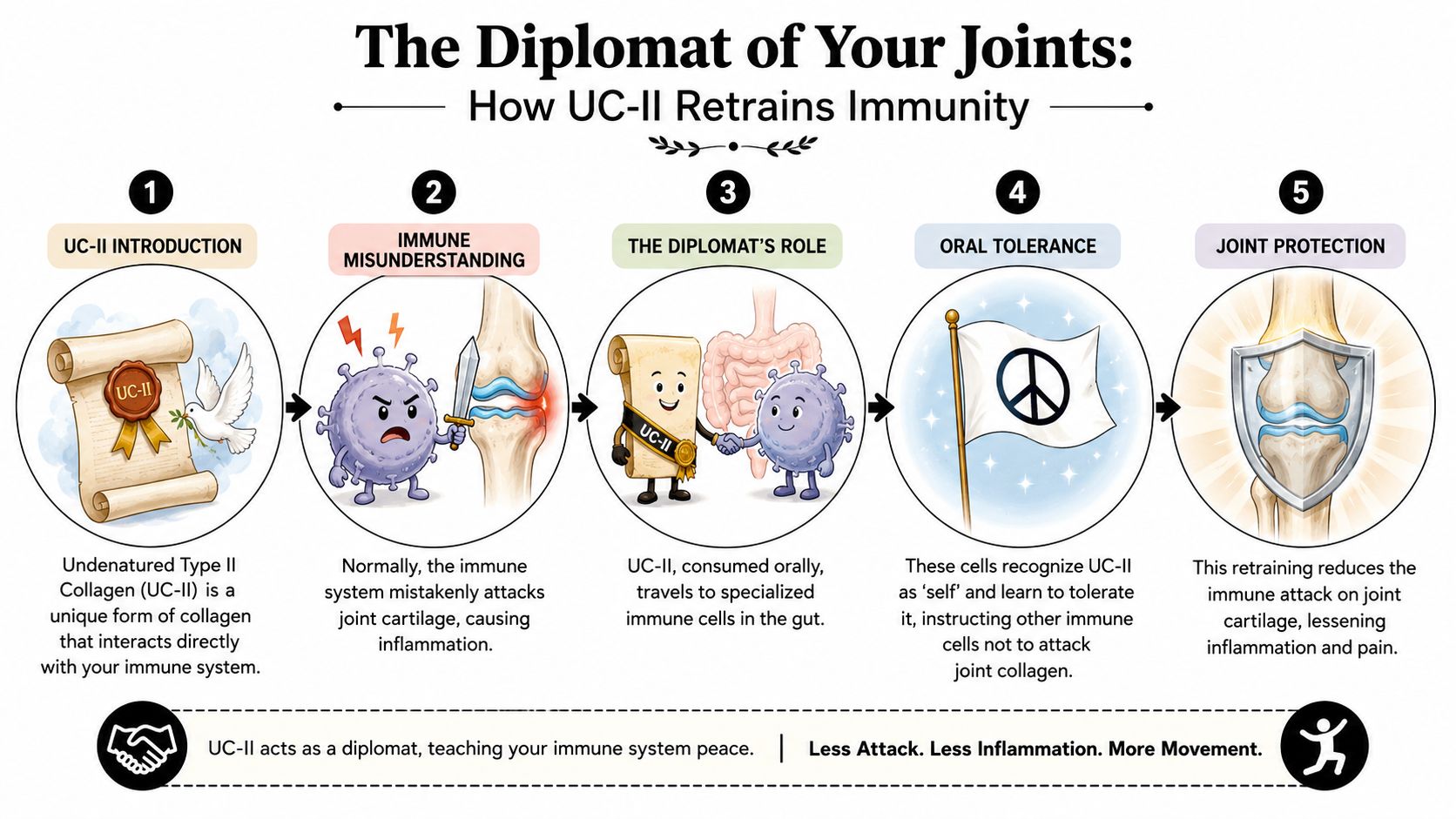
To make the mechanism easier to picture, this visual helps:
The immune system is the target
Undenatured Type II collagen works through oral tolerance. In plain English, that means the gut helps teach the immune system to respond more calmly to a specific protein.
The intact structure is what makes that possible. After you swallow UC-II, immune tissue in the gut, including Peyer's patches, encounters the undenatured collagen. That contact can promote regulatory T cells, which help reduce unnecessary immune reactivity against joint cartilage.
That is the part many labels skip over. The benefit does not come from dumping large amounts of collagen into the body. It comes from presenting the immune system with the right structure in the right form.
A whole key works because its shape is preserved. Broken key pieces do not open anything. UC-II follows that same logic.
What oral tolerance means for sore, stiff joints
Joint discomfort is not always just a mechanical problem. Friction, training load, age-related wear, and past injuries all matter. So does immune activity inside the joint.
When the immune response stays irritated, the joint environment tends to stay irritated too. That can show up as stiffness after sitting, sore knees on stairs, or a joint that feels slower to warm up and recover. UC-II is used to calm part of that cycle rather than only provide raw material.
The process looks like this:
You take a small daily dose of UC-II
Gut immune tissue recognizes the intact Type II collagen
Regulatory immune signaling increases
The immune system becomes less reactive to joint collagen
The joint gets a less hostile environment
That sequence is why the undenatured form matters so much. If heat or processing changes the structure too much, the immune signal weakens or disappears.
Later in the section, this video gives another easy overview of the concept:
UC-II works best viewed as an immune signal for joint comfort, not a bulk collagen product.
Why the dose is so small
This is the practical question I hear most. If collagen is helpful, why is the serving measured in milligrams instead of scoops?
Because the job is different. A signaling compound does not need to be taken in the same quantity as a general protein supplement. With UC-II, the goal is immune recognition of the intact Type II collagen, not flooding the body with collagen fragments.
That creates a real-world trade-off. If someone wants collagen mainly for skin, hair, nails, or general protein support, they often choose peptides. If the main goal is joint comfort and mobility, especially when the pattern suggests ongoing irritation, UC-II has a more targeted rationale.
Undenatured vs Hydrolyzed Collagen Explained
One of the biggest sources of confusion in the collagen aisle is that two products can share the word “collagen” and still behave very differently.
Undenatured Type II collagen and hydrolyzed collagen peptides are not interchangeable. They differ in structure, dose logic, and what they're mainly trying to accomplish.
Whole key versus broken pieces
Undenatured Type II collagen keeps its native folded shape. That preserved shape is the point. It allows the body to recognize the protein in a way that supports oral tolerance.
Hydrolyzed collagen is collagen that has been broken into smaller pieces. That can still be useful. It just serves a different purpose. Think of it as nutritional input rather than an immune signal.
If you want the shortest version, use this:
Undenatured Type II collagen is about signaling.
Hydrolyzed collagen is about supplying fragments.
Neither category is automatically “better” in every situation. But they are not doing the same job, and that's where people waste money.
Undenatured Type II vs. Hydrolyzed Collagen
Feature | Undenatured Type II Collagen (UC-II) | Hydrolyzed Collagen (Peptides) |
|---|---|---|
Structure | Intact, native protein structure | Broken into smaller peptides |
Primary mechanism | Immune signaling through oral tolerance | Provides collagen fragments as nutritional building blocks |
Dose style | Small daily capsule-sized amount | Larger gram-based servings are common |
Main target | Joint comfort and mobility, especially where immune signaling matters | Broader collagen intake goals such as skin, connective tissue, or general protein support |
Why it works | Depends on preserved structure | Depends on digestion and absorption of peptide fragments |
What works and what does not
In practice, the importance of label reading is underscored.
What works:
Choosing undenatured Type II collagen when your goal is joint comfort through the oral tolerance pathway
Understanding that the small dose is intentional
Looking for wording that confirms the collagen is undenatured
What usually doesn't work:
Assuming every collagen powder supports joints in the same way
Judging UC-II by the standards of peptide dosing
Buying a product that only says “collagen” without clarifying the form
If you want the immune-training effect, structure matters more than size.
There's also a manufacturing side to this. Research on undenatured Type II collagen from Atlantic salmon bone found that the ingredient retained measurable native epitopes under digestion conditions, supporting the idea that structural integrity is central to bioactivity in joint health use, as shown in the analysis of native Type II collagen integrity.
That's why the distinction isn't marketing language. It's functional biology.
The Clinical Evidence for Joint and Mobility Benefits
Mechanisms are useful, but people don't buy a supplement because the pathway sounds elegant. They buy it because they want stairs to feel easier, standing to feel steadier, and movement to stop feeling like negotiation.
That's where the clinical trial data matters.
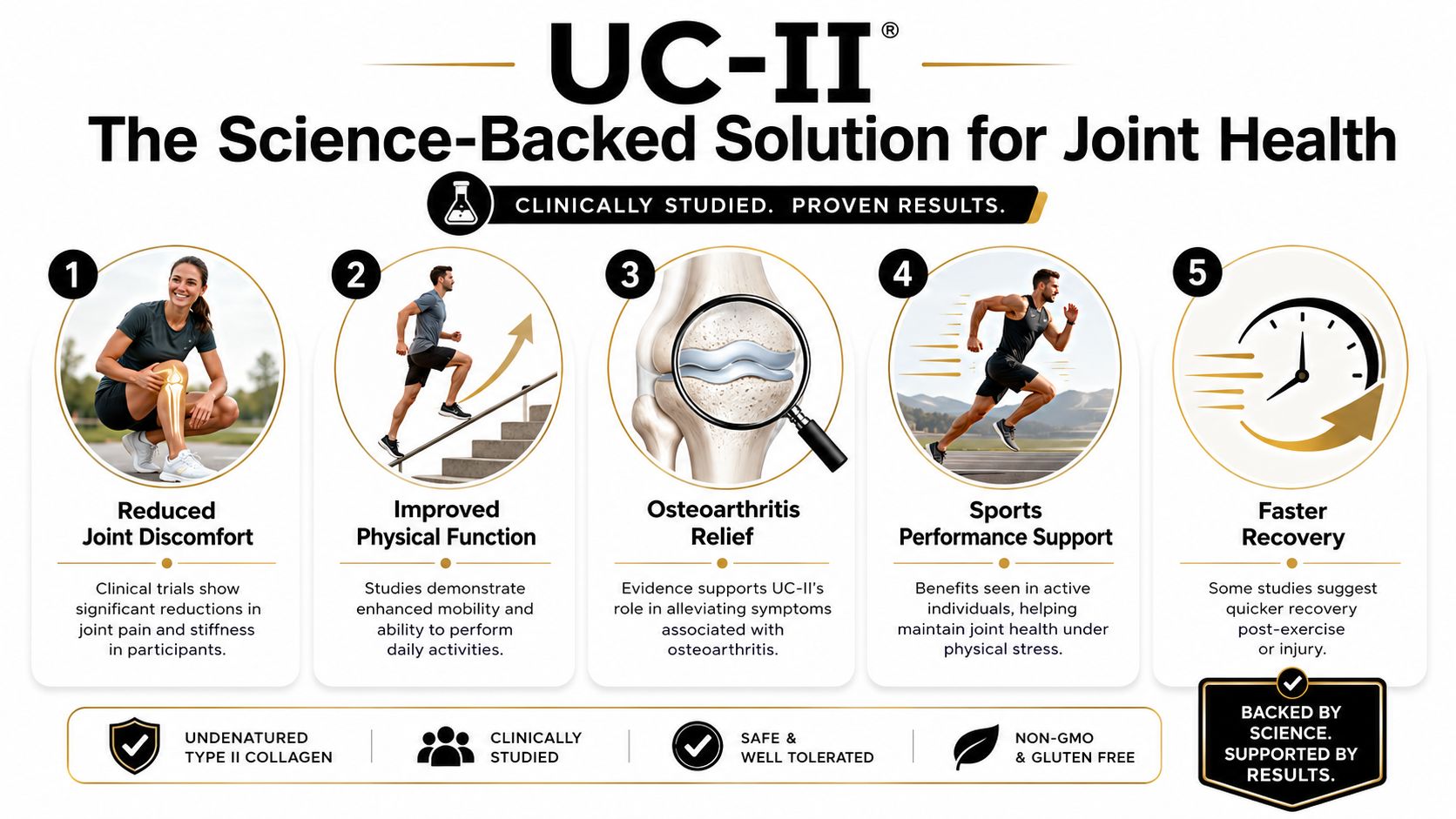
A helpful visual summary is below:
What happened in a controlled trial
In a controlled clinical trial involving healthy participants aged 50 years and older with exercise-induced knee pain, 40 mg daily of UC-II® for 120 days led to statistically significant improvements in knee function compared with placebo. Participants reported a 39.12% reduction in joint discomfort when standing upright versus 0% in the placebo group, a 30.8% reduction in discomfort ascending stairs versus 0%, and a 34.5% reduction in discomfort going up or down stairs versus 14.8%. The same study also found a 34.5% reduction in squatting discomfort versus 0% in placebo and a 13.1% improvement in bending to pick up an object versus an 8.7% worsening in placebo, according to the clinical UC-II knee function trial.
Those numbers matter because they match how people experience knee problems. Not in a lab fantasy, but in ordinary movement.
Translating the data into daily life
A reduction in discomfort while standing upright means the joint feels less irritated during one of the most basic positions of the day. Improvement on stairs matters even more. Stairs expose weakness, stiffness, and pain quickly. If a knee is unhappy, stairs tell the truth.
Squatting and bending are also revealing tests. They ask the knee to load, stabilize, and move through range. When those get easier, people usually notice it outside the clinic. Gardening feels less daunting. Getting down to a low shelf feels less risky. Exercise stops feeling like something you'll pay for later.
For readers comparing options, this fits well alongside other supplements people use for joint stiffness, but UC-II stands out because the dose is small and the mechanism is different.
What I take from the evidence
A few practical points stand out from the trial:
The benefit showed up in function-heavy tasks: standing, stairs, squatting, and bending.
The dose was modest: this supports the idea that UC-II is acting as a signal, not bulk material.
The placebo comparison matters: some outcomes improved in the UC-II group while placebo showed no improvement or even worsening.
There's also broader support for the category. Research has described undenatured Type II collagen as more effective than glucosamine and chondroitin sulfate in joint health studies involving humans and animals, suggesting a stronger option for early osteoarthritis management. I'm keeping that point qualitative here because the mechanism section is where the core source is anchored.
The most convincing joint supplement data usually involves ordinary actions. Standing, stairs, squatting, and bending are the tests people care about.
Finding the Right Dose and Formulation
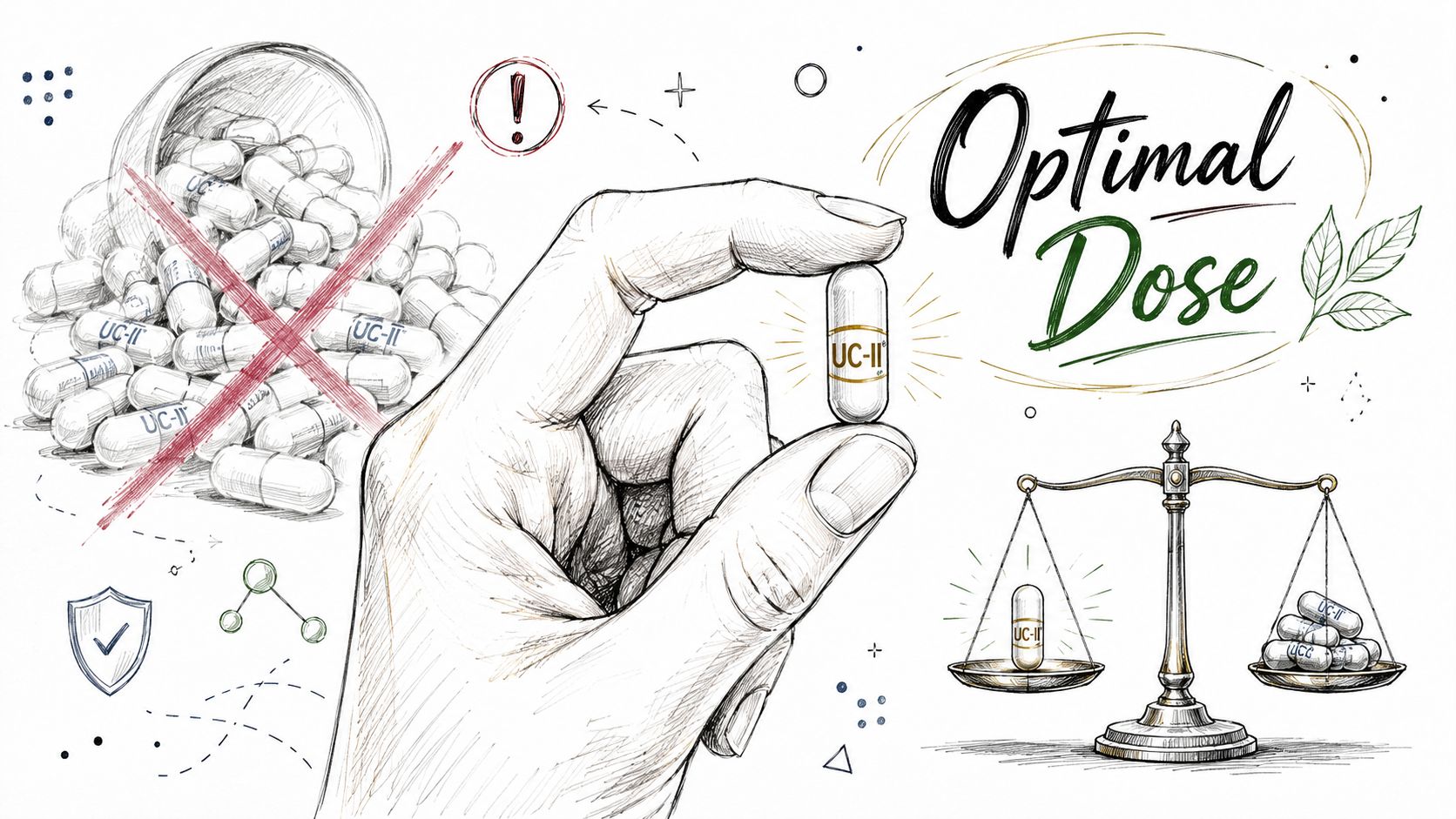
This is the part that surprises people most. With undenatured Type II collagen, more isn't better.
That sounds backward if you're used to powders and scoops, but UC-II isn't trying to provide collagen in bulk. It's trying to deliver a recognizable immune signal in the right form.
Why the dose is so small
The clinically studied amount people usually see with UC-II is 40 mg once daily. That small dose makes sense only when you remember the mechanism. The goal isn't to “feed” cartilage with a large collagen load. The goal is to present the immune system with the intact Type II collagen structure.
A lot of shoppers make the mistake of comparing labels by milligrams alone. That doesn't work across collagen categories. A gram-heavy peptide product and a tiny UC-II capsule are built around different logic.
What formulation tends to make the most sense
UC-II is usually easiest to take in capsule form. That's practical for a few reasons:
Small serving size: you don't need a scoop, shaker bottle, or flavored powder.
Simple routine: once-daily use is easy to keep consistent.
Combination formulas can be useful: some products pair UC-II with other joint-support ingredients, though the label should still make the undenatured Type II amount clear.
What I generally prefer is a straightforward product that makes the form obvious. If the front label is vague and the ingredient panel is doing all the clarifying work, I slow down and read closely.
What to expect from timing
UC-II isn't the kind of product I'd judge after a few days. This is not a quick numbing effect. It's a gradual support strategy.
A reasonable mindset is consistency first, judgment second. If someone takes it sporadically and expects a dramatic overnight shift, they'll probably be disappointed. The people who evaluate it best are the ones who track ordinary markers: stairs, rising from a chair, squat comfort, post-walk stiffness.
That's a better test than asking, “Do I feel different today?”
How to Choose a High-Quality UC-II Supplement
A good UC-II product should answer one simple question fast. Are you buying the intact undenatured form that works through oral tolerance, or are you buying a generic collagen ingredient that only sounds similar?
That distinction matters more than flashy branding, huge milligram counts, or a long joint blend on the front of the bottle. UC-II works because the type II collagen structure stays intact enough to be recognized by the immune system. If that structure is not clear on the label, I do not assume the product will act like the researched ingredient.
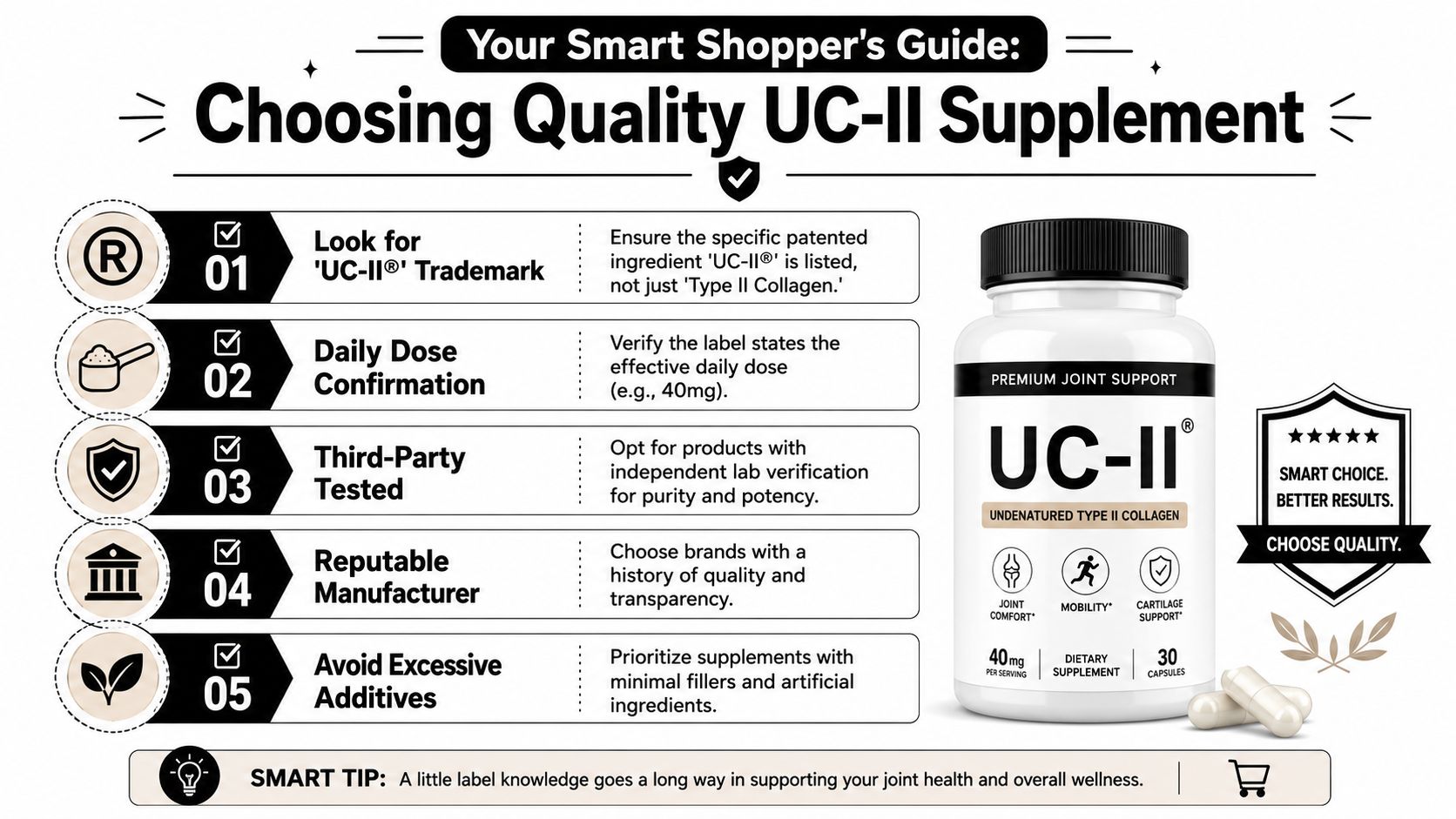
The label checks that matter most
Look for the exact form: The label should say undenatured Type II collagen or UC-II® clearly. “Collagen,” “collagen complex,” or “joint matrix” is too vague.
Check the daily amount: For UC-II, the research discussed earlier centers on a 40 mg daily dose. If the serving size is very different, read carefully.
Make sure the active ingredient is easy to identify: The amount of undenatured Type II collagen should be listed plainly, not buried inside a proprietary blend.
Review the full formula with some skepticism: Extra ingredients are not automatically better. They can be useful, but they can also distract from an underdosed main ingredient.
Choose companies that make verification easy: third-party testing, clear manufacturing details, lot tracking, and straightforward labeling all help.
A common shopping mistake is assuming “more collagen” means “better for joints.” That logic fits hydrolyzed collagen powders better than UC-II. Here, the key question is whether the product preserves the specific form that the immune system can respond to.
Safety and practical trade-offs
UC-II has a reassuring safety profile, as noted earlier in the article, but context still matters.
If someone has a simple goal, such as less knee stiffness on stairs or easier movement after walks, a plain UC-II formula usually makes the cleanest test. If someone is already using several joint supplements, combination products can make it harder to tell what is helping and what is just adding cost.
A few practical filters help:
Complex medical history: check with your clinician first.
Autoimmune disease or immune-active medication: use extra caution, because the mechanism involves immune signaling.
Heavy filler load or fuzzy wording: skip it.
Kitchen-sink joint formulas: decide whether you want a targeted UC-II trial or a broad formula that may overlap with other products, such as curcumin support for arthritis and joint pain.
A simple shopping standard
I use a plain standard in clinic-style conversations and in my own label review. If I cannot confirm the form, the dose, and the manufacturer without doing detective work, I pass.
Buy the product that makes verification easy.
The best UC-II supplements are usually the least dramatic ones. Clear ingredient name. Clear dose. Clear sourcing. That is what earns trust.
Is Undenatured Type II Collagen Right for You
This supplement makes the most sense when your joint issue sounds mechanical on the surface but has an inflammatory or immune component underneath. That includes people whose knees protest during stairs, squats, long walks, or training blocks.
Where it fits best
For older adults with everyday joint stiffness, UC-II can be a smart option when the main goal is smoother movement and less discomfort during ordinary tasks.
For active adults, it's appealing because it targets exercise-related joint irritation without requiring a large daily powder routine.
For people with more complicated inflammatory conditions, the mechanism is interesting, but that's also where I'd be most careful. If your immune system is already part of your treatment plan, your supplement choices should be reviewed alongside it. That's also where broader anti-inflammatory strategies, including things like curcumin support for arthritis and joint pain, may come up in a more complete plan.
The honest bottom line
Undenatured Type II collagen isn't a cure-all. It won't replace strength work, load management, weight management, or medical care when those are needed.
What it does offer is more precise than the average joint supplement. It gives you a targeted way to support joint comfort by working through oral tolerance, not by adding more collagen to the menu. If that mechanism matches your problem, it's one of the more rational options on the shelf.
If you're building a broader routine for joint comfort, recovery, and day-to-day resilience, River of Life offers a multi-ingredient capsule with turmeric extract, BioPerine, ashwagandha, ginger, and bromelain. It's a practical option for people who want joint-supportive ingredients in a simple daily format.