


Period Pain Ibuprofen: Dosing, Timing & Natural Alternatives

You're bent over a heating pad, one hand on your lower abdomen, wondering if you should take ibuprofen now or wait until the pain gets worse. Maybe you've already taken it before and felt only partial relief, or maybe you've never been sure whether you were using the right dose at the right time. That uncertainty is common, and it matters, because period pain ibuprofen works best when you understand when to use it, why it works, and when pain needs a different answer.
Table of Contents
Why Ibuprofen Is the Go-To for Period Pain
A painful cramp can make even simple plans feel impossible. The bottle of ibuprofen comes out, not because of habit alone, but because this medicine is aimed at the process behind menstrual cramping, especially for primary dysmenorrhea.
A major Cochrane review of 35 randomized controlled trials found that NSAIDs, including ibuprofen, were substantially more effective than placebo for primary dysmenorrhea, the medical term for period pain. The odds of getting moderate or excellent pain relief were 4.37 times higher with an NSAID, with a 95% confidence interval of 3.76 to 5.09 (Cochrane review). The same review estimated that if 18% of women taking placebo get moderate or excellent relief, about 45% to 53% of women taking an NSAID will do so.
Why that matters in real life
Those numbers help explain why ibuprofen has a place in period care. It does more than dull pain signals, it targets the inflammatory process that helps drive cramping, which is different from medicines that only blunt discomfort after it starts.
Older comparative research and later clinical guidance also helped establish ibuprofen as a standard option for menstrual pain by the late 20th century. A published prophylactic trial in 1998 concluded that preventive ibuprofen was effective for selected women with severe and disabling primary dysmenorrhea, and practical guidance commonly cites 200 to 400 mg every 4 to 6 hours, with a typical nonprescription maximum of 1,200 mg per day (published trial and dosing guidance). In plain terms, the reputation of ibuprofen in period care comes from trial evidence, not just family advice or habit.
If you want a simple starting point, this ibuprofen guide explains how people usually think about timing and use.
Practical rule: if ibuprofen has helped you before, the next improvement is usually not taking more. It is taking it at the right time.
That timing matters because prostaglandin-driven pain builds as the cramping process gathers speed. When ibuprofen is taken early enough, it has a better chance of interrupting that chain before the pain peaks.
How Ibuprofen Stops Cramps at the Source
Menstrual cramps feel like a deep squeeze because the uterus is contracting. Those contractions are not random, they're driven in part by prostaglandins, chemical messengers that rise around menstruation and help trigger inflammation and muscle tightening. If you've ever thought of cramps as your body's overactive alarm system, that's a useful model, because the pain is tied to a signal that gets turned up too high.
Ibuprofen belongs to the NSAID family, which means it reduces inflammation by blocking the enzyme pathway that helps make prostaglandins. That's why it helps with period pain more directly than medicines that only blunt pain perception. The point isn't just to mute the alarm, it's to lower the signal that keeps setting it off.
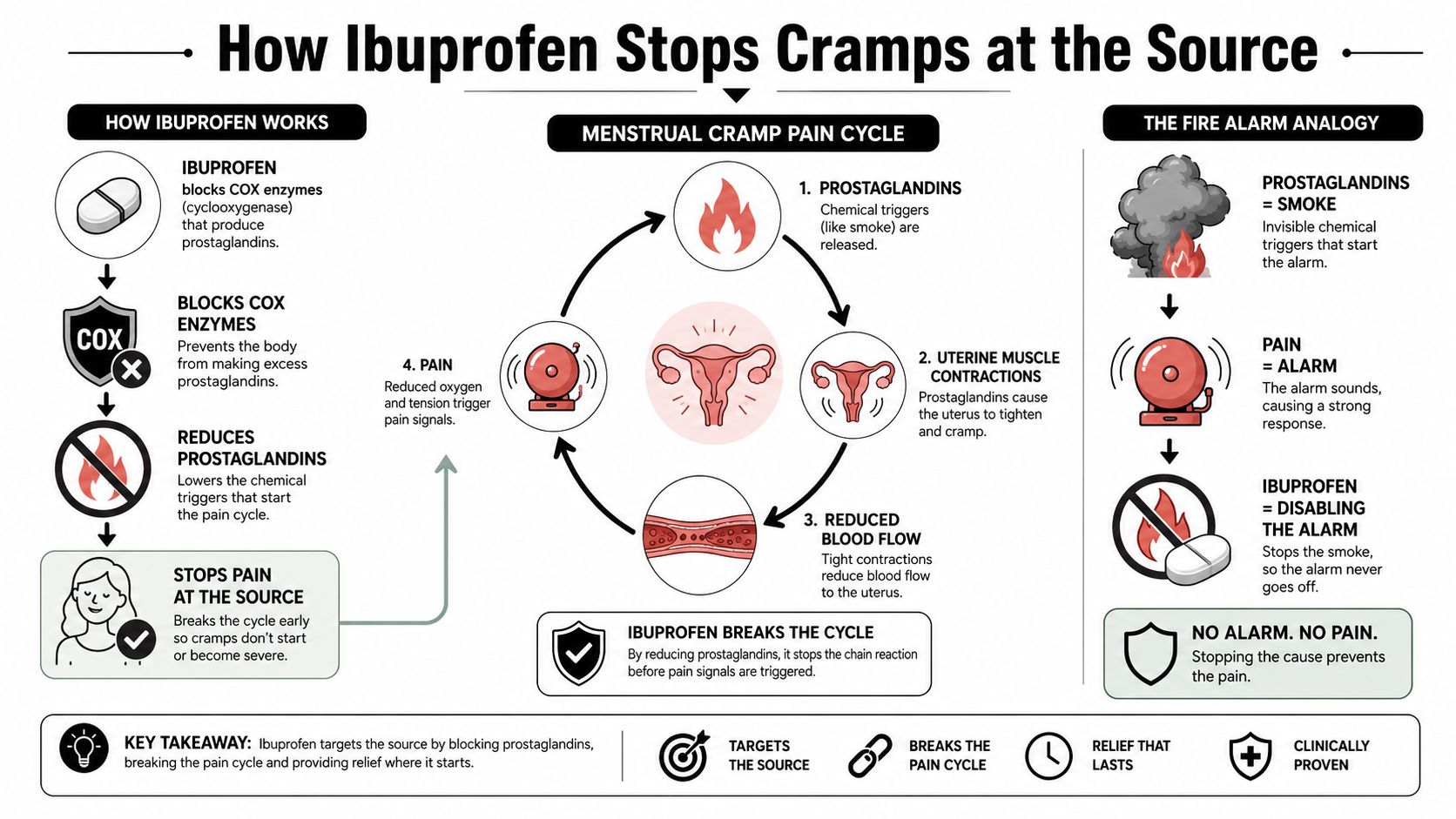
The pain loop ibuprofen interrupts
The simplest way to think about it is this. Prostaglandins rise, the uterine muscle contracts harder, blood flow gets reduced, and pain increases. Ibuprofen reduces prostaglandin production, which helps break that chain before it tightens into severe cramping.
That's also why the medicine feels less magical when it's taken late. If the prostaglandin surge has already hit full force, ibuprofen still helps, but it has less room to work. You're trying to calm a system that's already been revved up.
A short video can make that pathway easier to visualize. Here's a useful explainer on how ibuprofen works for period pain.
Why source control beats symptom chasing
This is the key difference between ibuprofen and a generic pain approach. If you only cover the sensation, the underlying cramp cycle can keep building. If you lower prostaglandins early, you interrupt the chain before it becomes a full-body event, with pain, tension, and often nausea or fatigue folded into the same episode.
That's why the next question isn't just “how much?” It's “when?” The timing strategy is where a lot of people accidentally sabotage a medicine that might have worked better for them.
The Timing Strategy Users Get Wrong
A lot of people wait until cramps are already intense, then take ibuprofen and hope it catches up. That timing leaves the medicine playing catch-up instead of getting ahead of the prostaglandin surge that drives the pain. Ibuprofen works best when started at the first sign of cramps or slightly before bleeding begins, before prostaglandin levels peak (clinical guidance).
If your cycle is predictable, earlier use usually gives better control than reacting after pain is already loud. Mainstream guidance commonly says ibuprofen works best if started 1 to 2 days before bleeding and continued through the first 2 to 3 days, because that is when cramping tends to be strongest (ACOG guidance).
A quick reference for timing and dose
Timing | Dose | Frequency | Notes |
|---|---|---|---|
At the first sign of cramps | 200 to 400 mg | Every 4 to 6 hours | Common nonprescription approach |
At the start of menstrual bleeding | 200 to 400 mg | Every 4 to 6 hours | Useful when your cycle is regular and symptoms begin quickly |
The day before bleeding begins | 200 to 400 mg | Every 4 to 6 hours | A preventive strategy for selected patients |
Short-term severe cramping, when clinically appropriate | Higher individualized dosing may be used | As directed by a clinician | Higher NSAID exposure raises gastrointestinal risk |
What people usually get wrong
Practical rule: don't wait for the pain to become unbearable. By then, you are often trying to reverse a process that had a head start.
Another common mistake is assuming every cramp pattern behaves the same way. Some people feel the first twinge before bleeding starts, while others do not notice symptoms until the flow is already underway. If your pattern is consistent, timing your first dose to your own body usually works better than copying someone else's schedule.
There is also a comfort issue that gets overlooked. If ibuprofen irritates your stomach, taking it with food is usually easier on the gut than taking it on an empty stomach. That does not erase side effects, but it can make the routine easier to stick with. If you cannot take ibuprofen, or it bothers your stomach too much, a separate option like acetaminophen for menstrual discomfort may be part of the conversation with your clinician.
Some readers also expect ibuprofen to fix every kind of period pain. That is not how it works. When cramps come from secondary dysmenorrhea, meaning there is another condition behind the pain, the timing trick may help a little but still fall short. Pain that keeps showing up in new ways, spreads beyond the usual menstrual window, or comes with other symptoms deserves a closer look rather than just stronger self-treatment.
A small adjustment in timing can change the whole experience. Timing is part of the treatment, not a detail to ignore. If you use ibuprofen like a rescue medicine instead of a preventive tool, you can miss one of its main strengths, and you may also miss the chance to pair it with gentle supports such as ginger or turmeric when those fit your routine.
When Ibuprofen Is Not Enough
Ibuprofen helps a lot of people, but it does not help everyone the same way. If you have used it correctly and still get little relief, the next question is not how to keep adjusting the dose forever. The more useful question is whether the pain is being driven by something beyond ordinary period cramps, such as secondary dysmenorrhea, where another condition is behind the symptoms.
That difference matters because endometriosis, adenomyosis, and fibroids can cause pain that behaves differently from typical cramps. The pain may change over time, spread outside the usual menstrual window, or show up with other symptoms that do not fit your normal pattern. When that happens, a closer look is more helpful than trying a stronger self-treatment plan.
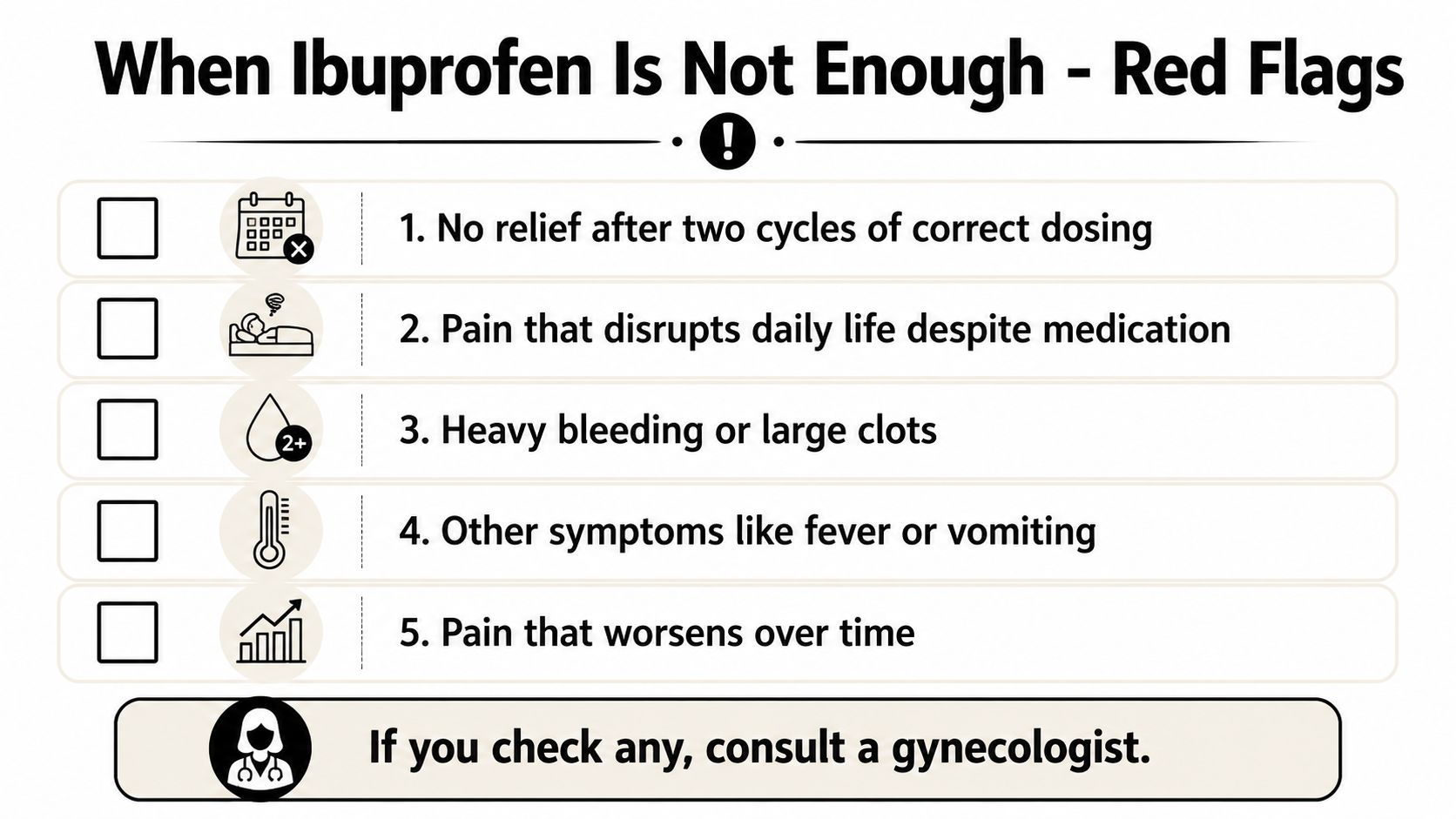
Signs the issue may be more than ordinary cramps
Pain that keeps disrupting daily life: If cramps still stop you from working, studying, or handling normal routines after correct dosing, that is a sign to talk with a clinician.
Pain outside the menstrual window: Cramps that show up between periods are not acting like straightforward primary dysmenorrhea.
Symptoms that intensify over time: Pain that gets worse from cycle to cycle deserves attention.
Heavy bleeding or other concerning symptoms: When pain comes with patterns that feel unusual for you, it is worth getting assessed.
If you are trying to sort out whether the pain is “just period pain” or something else, a doctor's visit can save time and frustration. A practical overview of pain options is also useful if you are comparing relief strategies, and a separate guide to acetaminophen and period pain can help you understand why some people notice a different response to different pain medicines.
The main point is simple. Sometimes the pain is asking a different question. If ibuprofen gives little or no relief, that is a reason to investigate, not a reason to treat ongoing suffering as normal.
Natural Anti-Inflammatory Alternatives and Complements
Some people want a non-drug layer they can use alongside ibuprofen, not instead of it. That's a sensible approach, especially when the goal is to soften inflammation overall rather than chase one acute cramp after another. Plant-based options won't work the same way as an NSAID, but they can fit into a broader comfort routine.
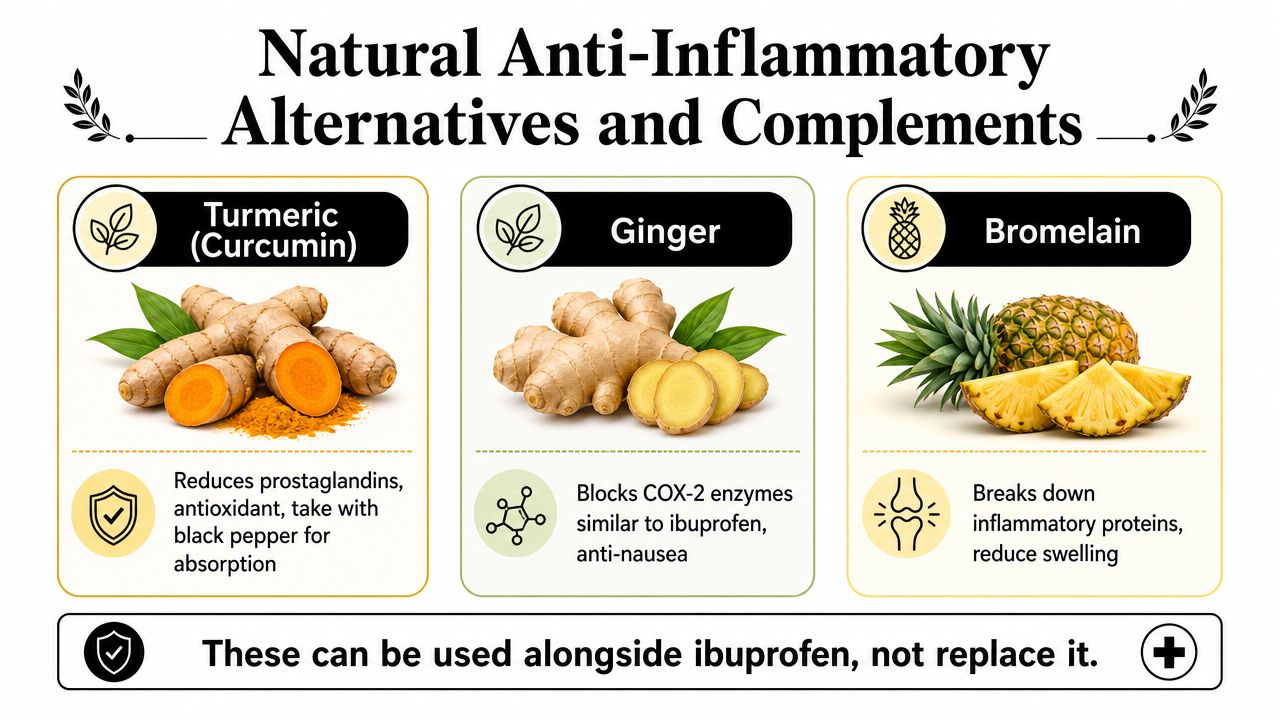
Turmeric, ginger, and bromelain in context
Turmeric is often discussed because its active compound, curcumin, is associated with anti-inflammatory effects. The catch is absorption. Curcumin is hard for the body to use on its own, which is why black pepper extract is often paired with it in supplement formulas. If you want a deeper look at supplement design and ingredient pairing, this overview of best natural anti-inflammatory supplements gives a broader picture.
Ginger is another common choice for menstrual comfort. It has a long history in food and wellness routines, and many people use it because it feels gentle, familiar, and easy to add through tea, capsules, or cooking.
Bromelain comes from pineapple and is often discussed for its role in supporting inflammation balance. People usually treat it as a complement, not a stand-alone fix for severe cramps.
How to think about supplements without overpromising
The cleanest way to compare these options is this. Ibuprofen acts quickly on the prostaglandin pathway, while turmeric, ginger, and bromelain are usually better thought of as background supports that may help the body stay calmer overall. That makes them useful for some people, especially when cramps tend to recur every cycle.
Practical rule: if you combine natural anti-inflammatory options with ibuprofen, treat them as support, not as proof that you can ignore dose timing or medical evaluation.
Safety still matters. Supplements can interact with medicines or feel too aggressive for some stomachs, especially when someone already has digestive sensitivity. That's why “natural” should never mean “automatic.” A smarter question is whether a supplement fits your pattern, your medications, and your tolerance.
Used well, these options can make a routine feel more complete. Used carelessly, they can distract from the one thing that matters most, finding the approach that helps your body.
Building Your Personalized Period Pain Relief Plan
A good pain plan is less about finding one perfect fix and more about matching the fix to your cycle. Some people need early ibuprofen and a heating pad. Others need a conversation about secondary causes. Many do best when they combine careful timing, symptom tracking, and a few low-risk supports they can repeat each month.
A simple way to start
Track your cycle. Note when cramps begin, how long they last, and whether they arrive before bleeding.
Start earlier next time. If your period is predictable, try taking ibuprofen at the first sign of symptoms or slightly before bleeding begins.
Use the labeled dose pattern. The common nonprescription approach is 200 to 400 mg every 4 to 6 hours, staying within the usual 1,200 mg per day limit unless a clinician tells you otherwise (published dosing guidance).
Add comfort supports. Heat, rest, hydration, and gentle movement can all make the day more manageable.
Layer natural anti-inflammatory options if they suit you. Turmeric, ginger, or bromelain may fit as complements.
Reassess after a few cycles. If correct use still isn't helping, get evaluated for a secondary cause.
The goal is not to white-knuckle through pain or endlessly increase medication. It's to learn your pattern well enough that each cycle gives you better information than the last one.
If you've been guessing your way through cramps, start with one small change this month, usually earlier ibuprofen and a symptom log. If you want natural, plant-based capsules that fit an anti-inflammatory lifestyle, take a look at River of Life, where the focus is on practical support for people who want to build steadier daily routines around inflammation, comfort, and wellness.