

Natural Hormone Support Supplement Guide for 2026

“Natural” is often treated as a synonym for safe, gentle, and suitable for everyone. That assumption is the first thing to discard. A natural hormone support supplement can influence stress-response pathways, thyroid signaling, sleep, or sex-hormone-related outcomes, so the right question is not, “Which product balances hormones?” It's, “Which symptom am I addressing, what pathway does the formula affect, and could that pathway create a risk for me?”
The category is useful when approached as individualized endocrine risk management rather than a universal wellness shortcut. Evidence is strongest for some stress-related outcomes, mixed for others, and insufficient for broad promises about hormone replacement. The following guide shows how to match ingredients to symptoms, read a label, recognize safety red flags, and decide when professional evaluation makes more sense than self-experimentation.
Table of Contents
What a Natural Hormone Support Supplement Actually Is
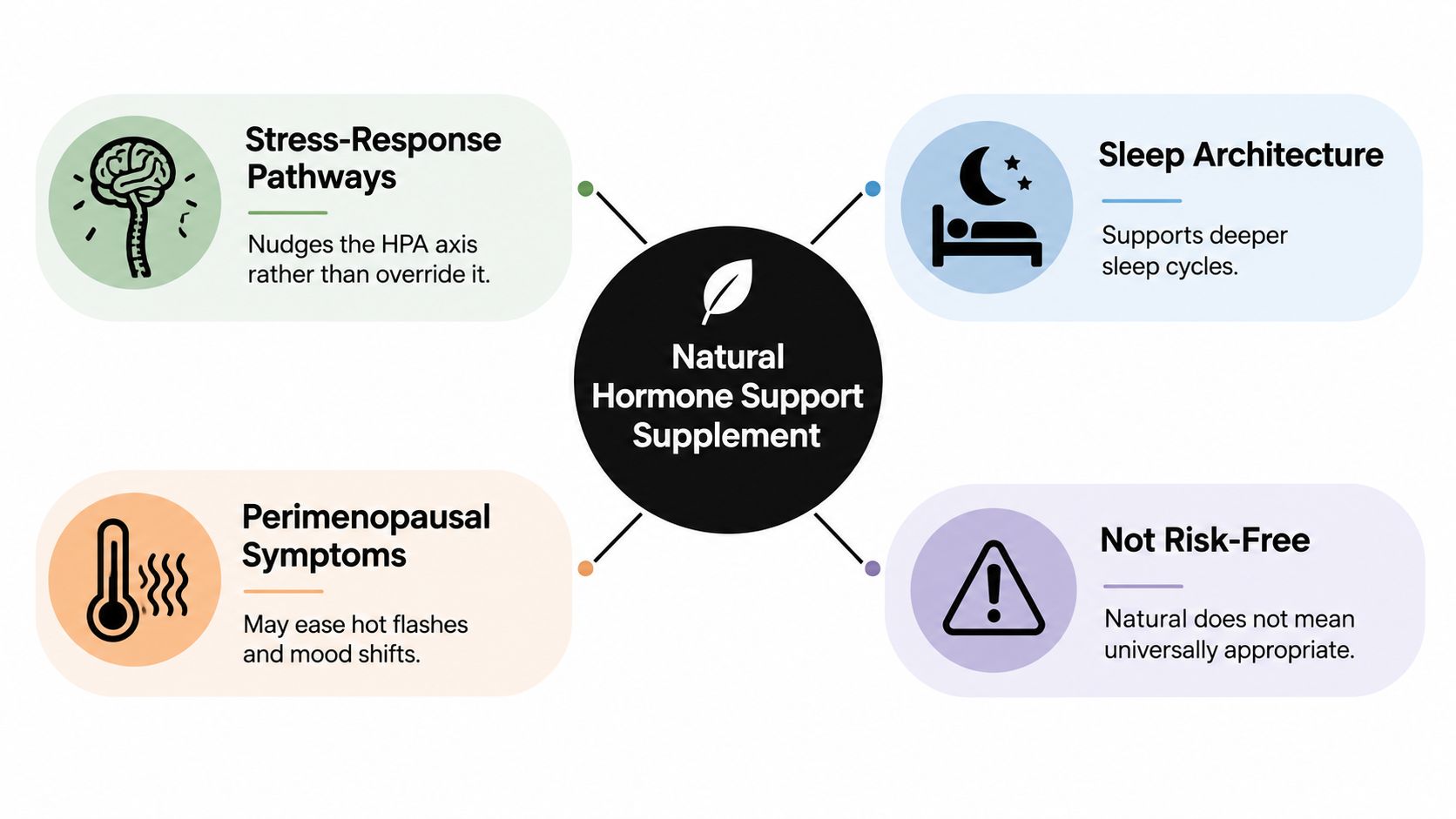
A natural hormone support supplement is best understood as a targeted botanical or dietary formula, not a general-purpose hormone reset. It may support the body's existing regulatory systems by influencing stress signaling, sleep, or other hormone-related processes. Prescription hormone therapy works differently, delivering specific hormones within a clinical treatment plan.
“Natural” describes where an ingredient comes from, not how it behaves in the body. Ashwagandha, for example, may affect thyroid function, testosterone, and responses to medication, according to the NIH Office of Dietary Supplements' professional fact sheet on ashwagandha. A plant compound can therefore be useful for one person and unsuitable for another, depending on symptoms, medical conditions, and medicines.
A different regulatory category
In the United States, dietary supplements operate under the framework created by the Dietary Supplement Health and Education Act, signed on October 15, 1994. The FDA's account of responsible innovation in dietary supplements describes supplements as a distinct category with less FDA premarket authority than applies to prescription medicines.
Manufacturers are responsible for lawful labels, safety, and good manufacturing practices. The FDA generally does not approve supplements for safety or effectiveness before sale as it does prescription drugs. A product's availability, polished packaging, or “hormone balance” wording therefore cannot establish that it works clinically.
What falls under the category
A natural hormone support supplement may be:
A single-ingredient product: An ashwagandha extract positioned for stress or sleep support.
A botanical blend: Several plants combined around a goal such as everyday stress resilience.
A symptom-focused formula: A product marketed for perimenopause, sleep disruption, libido, or general “hormone balance.”
Read those descriptions as intended uses, not diagnoses. A formula may support a physiological process or symptom, but it is not automatically hormone replacement, endocrine treatment, or a substitute for investigating persistent changes.
Practical rule: Treat “natural hormone support” as a label for intended support. Match the ingredients to the symptom, check relevant risks, and avoid assuming that every hormone needs to be pushed toward “balance.”
The Hormone Pathways These Supplements Target
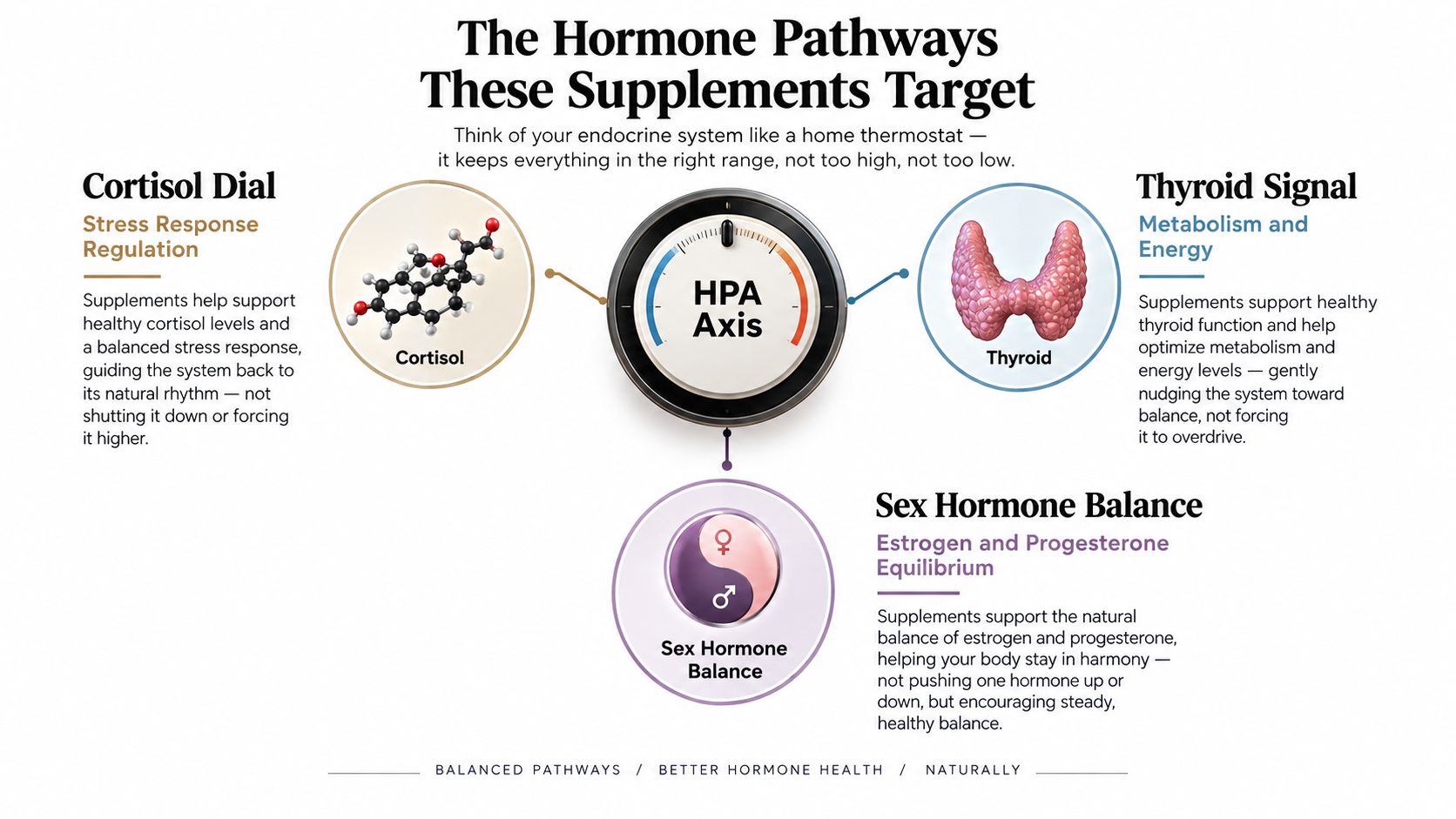
The endocrine system becomes easier to understand when you stop picturing it as one master switch. Think of the body as a home with several climate controls. The hypothalamic-pituitary-adrenal axis, or HPA axis, is one thermostat. It helps coordinate the stress response and influences cortisol. The thyroid is another control system, more like the furnace setting for energy and metabolism. Sex hormones operate through another network that affects reproductive health, libido, and life-stage changes such as perimenopause.
Cortisol isn't harmful. Your body uses it to respond to demands and coordinate energy availability. The practical concern is whether a formula's claimed action matches the pathway it has been studied for. An ingredient with evidence related to stress scores and cortisol shouldn't automatically be described as a thyroid enhancer or testosterone replacement.
Start with the stress thermostat
Adaptogens are commonly positioned as substances that help the body respond to stress. In practical terms, many natural hormone support formulas focus on the stress thermostat, not on forcing the thyroid or sex hormones upward.
Ashwagandha is the clearest example. Research has examined it for stress, anxiety-related measures, sleeplessness, fatigue, serum cortisol, testosterone, and sperm quality. Those outcomes aren't interchangeable. Lower perceived stress doesn't prove that a product will change reproductive hormones, and a testosterone finding doesn't establish treatment for an endocrine disorder.
Keep the other controls separate
Thyroid hormones influence energy, metabolism, and other body functions. A supplement that affects thyroid signaling may be inappropriate for someone with thyroid disease or someone taking thyroid medicine. The National Center for Complementary and Integrative Health overview of ashwagandha specifically notes that evidence remains limited for some uses and that thyroid-related considerations deserve attention.
Sex hormones also require careful wording. Perimenopause, hot flashes, libido concerns, and testosterone questions involve different populations and outcomes. A label that says “supports cortisol balance” is making a narrower claim than one that promises to “balance all hormones.”
For a related explanation of stress-focused formulas, see adrenal support supplements. The useful distinction is simple: identify the dial an ingredient may influence, then reject claims that leap to a different control system without product-specific evidence.
Active Ingredients and What the Evidence Actually Shows
Ingredient lists can appear stronger than the research behind them. A formula may contain several familiar botanicals, while the studies tested one ingredient, another extract, or a different population. Treat each ingredient like a separate dial: match the claim to the plant part, extract, amount, duration, and outcome before treating it as evidence for hormone support.
Ashwagandha, or Withania somnifera, has the most relevant evidence in this category for stress-related outcomes. A systematic review of seven randomized studies involving 491 adults found reductions in validated stress and anxiety scores, sleeplessness, fatigue, and serum cortisol after 6 to 8 weeks of supplementation compared with placebo, according to the NIH Office of Dietary Supplements review. The results support cautious language for root-only extracts standardized to withanolides over 6 to 8 weeks, not for leaf-inclusive products or unspecified powders. They do not establish a guaranteed “hormone reset.”
The PubMed review also describes limited evidence that taking ashwagandha for 2 to 4 months may increase testosterone and improve sperm quality. That finding applies to particular study populations and outcomes. It does not justify broad promises about male vitality, libido, or endocrine health. Extract identity and dosing schedule matter because research preparations were not identical.
Supporting botanicals need their own lane
Turmeric, ginger, and bromelain are often included for inflammation-related discomfort and recovery. Those effects may overlap with how people experience stress, poor sleep, and reduced activity, but joint comfort is a different outcome from changing hormone concentrations.
BioPerine, a black pepper extract, is commonly paired with turmeric to support absorption. That choice may fit a formula centered on curcumin delivery. It does not make turmeric a hormone treatment. A transparent formula explains each ingredient's intended role instead of presenting every botanical as an equal “balancer.”
Ingredient | Primary target | Evidence strength | Typical use |
|---|---|---|---|
Ashwagandha root extract | Stress-related outcomes, sleep, cortisol | Moderate for selected stress-related outcomes, preliminary for some hormone-related outcomes | Stress resilience and sleep support |
Turmeric extract | Inflammation-related discomfort | Promising, but not evidence for broad hormone regulation | Joint comfort and everyday recovery |
Ginger | Digestive and inflammation-related support | Context-dependent and not a general hormone claim | Everyday comfort and recovery |
Bromelain | Enzyme-based recovery support | Formulation and use dependent | Activity-related comfort |
BioPerine | Absorption support for certain compounds | A delivery aid, not a hormone-active ingredient | Used alongside turmeric or curcumin |
A recent review of 23 randomized, placebo-controlled trials involving 1,706 participants reported a significant cortisol reduction, with a standardized mean difference of -1.18. It found no significant effect on thyroid-stimulating hormone or T3, while T4 increased modestly. The finding supports a selective interpretation: cortisol results should not become a claim of generalized hormone elevation.
How to Read a Label Like a Practitioner
A credible label should let you answer four questions without contacting the manufacturer. What extract is used? How much is present? Which part of the plant was used? What else is in the capsule? If the label hides the active amounts inside a proprietary blend, you can't compare the product with the research that supposedly supports it.
Compare the label, not the marketing
A vague label might say “turmeric powder” without identifying an extract type or the amount of active compounds. A more informative label could identify turmeric extract, state the amount per serving, specify the plant material, and explain that BioPerine is included for absorption support.
The same principle applies to ashwagandha. “Ashwagandha” alone doesn't tell you whether the product uses root, leaf, or a combination, nor does it identify the extract concentration. Since studies use distinct preparations, standardization and plant-part information help you judge whether a research claim is even relevant.
A four-question cart check
Standardized extract: Does the label identify the extract and its active compounds?
Exact amount: Are milligrams listed for each ingredient, or is everything hidden in a proprietary blend?
Plant part: Does it specify root, leaf, berry, or another part?
Inactive ingredients: Are fillers, colors, sweeteners, and capsule materials clearly disclosed?
Bioavailability means how much of a compound reaches circulation after you take it. Curcumin is often discussed in this context because formulations may use an absorption enhancer or a meal containing fat. The label should describe the delivery approach without implying that better absorption guarantees a hormone-related result.
For a practical breakdown of supplement facts panels, use this guide to reading supplement facts. Transparency doesn't prove effectiveness, but vague labeling makes meaningful evaluation much harder.
Dosing, Timing, and the Habits That Make It Work
Adaptogens generally aren't instant fixes. The relevant ashwagandha evidence includes consistent use over 6 to 8 weeks, so judging a product after a single capsule or a few irregular doses doesn't match the way the research was conducted. That timeframe is a trial window, not a promise that every person will respond.
Timing should fit the formula and your response. An ashwagandha-containing product may suit an evening routine if it feels calming, while a formula that feels stimulating may fit better earlier in the day. Follow the product label, avoid increasing the amount because results aren't immediate, and don't combine several hormone-focused products without checking for overlapping ingredients.
Build a routine around the physiology
Protect sleep: A regular bedtime, a darker bedroom, and reduced late-night stimulation support the recovery process that stress-focused supplements are supposed to complement.
Keep moving: Walking and resistance training support physical function and metabolic health. They also give you measurable habits to maintain while you assess a supplement.
Eat for consistency: Colorful plants, adequate protein, and sources of omega-3 fats can support an anti-inflammatory eating pattern without turning the diet into another extreme intervention.
Track a few markers: Note sleep quality, morning energy, perceived stress, and any relevant symptom rather than recording every minor fluctuation.
A capsule can support a routine, but it can't compensate for a routine that consistently undermines sleep, movement, and food quality.
The most useful question after the trial window isn't “Did I feel different every day?” It's “Is there a clear, sustained change in the symptom I chose to track, and did any unwanted effect appear?” If the answer is unclear, reassess the product, the goal, and whether clinical evaluation is needed.
Matching Symptoms and Populations to the Right Approach
“Hormone support” becomes misleading when it treats stress, hot flashes, thyroid concerns, and testosterone questions as one condition. A symptom-and-population approach is more useful because each group has a different evidence base and a different safety profile.

Stress and sleep
Ashwagandha has its clearest role here. The available research has examined validated stress measures, sleeplessness, fatigue, and cortisol, so a person whose main concern is stress-related sleep disruption may be evaluating a plausible use case. That still doesn't mean the ingredient will resolve insomnia caused by sleep apnea, medication effects, depression, thyroid disease, or another medical condition.
Perimenopause and hot flashes
Hot flashes shouldn't automatically lead to an ashwagandha purchase. A 2025 review of 48 higher-quality publications evaluated multiple natural approaches, and one cited finding involved 50 to 80 milligrams per day of isoflavones reducing severe hot flashes by up to 92%, as reported in the Frontiers review of natural strategies. That result concerns a specific phytoestrogen intervention, not ashwagandha and not every multi-ingredient capsule.
Thyroid symptoms and testosterone questions
Fatigue, temperature sensitivity, mood changes, low libido, and changes in sexual function can have many causes. Someone with thyroid disease, thyroid medication use, unexplained symptoms, or a history of hormone-sensitive illness should consider clinician review before trying an adaptogen.
For men asking about testosterone or sperm quality, ashwagandha research is limited and product-specific. It shouldn't be positioned as predictable testosterone replacement, and it shouldn't delay evaluation for sleep problems, medication effects, nutritional issues, or an endocrine disorder.
A simple decision matrix can help:
Stress or sleep is the main concern: A standardized ashwagandha extract may be worth discussing, especially when the goal is clearly defined.
Hot flashes dominate: Look for evidence tied to the specific intervention and population. Don't generalize from cortisol research.
Thyroid symptoms or treatment are involved: Get professional guidance before using a product that may affect thyroid signaling.
Symptoms persist, worsen, or involve several systems: Evaluation is more appropriate than stacking multiple supplements.
Safety Red Flags Most Articles Skip
“Natural hormone support” is not a safety category. An ingredient can be plant-derived yet still act on thyroid signaling, immune activity, or medication metabolism. Ashwagandha may affect thyroid function and interact with thyroid medicines, sedatives, diabetes medicines, blood-pressure medicines, and immunosuppressants. See this ashwagandha interactions guide before combining it with treatment.
Pregnancy and breastfeeding call for extra caution because available evidence may not match the product, dose, or individual circumstances. Liver concerns deserve the same attention. Reports involving ashwagandha include possible liver-function problems, and long-term use has less supporting evidence than short-term use. The NCCIH ashwagandha overview also advises care around these safety questions.
Pause before you start if you have
Thyroid disease or thyroid medication: Ask a clinician or pharmacist whether changes in thyroid signaling could affect your treatment.
Pregnancy or breastfeeding: Avoid self-prescribing a hormone-active botanical.
Liver disease or unexplained liver symptoms: Get individual guidance first.
Autoimmune disease: Review immune-related concerns and current treatment.
Hormone-sensitive cancer history: Seek professional advice, including when prostate cancer is a concern.
Medication use: Check sedatives, blood-pressure medicines, diabetes medicines, immunosuppressants, and other hormone-active treatments for interactions.
Clinical evidence mainly covers short-term use, generally about three months or less. Evidence for use over many months or years is lacking. That does not prove longer use is unsafe, but it makes periodic reassessment more sensible than automatic renewal.
Treat the checklist as a screening tool, not a reason to fear every supplement. Stop if new symptoms appear and seek advice. If the original problem continues, investigate its cause instead of increasing the dose.
How River of Life Capsules Put These Practices Together
River of Life Capsules offer one example of a multi-ingredient approach. The formula combines standardized turmeric extract with BioPerine, alongside ashwagandha root, ginger, and bromelain. Each component has a distinct intended role: turmeric and BioPerine address the formulation challenge of absorption, ashwagandha is positioned for stress and sleep support, and ginger and bromelain are included for everyday comfort and recovery.
That structure aligns with the label principles discussed earlier when the product provides ingredient amounts, identifies the relevant plant material, and explains the purpose of the combination. A single daily capsule can also make consistency easier than managing several separate bottles, although convenience doesn't remove the need to check interactions or match the product to a specific goal.
The company sells 60-capsule bottles, with one-time purchases and subscription plans for a 30-day supply or bi-monthly supply. Subscription plans can be paused or canceled, international fulfillment reaches more than 40 countries, and unopened bottles are covered by a 30-day return policy. These are purchasing details, not evidence that the formula will produce a particular clinical outcome.
Use a three-step review
Name the symptom: Choose stress, sleep, joint comfort, recovery, or another specific outcome instead of using “balance hormones” as the goal.
Read the label: Check extract standardization, plant part, exact amounts, absorption support, and inactive ingredients.
Rule out red flags: Review thyroid, liver, pregnancy, autoimmune, medication, and hormone-sensitive cancer considerations before starting.
Track sleep quality, morning energy, perceived stress, and joint comfort over 6 to 8 weeks, rather than chasing daily changes. If symptoms persist or worsen, a natural hormone support supplement should remain a support tool, not a treatment substitute, and a clinician's review becomes the more sensible next step.
River of Life offers a single capsule combining turmeric extract, BioPerine, ashwagandha root, ginger, and bromelain for people seeking a convenient option that fits a consistent wellness routine. Review the ingredients and safety considerations first, then visit River of Life to explore the formula and purchase options.