
Women's Wellness Supplement Guide: Support & Benefits

You're tired, sleeping badly, and wondering whether the capsules in your cabinet are helping or just adding another variable to an already complicated routine. Maybe you take a prescription medicine, a multivitamin, and a botanical product recommended by a friend. Maybe you're pregnant, breastfeeding, approaching perimenopause, or managing a chronic condition. In each situation, the important question isn't only what a women's wellness supplement promises. It's whether the ingredient, dose, timing, and combination make sense for your health profile.
Women already have substantial experience with supplements. 66.1% of women aged 20 and older reported taking at least one dietary supplement during the previous 30 days in nationally representative CDC data covering August 2021 through August 2023, compared with 53.9% of men. The CDC data measure supplements broadly, not one narrowly defined women's wellness category, but they show how familiar these products are in everyday life.
Table of Contents
Understanding What Women's Wellness Supplements Actually Do
A supplement can be useful without being a cure. Think of it as one tool in a larger system that includes sleep, food, movement, stress management, medical care, and the treatment of underlying conditions. A capsule may support joint comfort, relaxation, or recovery, but it can't replace an evaluation for persistent pain, severe insomnia, unexplained fatigue, or significant mood changes.
Consider someone whose workday runs from one demand to the next. She wakes unrefreshed, spends hours at a desk, exercises when she can, and takes an evening supplement because she wants better sleep and less stiffness. The sensible approach isn't to promise that one product will fix everything. It's to identify the main goal, choose ingredients with a plausible role, and give the routine enough time to judge whether it helps.

Support is different from treatment
Turmeric-derived curcumin is commonly included in formulas designed around everyday mobility and comfort. Ashwagandha is more relevant to stress and sleep support, while ginger and bromelain may be selected for broader recovery-oriented formulas. These roles are not interchangeable, and none should be presented as treatment for arthritis, anxiety, insomnia, menopause, or another diagnosed condition.
Marketing often skips this distinction. Words such as “detox,” “hormone reset,” and “instant balance” sound decisive, but they don't tell you what the product does, how strong the evidence is, or whether it fits your medications. A more useful label connects each ingredient to a modest, specific purpose and states the amount clearly.
Fewer well-chosen ingredients can be easier to manage
Taking five separate products creates five labels to interpret, five potential sources of duplication, and more opportunities for interactions. A carefully designed multi-ingredient formula can simplify the routine, but only if it discloses each ingredient and amount rather than hiding everything inside a proprietary blend.
Practical rule: Choose a product for a defined need, then judge it by label transparency, evidence quality, tolerability, and whether it fits your medical situation.
The best outcome isn't a dramatic overnight transformation. It's a routine that supports a realistic goal without creating new confusion. If symptoms are persistent or worsening, the next step should be medical assessment, not a larger supplement stack.
The Science Behind Common Ingredients
The useful question isn't whether an ingredient sounds natural. It's whether the finished formula delivers a studied form at a meaningful amount and whether your body can absorb it.
Turmeric illustrates the point. Curcumin, a compound derived from turmeric, has limited systemic availability on its own. In a human volunteer study, 20 mg of piperine increased curcumin bioavailability by approximately 2,000%. The proposed mechanism involves reduced glucuronidation in the intestine and liver, which can increase circulating exposure. The study also reported earlier and higher curcumin concentrations, a longer elimination half-life, and lower clearance when piperine was taken with curcumin. The human pharmacokinetic study supports the idea that absorption design matters more than just adding more turmeric powder.
Ingredient | Primary benefit | Key consideration |
|---|---|---|
Curcumin with piperine | Joint comfort and broader inflammation-related support | Curcumin, piperine, and extract standardization should be listed separately |
Ashwagandha | Stress resilience and sleep support | Evidence depends on the extract, dose, duration, and population studied |
Ginger | Digestive and recovery-oriented support | Botanical identity and amount should be clear on the label |
Bromelain | Enzyme-based support for recovery and comfort | Medication and bleeding considerations warrant professional review |
Ashwagandha needs context
The strongest women's-wellness relevance for ashwagandha is stress and sleep support, not a universal promise about hormones. A systematic review summarized by the NIH Office of Dietary Supplements included seven randomized studies involving 491 adults treated for 6 to 8 weeks. Compared with placebo, participants generally showed reductions in validated stress or anxiety scores, sleeplessness, fatigue, and serum cortisol.
A separate sleep meta-analysis included five studies and 372 adults. It found a small but statistically significant sleep benefit, with larger effects most consistently observed around 600 mg per day and treatment lasting at least eight weeks. Those findings don't prove that every root powder will work for every woman. The trials were conducted in India and included mixed-sex adult populations, so claims should remain limited to structure and function support.
Why the label matters
“Turmeric” and “ashwagandha” aren't complete formulation descriptions. You need to know whether the product uses a standardized extract or an unstandardized root, the daily amount, and any relevant marker compounds or branded delivery system. A large scoop of a weak powder may not be equivalent to a smaller amount of a researched extract.
For more context on how ingredient choices relate to women's health discussions, compare the evidence and caution around supplements for hormone balance. The practical takeaway is simple: mechanism, extract quality, dose, and safety all matter together. A compelling ingredient without those details is still an incomplete product.
How to Choose a High-Quality Formula
Read a supplement label as if you were checking the specifications of a piece of equipment. The front panel is advertising. The Supplement Facts panel, serving size, ingredient forms, warnings, and testing information tell you what you are buying.
Start with the active ingredients
Look for the precise form of each botanical and the amount per daily serving. A label that says “turmeric complex” without separating turmeric extract, curcumin content, and piperine leaves you guessing. The same problem applies to ashwagandha when a manufacturer doesn't identify whether it uses root-only material, a standardized extract, or a blend of plant parts.
A proprietary blend isn't automatically poor quality, but it makes comparison harder. If the company won't tell you how much of each active ingredient you're taking, you can't reliably compare the product with research or assess duplication across your other supplements.
Check the quality signals
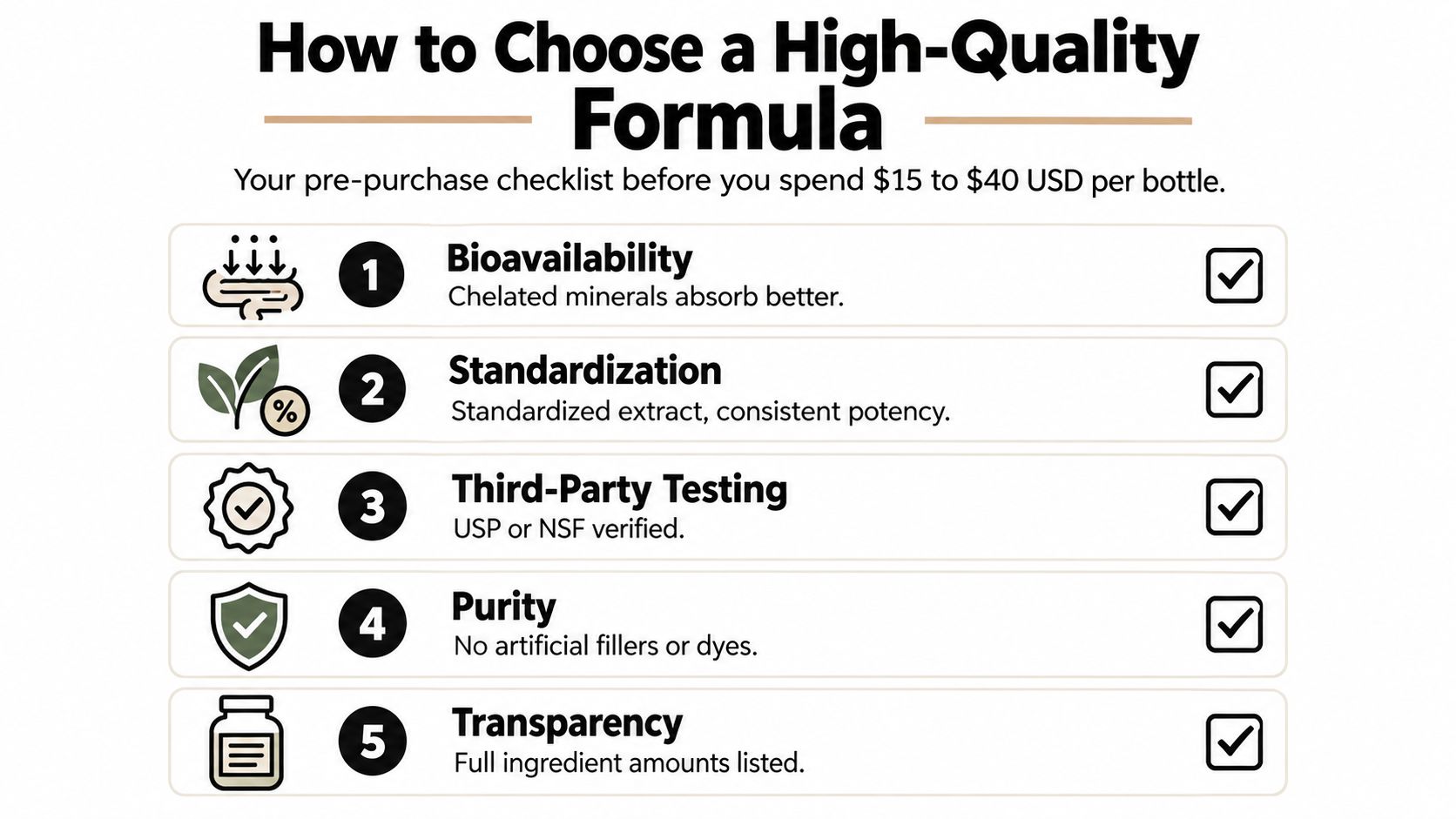
Use this short pre-purchase screen:
Bioavailability: Check whether the formula explains how poorly absorbed ingredients are delivered. For curcumin, that may include a clearly named absorption aid rather than an unexplained “enhanced” claim.
Standardization: Prefer a botanical extract with a stated standardization when the evidence depends on consistent active compounds.
Independent verification: Look for meaningful third-party testing information, such as verification from USP or NSF, and confirm what the certification covers.
Purity: Review allergen statements, excipients, dyes, and capsule materials. “Natural” doesn't automatically mean free from contaminants or suitable for every person.
Transparency: Make sure the label lists full ingredient amounts, serving instructions, country-specific warnings, and contact information for the manufacturer.
Treat claims as questions
“Supports healthy inflammation” is a structure or function claim. “Reverses arthritis” is a disease claim and should immediately make you more cautious. The FDA doesn't approve dietary supplements for safety or effectiveness before marketing in the same way it approves medicines, so the buyer has to assess evidence and manufacturing information carefully.
Packaging matters, but it isn't proof. A clean design, influencer recommendation, or long ingredient list can't substitute for a transparent label and a credible testing process. A practical women's vitamins and supplements guide can help you compare categories, but your final decision should still account for your medications, life stage, and specific goal.
Navigating Safety and Interactions
You pick up a supplement to help with energy, PMS, sleep, or joint comfort. Then you remember the rest of the cabinet. A prescription, a birth control pill, a thyroid tablet, maybe an occasional sleep aid or pain reliever. That is usually where the real safety question starts.
40.1% of supplement users who also took prescription medicines had at least one potential drug-supplement interaction in a 2025 study. The study findings also found that most identified interactions were moderate and some were severe. The actual risk changes with the ingredients, the dose, your health conditions, and the number of products used at the same time.

Review the whole stack
A supplement should never be judged by its label alone. It has to be judged against everything else you take and the life stage you are in. That matters for women using antidepressants, contraceptives, diabetes medicines, blood-pressure drugs, or anticoagulants. It also matters before surgery and during pregnancy, breastfeeding, and perimenopause, when risk tolerance and monitoring needs can shift.
Some ingredients deserve extra caution. Piperine is often added to improve curcumin absorption, but that same effect can change exposure to other compounds processed through related intestinal or liver pathways. Ashwagandha also deserves a medical review if you have an existing condition or take regular medication, and caution is especially important during pregnancy and breastfeeding.
“Natural” describes an origin, not a guarantee of compatibility.
Compare the decision, not only the product
Buying one bottle first can be the safer choice. It gives you time to read the label closely, see how you tolerate the formula, and ask a pharmacist about ingredient-specific concerns before you commit to repeat shipments. A subscription may make adherence easier later, but convenience should come after fit.
A practical process keeps this simple:
Write down everything you take. Include prescriptions, over-the-counter medicines, vitamins, teas, powders, and products you use only sometimes.
Ask a pharmacist or clinician to review the list. Bring the exact label, not just the brand name.
Ask about timing and stopping rules. Some supplements may need separation from medicines or discontinuation before surgery.
Watch for changes. New bleeding, rash, severe digestive symptoms, dizziness, heavy sedation, or other concerning symptoms deserve prompt attention.
A generic disclaimer at the bottom of a product page is not enough. What helps is clear dosing, ingredient-specific cautions, and a plain answer about when to stop and get medical advice.
Subscription vs One-Time Purchase Options
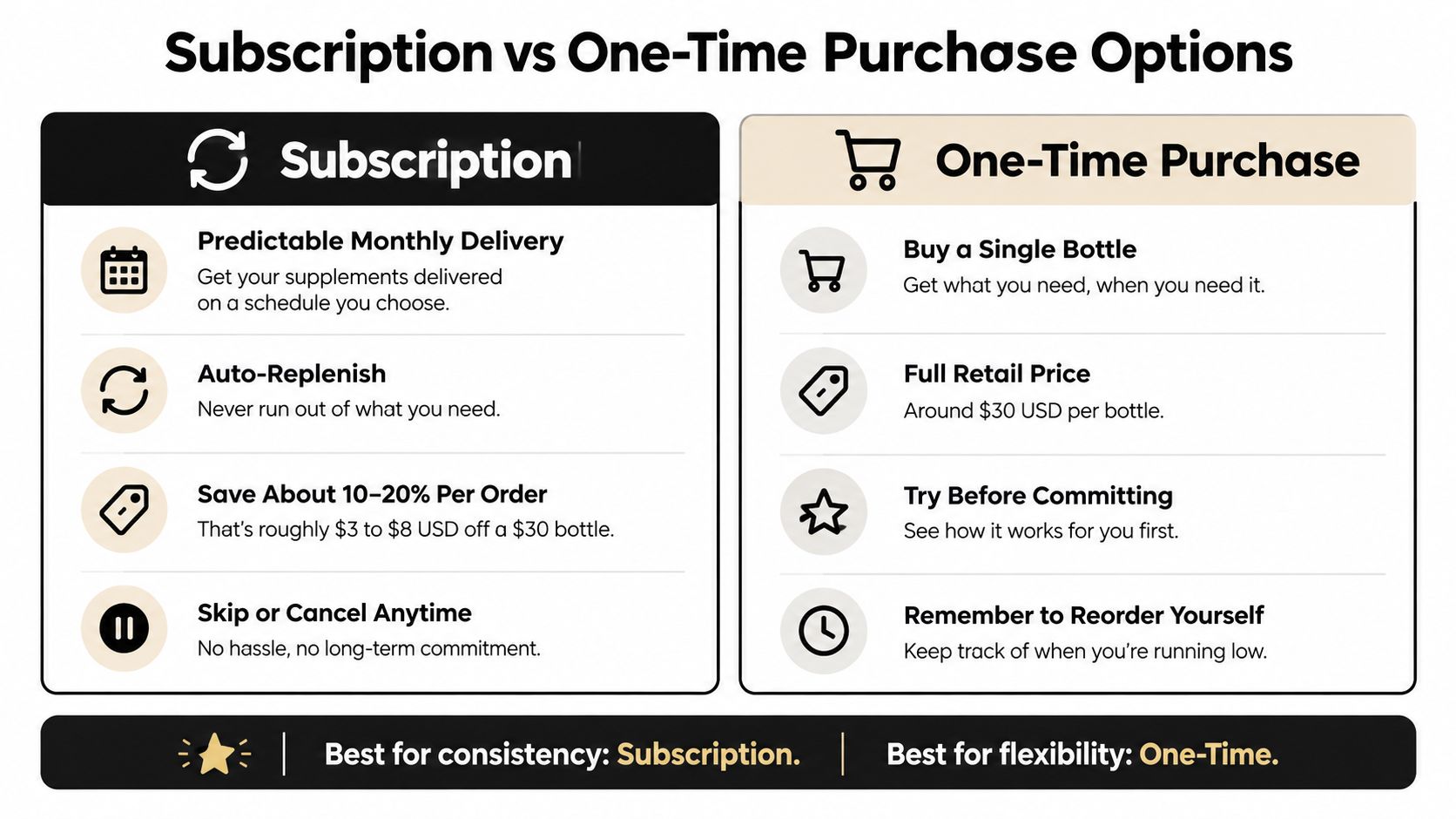
Convenience can improve consistency, but consistency isn't always the first priority. Suitability comes first. If you haven't checked a formula against your medicines, a recurring order just repeats an unresolved decision.
When a one-time purchase makes sense
Buying one bottle is practical when you're testing tolerability, comparing formulations, or waiting for professional advice. It also gives you time to examine the Supplement Facts panel and observe whether the product fits your routine without creating an automatic financial commitment.
This approach works well for someone who has never used the ingredients before, has recently changed medication, or is uncertain whether a multi-ingredient formula duplicates another product in the cabinet. Keep the receipt and review the return policy before opening the bottle, because many retailers accept returns only under specific conditions.
When a subscription is useful
A subscription can help someone who has already reviewed the formula, tolerates it well, and wants predictable replenishment. Automatic delivery removes the need to remember a reorder and can support a regular routine. The value depends on the terms, not just the advertised discount.
Check whether you can pause, cancel, or change the delivery date without contacting customer service. Confirm shipping destinations, renewal timing, bottle quantity, return conditions, and whether the subscription renews at the same price. International buyers should also check customs responsibilities and packaging protections.
A better buying sequence
Don't choose a subscription because a countdown timer makes the decision feel urgent. Start with the label and your health context. Buy a single bottle if you need to test the fit, then consider recurring delivery only after you've confirmed that the product is appropriate and manageable.
Buying principle: Automate replenishment only after you've made the health decision deliberately.
That distinction protects both your budget and your routine. A subscription is a logistics tool. It can't compensate for unclear dosing, weak evidence, or an interaction that hasn't been reviewed.
Building a Simple Daily Wellness Routine
A good routine should be easy to repeat and easy to reassess. Attach the supplement to an existing habit, such as breakfast, brushing your teeth, or preparing your evening tea. Use the serving instructions on the label, and don't increase the amount because you haven't noticed an immediate effect.
CDC data show that 66.1% of women aged 20 and older reported taking at least one dietary supplement during the previous 30 days. The CDC report describes broad supplement use, not proof that every product works. The useful lesson is that a familiar habit still needs thoughtful selection and review.
Match the routine to the goal
If your goal is daytime stress support, taking a product earlier may make more sense than waiting until bedtime, depending on the label and your response. If the formula causes digestive discomfort, review whether food is recommended and speak with a pharmacist rather than ignoring the symptom. If it makes you drowsy, don't drive or combine it casually with other sedating products.
Life stage changes the decision. Pregnancy and breastfeeding require particular caution because many supplements haven't been adequately tested for safety. Perimenopause also has important evidence gaps, and a symptom such as poor sleep, fatigue, cognitive change, or joint discomfort may have several possible causes.
Use a small tracking system
Write down four things:
Purpose: Record the specific outcome you want to support, such as easier sleep or more comfortable movement.
Routine: Note when you take the product and whether you take it with food.
Response: Track useful changes and unwanted effects without expecting instant results.
Review date: Revisit the decision after a reasonable trial period, or sooner if symptoms appear.
Don't track every sensation obsessively. A short weekly note is enough to identify a consistent pattern. If nothing improves, ask whether the goal was realistic, the evidence applies to your situation, or the symptom needs medical investigation.
Keep the routine small
Avoid adding several new supplements at once. If you start multiple products together and develop a rash, stomach upset, sedation, or another problem, you won't know which ingredient caused it. A focused routine also makes it easier for your clinician or pharmacist to review the list.
For broader ideas on creating a practical women's wellness routine, keep the same standard throughout: clear purpose, transparent ingredients, realistic claims, and regular review. A supplement should fit into your life, not become another source of uncertainty.
River of Life offers a vegan, capsule-based formula combining turmeric extract with BioPerine, ashwagandha root, ginger, and bromelain for everyday joint comfort, stress resilience, sleep support, and mental clarity. Explore the one-time and subscription options, review the product information carefully, and visit River of Life to decide whether its approach fits your wellness routine.