

Natural Sleep Aid No Melatonin: Your 2026 Guide

If you're searching for a natural sleep aid no melatonin option, the usual advice often misses the underlying problem. Melatonin gets treated like a universal sleep fix, but it isn't. For some people, it's a poor match because their issue isn't body-clock timing. It's stress, nighttime tension, a racing mind, or waking up at 2 a.m. and not getting back to sleep.
That distinction matters. A supplement that helps you fall asleep isn't always the one that helps you stay asleep. Most sleep guides blur those together, then wonder why people feel disappointed. If your sleep problem is mismatched to the supplement, even a decent product can feel useless.
The better approach is simpler. Match the tool to the sleep pattern. Use ingredients with actual dosing guidance. Pay attention to timing. And stop expecting one hormone-based shortcut to solve every kind of insomnia.
Table of Contents
Tossing and Turning Beyond Melatonin
Melatonin isn't the only natural sleep option, and for plenty of adults it shouldn't be the default first choice. That's especially true when the complaint is, “I'm exhausted, but my brain won't shut off,” or, “I fall asleep fine, but I keep waking up.”
Those aren't the same problem.
A natural sleep aid no melatonin approach makes more sense when you want non-hormonal support and a more targeted fit. Some ingredients lean toward calming the nervous system. Others are better for stress load. A few seem more useful for sleep continuity than sleep onset.
Practical rule: Stop asking, “What's the best natural sleep aid?” Start asking, “What exactly is my sleep problem?”
That shift cuts through a lot of hype. It also explains why people bounce from one supplement to another with mediocre results. They're often using the wrong category. A bedtime formula aimed at relaxation won't always help frequent awakenings. A supplement that smooths stress across the evening may not knock down a busy mind quickly enough for fast sleep onset.
There's also a quality issue. Some ingredients have real dosing ranges and at least some clinical support. Others get lumped into “sleep support” lists because they sound calming, not because they're especially well defined.
What tends to work best is a narrower, more practical approach:
For trouble falling asleep: use ingredients that quiet mental or nervous system activation near bedtime.
For trouble staying asleep: use ingredients with evidence for sleep maintenance or overnight calm.
For stress-driven insomnia: use adaptogens and calming compounds based on timing, not just label claims.
The goal isn't to sedate yourself. It's to remove the reason your body isn't sleeping.
Why Look for a Melatonin Alternative
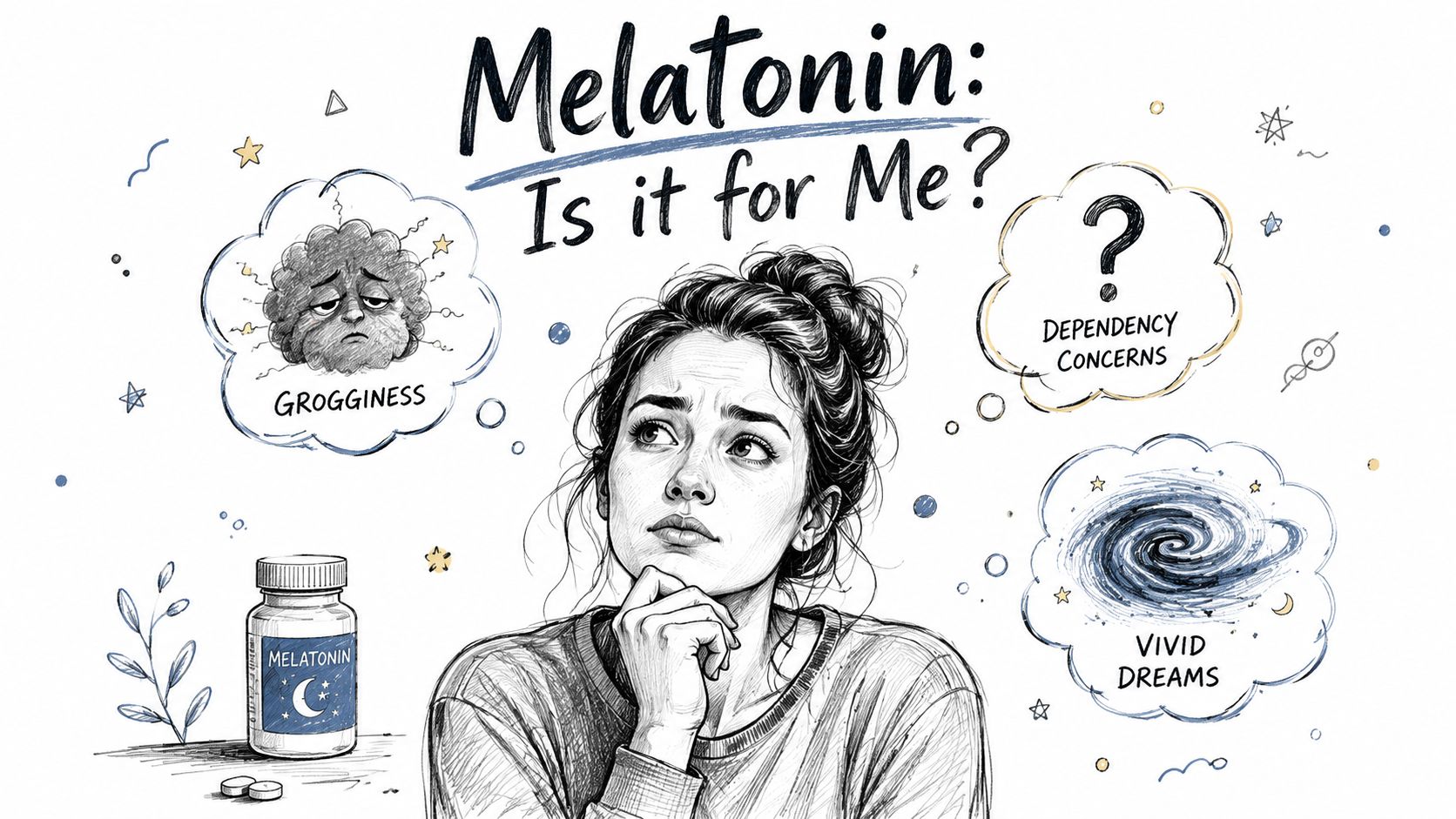
People usually don't search for alternatives because they hate melatonin on principle. They look because something about it doesn't fit. Maybe they feel groggy the next day. Maybe they don't like taking a hormone regularly. Maybe it doesn't touch the kind of insomnia they have.
Melatonin isn't aimed at every sleep problem
Melatonin is mainly a timing signal. It tells the body that it's nighttime. That can be useful when sleep timing is off, but it doesn't automatically solve stress-driven wakefulness, tension, or middle-of-the-night alertness.
That's why someone can feel sleepy after taking it and still lie there mentally active. The body gets a darkness cue, but the mind stays “on.” In practice, that mismatch is common.
Why some people prefer a non-hormonal route
A lot of adults want support without relying on a hormone-based supplement. That preference is reasonable. Herbs, amino acids, and food-based options don't act the same way, and that difference can be useful.
Some people also want better precision. Instead of shifting the sleep-wake signal, they want to target a more specific driver:
Stress load at night
Racing thoughts at bedtime
Frequent waking
Restlessness linked to tension
Poor sleep quality despite feeling tired
A non-melatonin option often works better when the issue is arousal, not clock timing.
The real trade-off
Non-melatonin options aren't magic either. They can be slower, subtler, and more variable from person to person. Valerian helps some people and does little for others. Ashwagandha may improve sleep quality, but timing matters. L-theanine has a specific niche that many articles misstate. Passionflower looks promising, but it still belongs in a safety conversation like any active supplement.
The upside is that these options let you be more precise. Instead of taking the same thing for every kind of insomnia, you can choose a tool that matches your pattern.
That's usually the difference between “I tried natural sleep aids and nothing worked” and “I finally picked the right one.”
Top Evidence-Backed Natural Sleep Aids
The usual “best natural sleep aids” lists lump everything together. That is how people end up taking the wrong tool for the wrong problem.
A better shortlist separates supplements that help you fall asleep from those that are more useful for staying asleep or improving sleep quality across the night. That distinction matters more than the marketing on the bottle.
What actually earns a spot
Valerian root is still one of the more defensible herbal picks for people who lie down tired but do not drift off. Reviews from the U.S. Department of Veterans Affairs Whole Health library note that valerian has been studied for insomnia, with bedtime dosing commonly landing in the 300 to 600 mg range. Results are inconsistent, which is the honest part many roundups skip. In practice, valerian makes the most sense for sleep onset, not for repeated 2 a.m. waking.
Passionflower is worth more respect than it usually gets. The Memorial Sloan Kettering Cancer Center monograph on passionflower describes its traditional use for anxiety and insomnia and outlines the main safety concerns. For adults using a standardized extract, 100 to 200 mg near bedtime is a common starting range. I put it in the “tense but tired” category. It is usually a better fit for stress-driven restlessness than for chronically fragmented sleep.
Ashwagandha is often mislabeled as a generic bedtime herb. That misses the point. Its better use is for people whose sleep is getting dragged down by stress load, wired-but-tired evenings, or light, unrefreshing sleep. Human trials summarized in a National Institutes of Health Office of Dietary Supplements fact sheet on ashwagandha support its use for stress and sleep, with studied doses often falling between 250 and 600 mg per day. Timing changes the result. For a closer look at how ashwagandha supports better rest without relying on melatonin, that guide is useful.
L-theanine gets oversold as a sedative. It is not one. The Cleveland Clinic review of L-theanine describes it more accurately as a calming amino acid that may reduce mental tension. That makes it more useful for a busy mind, evening overstimulation, or waking up alert and having trouble settling again. For many adults, 100 to 200 mg is enough to test the effect. Higher is not always better if the goal is clean, next-day sleep support without grogginess.
Tart cherry is one of the better food-based options. The American Academy of Sleep Medicine has highlighted research on tart cherry juice for sleep showing potential benefit for sleep time and sleep quality in some adults. Practical use usually looks like 8 ounces of juice in the evening, sometimes repeated earlier in the day, or a labeled extract dose if sugar intake is a concern. It is a reasonable option for people who want something gentler, but it is rarely the strongest choice for acute bedtime anxiety.
Non-Melatonin Sleep Aid Comparison
Supplement | Primary Mechanism | Best For | Typical Dose |
|---|---|---|---|
Valerian root | GABA-related calming support | Trouble falling asleep, bedtime tension | 300 to 600 mg 30 to 60 minutes before bed |
Passionflower extract | Calming support for stress-related arousal | Restlessness, stress-heavy evenings | 100 to 200 mg near bedtime |
Ashwagandha | Stress-load reduction, sleep quality support | Light sleep, stress-linked poor sleep quality | 250 to 600 mg daily, timing depends on pattern |
L-theanine | Mental calming without strong sedation | Middle-of-the-night mental activation, evening overstimulation | 100 to 200 mg |
Tart cherry juice or extract | Food-based sleep support | Mild sleep quality support, longer sleep | About 8 oz juice in the evening or labeled extract dose |
A few practical conclusions matter.
Best for falling asleep: Valerian is the more direct option.
Best for stress-heavy nights: Passionflower and ashwagandha are usually better matched.
Best for staying asleep when the mind switches back on: L-theanine deserves a more precise look than it usually gets.
Best food-first option: Tart cherry is reasonable, especially for adults who want to avoid another capsule.
The trade-off is simple. The stronger the fit between the supplement and your actual sleep pattern, the better the odds it helps. If you mix up sleep onset, sleep maintenance, and stress-related light sleep, even a decent supplement can look useless.
How These Natural Aids Actually Work
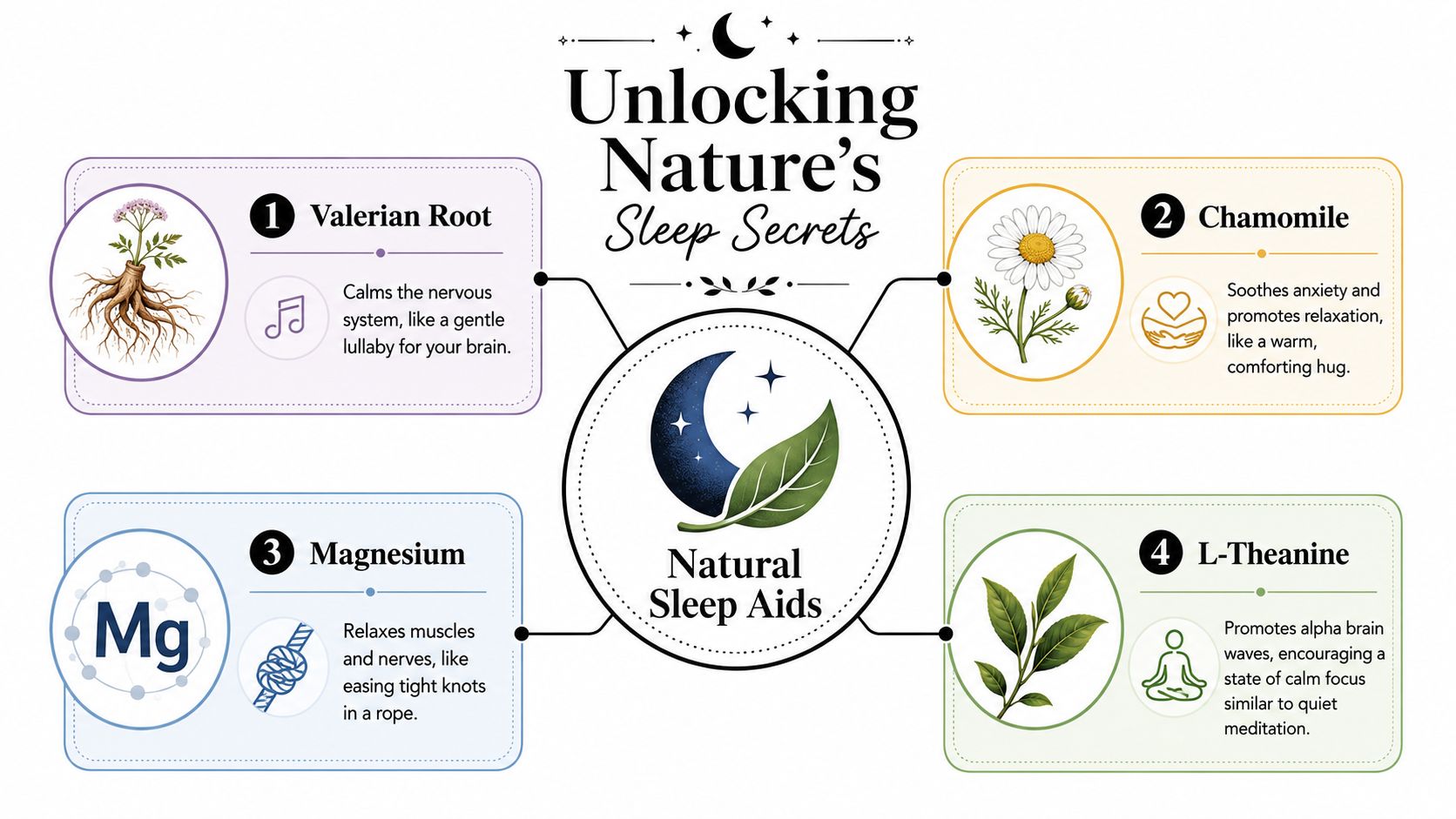
The mistake is treating every natural sleep aid like a weaker sleeping pill. That is not how the better options work. Each one targets a different part of the problem, and that matters a lot if your issue is falling asleep versus waking at 2 a.m. and staying awake.
Think in mechanisms, not marketing
A useful way to sort these is by function: calming bedtime arousal, lowering stress load, or supporting steadier sleep through the night.
Valerian is the clearest example of bedtime calming support. It appears to influence GABA-related signaling, which helps dial down that wired-but-tired state. This is the person who gets into bed exhausted, then feels mentally alert the second the room gets quiet.
Ashwagandha works differently. It is usually a stress-modulating tool, not a direct sedative. That distinction gets missed all the time. If stress is driving light, broken, or delayed sleep, it can help. If your problem is a racing mind right at bedtime and you want an immediate knockout effect, it is often a poor fit.
L-theanine is another one that gets oversimplified. It tends to quiet mental tension without heavy sedation. In practice, that makes it more useful for people whose brain reactivates during the night or who stay mentally “on” into the evening, rather than people who need a strong push into sleep.
Passionflower overlaps somewhat with valerian, but it often fits better when nervous tension and emotional restlessness are tied together. It is a reasonable option for nights when the problem is less raw stimulation and more difficulty unwinding.
Then there is tart cherry, which belongs in its own category. It is a food-based option with compounds that may support sleep timing and sleep continuity through melatonin-related pathways without taking melatonin as a supplement. If you want a practical overview of that angle, this guide to tart cherry gummies for sleep support is a useful companion.
What this means in real life
A supplement can help and still feel subtle. That does not mean it failed.
Valerian is more likely to help with sleep onset. L-theanine is often better matched to mental reactivation and sleep maintenance. Ashwagandha is often the better choice when the whole pattern points to ongoing stress, lighter sleep, and a nervous system that never really powers down. Passionflower sits somewhere between bedtime calming and stress-related unwinding.
Magnesium deserves a brief reality check too. It may help physical tension, muscle tightness, or general nervous system relaxation in the right person. It is supportive. It is not a reliable answer for every form of insomnia.
The practical takeaway is straightforward. Match the supplement to the exact failure point. If you use a “good for sleep” product for the wrong problem, you can get the dose right and still get a disappointing result.
Dosing for Falling Asleep vs Staying Asleep
The usual sleep supplement advice misses the part that matters most. You have to dose for the failure point.

A person who cannot settle at the start of the night needs a different tool, and often different timing, than someone who falls asleep fine but wakes at 2 a.m. and never gets back into deep sleep. That is where many “natural sleep aid” guides go off track. They name ingredients, but they do not tell you what problem each one is suited for.
A useful food-based option for sleep continuity is tart cherry gummies for sleep support.
If you can't fall asleep
Use bedtime-focused calming aids.
Valerian root fits best when the problem is mental activation at lights-out. A practical range is 300 to 600 mg about 30 to 60 minutes before bed. If it helps, it usually helps with sleep onset more than middle-of-the-night waking.
Ashwagandha gets mistimed all the time. If stress is keeping your system keyed up at night, 250 to 600 mg can make sense, but it usually works better as a steady nightly trial than as a one-off rescue pill. For people trying to fall asleep faster, I usually prefer taking it in the evening, roughly 1 to 2 hours before bed, not right at lights-out. That gives it time to take the edge off without expecting a sedative effect it does not reliably provide.
Set expectations correctly. Ashwagandha is better for the person whose sleep is getting chipped away by ongoing stress, shallow sleep, and that “tired but still on” feeling. It is not the strongest choice if you want an obvious drowsy effect in 20 minutes.
For a visual overview, this short video is helpful:
If you wake up during the night
Use products that are more likely to support sleep maintenance.
L-theanine is one of the most commonly misused options. It is often taken by people who want to knock themselves out at bedtime, then dismissed when it does not do that. In practice, it tends to fit better when the problem is nighttime reactivation, especially the “I woke up and my brain came back online” pattern. A reasonable starting dose is 200 mg, taken about 30 to 60 minutes before bed. Some people do better with a slightly earlier dose if late-evening stress is part of the pattern, but taking more does not always improve the result.
Passionflower extract also makes more sense here when awakenings come with restlessness rather than full-alert anxiety. It is less about forcing sedation and more about making the night less broken up.
Clinical shortcut: Use valerian for bedtime mental overactivity, L-theanine for waking and having trouble settling back down, and ashwagandha when chronic stress is degrading the whole night.
Tart cherry is usually better matched to staying asleep than falling asleep fast. Timing often works best at 1 to 2 hours before bed, used consistently for at least several nights, not randomly on a desperate night when you want an immediate knockout effect.
Keep the first trial simple. Start one product, use the lowest sensible dose, and give it a few nights before you decide it failed. Stacking three supplements on night one is how people end up confused about what helped, what did nothing, and what made them feel off the next morning.
Important Safety and Drug Interactions
The fastest way to turn a reasonable sleep experiment into a bad one is to treat every calming supplement like it does the same job. It does not. A formula that helps you fall asleep can hit too hard if your real problem is waking at 3 a.m., and a supplement chosen for staying asleep can feel useless if you expect an immediate sedative effect at lights-out.
That distinction matters for safety, not just results.
A person using ashwagandha for stress-driven sleep disruption often does better with a consistent daily dose, not a random extra capsule on a rough night. L-theanine creates a different problem. If taken too late or pushed too high, it may leave some people groggy by morning without doing much for sleep onset. Matching the supplement to the pattern keeps people from chasing the wrong effect with more pills.
Basic rules before you start
Start low. Change one thing at a time. Hold the rest of your routine steady so you can tell what caused the change.
Pregnancy, breastfeeding, thyroid disease, autoimmune disease, liver problems, and prescription medication all raise the bar for caution. In those cases, get clearance before using supplements that affect stress signaling, sedation, or hormone-related pathways.
Also screen the problem thoroughly. Loud snoring, witnessed pauses in breathing, creeping leg discomfort, panic awakenings, and crushing daytime sleepiness point to problems a supplement will not fix well.
Where problems usually show up
Valerian can cause next-day heaviness, vivid dreams, or the opposite of what you wanted. Some people get more alert, not less. Alcohol, antihistamines, sleep medications, and other sedatives raise the risk of overdoing it.
Passionflower is mild compared with prescription sleep drugs, but mild does not mean trivial. If you are already using anything that causes drowsiness, use extra care. The issue is cumulative effect.
Ashwagandha deserves more respect than it usually gets. It is often sold as a simple stress herb, but it can matter if you take thyroid medication, sedatives, immunosuppressants, or drugs that affect blood sugar or blood pressure. A more detailed review of ashwagandha supplement interactions is worth reading before you add it.
L-theanine is usually well tolerated, but people still misuse it. I see two common mistakes. Taking it at bedtime when the underlying problem is sleep onset failure from an overstimulating evening, then assuming it “doesn't work.” Or stacking it with multiple calming products and not realizing the foggy morning came from the combination.
Practical safety rules
Do not stack alcohol with sleep supplements. Herbs and amino acids can still add to sedation.
Watch the morning after. Grogginess usually means the dose was too high, the timing was off, or the supplement was the wrong fit for your sleep pattern.
Be careful with combination formulas. If a blend helps or causes side effects, you will not know which ingredient deserves the credit.
Stop if the response is backwards. More alert, more wired, vivid dreams, palpitations, stomach upset, or worse sleep are all good reasons to stop rather than push through.
Get medical help sooner if the pattern looks medical. Supplements are a poor detour if sleep apnea, restless legs, panic, reflux, or medication side effects are driving the problem.
The safest approach is plain and a little boring. That is usually how good sleep decisions look.
Building Your Personalized Sleep Solution
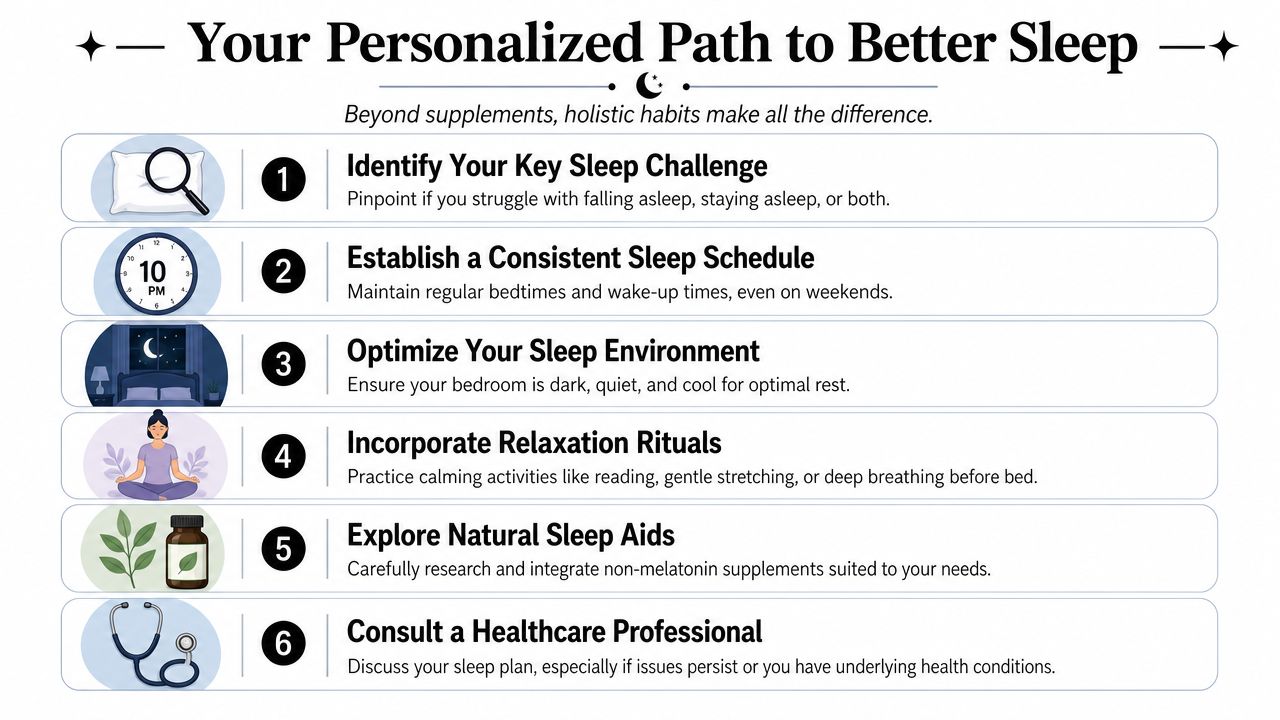
A bigger supplement drawer isn't what's needed. A cleaner decision process is. Start with the sleep pattern, choose the narrowest useful tool, and support it with habits that make any sleep aid work better.
A practical way to choose
If you're stuck, use this quick filter:
You can't fall asleep: Start with valerian.
You stay stressed and your sleep quality is poor: Consider ashwagandha.
You wake during the night: Consider L-theanine.
You want a food-based option: Try tart cherry.
Your sleep gets fragmented when stress rises: Passionflower is a reasonable option.
Keep the rest of your routine stable while testing. Don't change caffeine, bedtime, screen use, and three supplements all at once, then try to guess what happened.
Supplements should support a system
The best natural sleep aid no melatonin strategy is never just about the capsule, tea, or juice. It works better when you pair it with basic sleep discipline: a consistent bedtime, a dark room, a cooler sleep environment, and a wind-down routine your body can recognize.
Supplements are supporters, not saviors.
Single-ingredient products are usually the easiest starting point because they let you learn your response. Multi-ingredient blends can make sense later, especially when stress, soreness, and sleep quality overlap, but they work best when you already know which mechanism helps you.
Choose for the problem you have. This step is often skipped, which causes frustration to persist longer than necessary.
If you're looking for a more complete wellness approach instead of chasing single-use fixes, River of Life offers a multi-ingredient capsule designed to support stress resilience, sleep quality, joint comfort, and mental clarity. It's a practical option for adults who want one daily formula built around ingredients like ashwagandha rather than a growing pile of separate supplements.