

Mental Fatigue Causes and What They Do to Focus

Your afternoon goes fine until it doesn't. A document you could draft half asleep turns into a slow negotiation with your own attention, and by the fourth paragraph you're rereading the same line. Nothing dramatic happened. You slept, sort of. You ate, mostly.
That gap between what you intend to do and what your brain will deliver is what people usually call brain fog or burnout. Researchers call it mental fatigue, a genuine reduction in the capacity to hold attention, keep information in working memory and exercise self-control. It has more than one cause, and the causes don't all respond to the same fix. A short night, a 65-hour work week, a low-grade infection and a post-viral crash can produce an identical flat feeling, and pushing harder helps with exactly one of them.
Table of Contents
When a Familiar Task Suddenly Feels Heavy
It's 3:40 on a Tuesday. The report is due Thursday, the tabs are open, the coffee is still warm, and your attention slides off a sentence you've now read three times. You aren't bored, exactly. You aren't sleepy, exactly. The task has become heavy, and the heaviness arrived without warning.
That state has a name. Mental fatigue is a reduced capacity to hold attention, keep several things in working memory at once and keep self-control online long enough to finish. It isn't laziness, and it isn't the same thing as sleepiness, though a short night can produce both at the same time.
Mental fatigue isn't one condition with one fix. It's a set of look-alike patterns that feel identical from the inside.
The common mistake is assuming a single cause. Mental fatigue causes sort into groups that need different responses: short or broken sleep, long stretches of demanding cognitive work, screens and switching, medicines and mood, inflammation and illness, and a post-exertional pattern where effort today produces a crash tomorrow. Sorting matters, because the correction that rescues one group can make another worse.
In 2024, 30.5% of U.S. adults reported averaging fewer than seven hours of sleep per 24-hour period, according to CDC data reported by Yahoo Health, which makes short nights a sensible first thing to check. It doesn't make them the only thing. Start with your nights, then with the length of your unbroken focus blocks, then with how much recovery your week holds. If rest doesn't restore you, the question changes from habit to health.
A Quick Map of Mental Fatigue Causes
Find the row that best matches today's pattern before reading the longer explanations. Each one names a cause, the typical cost to focus and energy, and the first thing worth checking.
Cause | What it does to focus and energy | First check |
|---|---|---|
Sleep under 7 hours or broken nights | Weaker attention, working memory and executive control; more lapses | Hours asleep and how often you wake |
Work above about 280 hours a month | General fatigue, anxiety and chronic tiredness; 27.5% of employed adults in one review reported more fatigue | Overtime, shifts and real days off |
Unbroken high-attention work | Tiredness can start near 30 minutes; slower responses and weaker self-control | Length of the longest focus block |
Screens, switching and monotonous monitoring | Cumulative load from alerts, games or watching a display | Continuous high-stimulation sessions |
Mood, medicines or substances | Effort feels costly; alertness and motivation drop | Recent mood change or new medicines |
Illness, inflammation or neurological disease | Ordinary tasks feel exhausting even at rest | Persistence despite real rest |
What a first check can and cannot tell you
A first check is the cheapest question that rules a cause in or out. Counting hours asleep and awakenings across five nights beats guessing at your average. For workload, the check is overtime, shift rotation and whether a day off survives contact with email. For focus, it's the length of your longest unbroken block, not the number of hours you sat at a desk.
None of these checks diagnose anything. Two people with identical scores can land on different rows, and one person can occupy three at once.
Why one week can stack three rows
A night-shift week stacks short sleep, long hours and thin recovery into the same 24 hours. That's why the table sorts likely causes instead of assigning a single culprit.
Workload deserves its own number. A 2023 comparative review of work and fatigue reported that working more than 280 hours a month, roughly 65 hours a week, was associated with increased general fatigue, physical disorders, anxiety and chronic tiredness. The same review cited occupational research in which 27.5% of employed participants reported increased fatigue, with the strongest links to heavy workload, frequent overtime, insufficient vacation or leisure time, shift work, piece-rate pay and conflict with supervisors or colleagues.
A detail worth keeping: Australian estimates cited in that review put fatigue-related driving at roughly 10% to 40% of traffic accidents, and the tiredness may have started with mental work done well before the drive, like a long accounting session or a 12-hour surgical shift.
If your nights are short, that row is the one to pull on first. If rest doesn't restore you, the last row is the one that matters, and it leads somewhere different.
Short Sleep and a Brain That Drops the Thread
Sleep comes first because it's measurable, modifiable, and the cause many of us skip past on our way to a supplement. It also has a common accomplice: stress is a frequent reason a firm bedtime doesn't deliver a full night, and how stress affects sleep is worth understanding before you blame the schedule alone.
Research on students links shorter sleep with higher mental fatigue and poorer concentration, and the study of sleep duration and mental fatigue found a significant negative relationship between the two, meaning shorter nights tracked with heavier fatigue. The broad pattern matters more than any single dataset: adults are commonly advised to get at least seven hours, and plenty of working adults regularly land under that line.

What the research describes is a dose effect, where shortened sleep appears to contribute to fatigue rather than appearing alongside it. Four five-hour nights cost more than one late evening. Ask anyone on a Thursday.
The kitchen timer that doesn't reset
Sleep pressure works like a timer that only clears with enough sleep. A six-hour night winds it partway down, and the next short night adds to what's left instead of starting fresh. That pressure then interacts with your body clock, so timing matters as much as total hours.
In an experimental review of sleep deprivation and attention, sustained wakefulness produced progressively more attention lapses across 62 hours awake, with the highest lapse counts in the morning circadian window. Recovery sleep restored performance quickly, and shorter rest breaks restored some vigilant attention too. That last finding is the practical one: when a full night isn't available, a real pause still buys you something.
What eighty milliseconds actually means
The fog has a measurable signature. In a controlled study of 26 healthy adults, acute sleep deprivation slowed reaction time by an average of 83.69 milliseconds and prolonged P300 latency, a marker tied to attention and processing speed, according to the sleep deprivation reaction time study.
Eighty milliseconds sounds like nothing until you put it somewhere. It's the gap between seeing brake lights and moving your foot, between reading a chart value and acting on it, between a toddler wobbling and your hand arriving. Shift workers, caregivers and anyone driving home after a long stretch are borrowing against that gap.
Keep one week of notes, nothing more
Write down four things and stop there:
Bedtime and lights out, logged separately, because the gap between them is usually the problem.
Wake time, weekends included.
Awakenings, with a rough count and what woke you.
The hour focus fails, since a steady afternoon slump points to sleep pressure while a random one points elsewhere.
Better sleep quality can ease this kind of fatigue, which is the honest reason to fix nights before you buy anything. A capsule doesn't compensate for a five-hour night, and no supplement outruns a schedule that hands you six.
Long Focus Blocks and the Screen Drain
The workday is its own fatigue exposure. Tasks demanding prolonged attention, inhibitory control, working memory or plain monotony produced fatigue after about 30 minutes in experimental settings, including computational tests, smartphone and social-media use and video games, according to a review of mental fatigue mechanisms.

The phone battery that never quite recharges
Intensive neural activity spends glucose and ATP faster than recovery refills them, and adenosine builds up, particularly in the anterior cingulate cortex. Adenosine dampens cortical activity and changes how effort gets regulated, so a tired brain doesn't just run slower. It becomes less willing to try.
Reviews reporting EEG findings describe increased frontal theta activity and altered central alpha activity during fatigue, the signature of a cortex running in a different gear. You can't measure that at home, and you don't need to. The subjective version, where the third paragraph of an email takes three attempts, is reliable enough.
Three exposures that feel different and add up
A long analytical block. Budget work, code review, contract reading. One unbroken stretch drains more than the same minutes split in two.
Rapid switching. Every app change reloads context, so an hour of alert-hopping costs more than an hour on a single task.
Monotonous monitoring. A security desk, a charting queue, a dashboard that has to be watched. Low stimulation sounds easy and isn't.
The grind counts alongside the puzzle
Effort isn't purely intellectual. A 2024 occupational study published in Scientific Reports found a correlation of 0.429 between mental demand and functional fatigue, and 0.409 between frustration and functional fatigue. Frustration sits close to mental demand in what it costs you, which matches the experience of a meeting that leaves you flatter than a spreadsheet did.
Three scheduling moves worth trying this week
Split the hard block. Give demanding work 25 to 40 minutes, then switch to something routine for five. The break isn't a reward, it's part of the task.
Alternate hard and routine. Pair a difficult hour with filing, invoices or clearing a queue, so recovery happens inside the workday rather than after it.
Cap continuous screen stimulation. Set a stopping point for scrolling, gaming or alert monitoring instead of waiting for the moment you notice you're spent.
Caffeine and motivation change how tired you feel without restoring what was spent. The number that predicts your evening is the length of your longest unbroken block, so keep that one in view.
Illness and Inflammation That Make Thinking Costly
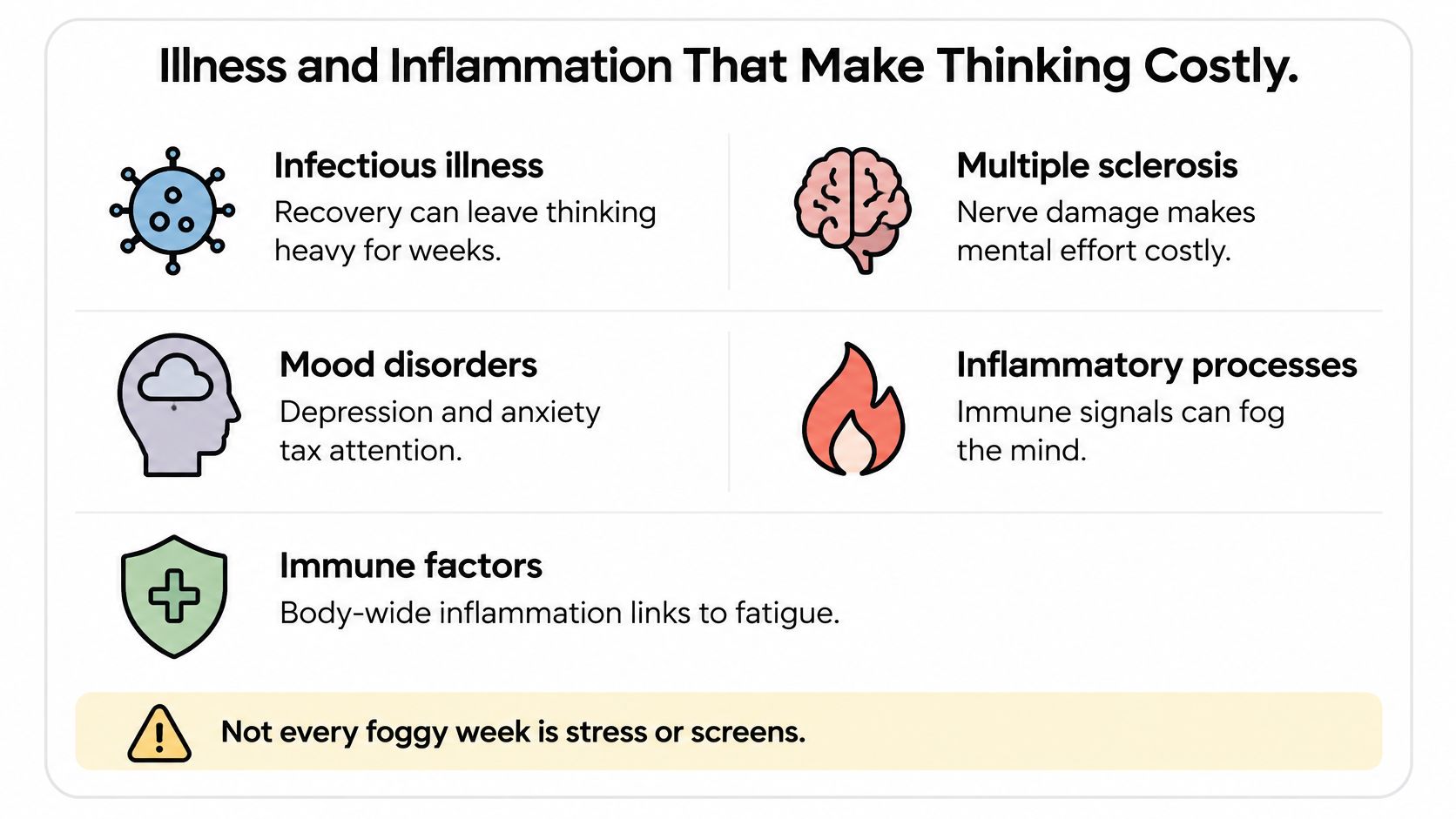
Some foggy weeks aren't about screens or deadlines at all. Reviews of mental fatigue place infectious illness, multiple sclerosis, mood disorders and inflammatory processes on the list of causes, alongside immune dysfunction, metabolic dysfunction, gut-brain interactions and disrupted circadian physiology, as set out in a review of fatigue mechanisms in cognitive science00056-7).
Why an ordinary email can feel like a hard puzzle
Inflammation doesn't only make you feel generally unwell. Inflammatory cytokines alter monoaminergic neurotransmission by activating enzymes that interfere with dopamine and serotonin biosynthesis, according to a review of inflammation and mental fatigue. Those two messengers support motivation, attention, mood and the willingness to spend cognitive effort, so disrupting them raises the price of ordinary tasks.
The same review describes inflammation raising cognitive load through altered anterior cingulate cortex function. That's part of the system that helps decide whether an effort is worth making. When it's working against you, opening a routine email feels like starting a puzzle, and the exhaustion arrives with no physical exertion to explain it.
Three everyday versions of this
Concentrating through a viral illness. The infection is the event; the heavy thinking is the aftershock.
The morning after a flare. Someone with an inflammatory condition can wake with a head full of wet sand and no change in workload to account for it.
The person who isn't active but feels spent by noon. A low-activity day with high inflammation can drain more than a busy one.
Other proposed pathways include adenosine accumulation, astrocytes that clear glutamate less effectively, and insufficient astrocyte-derived metabolic support for active neurons. The mechanisms differ and the practical point doesn't: these are reasons to look for a medical context, not proof that any one person has a disease.
A clinician can check sleep, mood, infection, medication effects and neurological signs. A capsule can't do that work, and it shouldn't be asked to. There's also a separate pattern where effort today produces a crash tomorrow, and it needs a different response again.
Medicines, Mood and Substances That Drain Focus
Two causes get skipped more than any others, and both are visible on a calendar if you look. The first is a substance. Sedating prescriptions, some antihistamines, alcohol, recreational drugs and abrupt caffeine withdrawal all dull alertness, slow thinking and flatten motivation.
Timing gives the answer away. Fatigue that begins after a new medicine, a dose change, a stopped prescription or a heavier drinking stretch points at the substance before it points at your character. Write down every medicine and substance you take with its start date and dose, then look for the line where the tiredness began.
Mood works differently. Low mood or anxiety makes ordinary tasks feel expensive and drains the willingness to start them, and that doesn't lift after an early night the way sleep debt does. Anxious rumination also competes for the same working memory the task needs.
One hard rule: never stop or change a prescription on your own. Take the list to the prescriber and ask whether timing, dose or an alternative could be behind the fatigue.
If you're layering sleep aids or sedatives on top of that, ashwagandha and sedatives is worth a look before you add anything else, because calming products can stack.
When mood symptoms, a recent medicine change and persistent fatigue all show up together, the question stops being about discipline and becomes a clinical one.
The Crash That Arrives After You Push
Ordinary tiredness is roughly proportional to what you did. A late night produces a slow morning, and a full night mostly fixes it. A post-exertional crash breaks that arithmetic. You have a manageable day, push through a meeting and a handful of emails, and hours later the floor drops.

A 2025 meta-analysis of long COVID estimated cognitive, memory or attention problems in 36% of people with long COVID and fatigue in 34%, with fatigue lasting an average of 5.5 months; another study cited in the same review found persistent fatigue in 52.3% during the post-acute phase, as reported in the 2025 review of post-viral fatigue. Triggers include mental work, physical exertion, stress, household tasks and a broken night.
Why the bill arrives hours late
The delay confuses people. Worsening can show up long after the task that caused it, which makes cause and effect easy to misread. Proposed contributors include inflammation, altered sleep, autonomic dysfunction, nutritional problems, vascular dysfunction and neuroinflammation. That list is context for a conversation with a clinician, not a self-diagnosis.
Track it in two columns
For one week, note what you did in the left column and whether focus, mood or stamina dropped later in the right. Patterns emerge fast, often within four or five days. If concentrating reliably produces a crash the next day, that's a pacing problem, not a discipline problem.
Pacing rule: when exertion repeatedly makes symptoms worse, rapid jumps in activity are a poor plan. Protect sleep continuity and get a medical review before adding workouts or longer work blocks.
Ordinary tiredness from one late night usually lifts after recovery sleep. A pattern that worsens after effort, week after week, deserves a different response than trying harder.
Decide Whether to Rest or Call a Clinician
A week of proper sleep is the cheapest diagnostic test you have. If a run of good nights brings back your focus, the fatigue was the everyday kind: short sleep, a brutal deadline, a stretch of long screen blocks. Rest and shorter focus sessions are the right fix, and the difference usually shows within a few nights.
The other picture needs a different response. Fatigue that persists or worsens despite real rest, a drop in daily function at work or home, snoring or breathing pauses, low or anxious mood, a recent medicine change, neurological symptoms, or fatigue that followed an infection and crashes after effort all point somewhere a clinician should look.
Pattern | Why it matters | Next step |
|---|---|---|
Clears after a few full nights | Fits short sleep or a deadline spike | Protect sleep and add breaks |
Lasts or worsens despite rest | Wide differential, not willpower | Primary care review |
Breathing pauses, snoring, morning headache | Possible sleep-disordered breathing | Ask about a sleep evaluation |
Low mood, anxiety or major functional drop | Mood and burnout overlap but are not identical | Mental health screening |
Crash hours after mental or physical effort | Post-exertional pattern | Pace activity and get medical advice |
New weakness, vision change, severe headache or confusion | Possible neurological illness | Urgent or same-day care |
Use the table to sort, and let a clinician do the diagnosing. Several rows can apply to one person at once. In research on hospital physicians, work-related fatigue showed up alongside measurable rates of depression, anxiety, post-traumatic-stress complaints and burnout, which is a reminder that overlapping rows are common rather than rare.
Why fatigue isn't the same as burnout
The 2025 systematic review of mental fatigue induction methods noted that both workload and the characteristics and duration of a task shape fatigue, which undercuts the idea that one deficiency or one lifestyle failure explains it. Clinical guidance treats fatigue as having an extensive differential diagnosis, assessed alongside sleep, mood, substance use and physical health. Burnout is one possible label in that differential, and it is the wrong one when snoring, a new drug or a post-infection crash is the primary driver.
Practical brain fog relief starts with the boring items: consistent sleep and wake times, breaks inside the workday, food at regular intervals, and a medical review for anything on the red-flag list.
If you take antidepressants, anti-anxiety medication, sedatives, thyroid medication or blood thinners, or you're pregnant or breastfeeding, check with your doctor before adding any supplement. Ashwagandha may add to the effect of sedatives, so ask before combining it with melatonin or sleep medicine.
Once urgent causes are ruled out and you want steady support while you rebuild sleep and recovery, ashwagandha is the ingredient in our formula aimed at managing stress while staying mentally sharp. You can look at River of Life daily capsules as optional support alongside that plan, never as a substitute for it.
Bring your week of notes to the appointment. A short record of what cleared, what crashed and when makes the sorting faster for both of you. If a red-flag row matches what you're seeing, book the visit instead of waiting for the fog to lift on its own.
River of Life makes a single daily capsule built around ashwagandha root, turmeric with BioPerine, ginger and bromelain, formulated to support stress resilience, sleep quality and mental clarity. If sleep, workload and recovery are the levers you're working on, it's designed to sit alongside that routine rather than replace it. Visit River of Life to see the formula, the subscription options and the 30-day return policy on unopened bottles.