

Does Stress Affect Sleep? Causes, Signs and Fixes

Yes, stress affects sleep: 43% of U.S. adults in a 2013 survey reported stress-related difficulty falling asleep or lying awake during the previous month. Stress can disrupt sleep, and poor sleep can leave you feeling more stressed the next day.
But a restless night isn't always a night without deep sleep. You can sleep for less time, wake more often, and still record a higher proportion of deep sleep on a wearable. Understanding those differences helps you choose a useful response instead of chasing a perfect sleep score.
Table of Contents
Yes, Stress Disrupts Sleep, and the Numbers Show How Much
The American Psychological Association's 2013 Stress in America survey found that 43% of U.S. adults experienced stress-related difficulty falling asleep or lying awake during the previous month, while only 20% rated their sleep very good or excellent. These are adults' reports of their experiences, not diagnoses of insomnia.
That distinction matters. A demanding week can disturb sleep without becoming a lasting sleep disorder, and people who spend similar amounts of time in bed can experience very different nights.
How Stress Shows Up in Sleep Measures
The APA survey findings below describe perceived sleep and stress. The wearable findings describe changes in recorded sleep measures, which aren't interchangeable with how rested someone feels.
Measure | Finding | Source |
|---|---|---|
Stress-related trouble falling asleep or lying awake, past month | 43% of U.S. adults | APA 2013 survey |
Sleep rated fair or poor | 42%; only 20% rated it very good or excellent | APA 2013 survey |
Racing thoughts as reason for insufficient sleep | 49% of high-stress adults versus 10% of low-stress adults | APA 2013 survey |
Average nightly sleep | 6.2 hours among high-stress adults versus 7.1 hours among low-stress adults | APA 2013 survey |
Total sleep time on stressful days | Less total sleep | Large U.S. wearable dataset |
Wake after sleep onset on stressful days | More time awake after initially falling asleep | Large U.S. wearable dataset |
Deep sleep as share of sleep on stressful days | Higher proportion of deep sleep | Large U.S. wearable dataset |
Arousal index on stressful days | Lower recorded arousal index | Large U.S. wearable dataset |
The rows capture different questions: How long did you sleep? How interrupted was it? What portion was classified as deep sleep? How did the night feel?
Association isn't proof of cause. People experiencing more stress may also have demanding schedules, pain, anxiety, or other sleep-disrupting circumstances. Group averages don't predict exactly what will happen to you.
A useful sleep assessment includes duration, continuity, and daytime functioning, not just time in bed.
So, does stress affect sleep in a measurable way? Yes, but no single number describes every part of the experience, and no sleep score can identify stress as the cause on its own.
How Stress Keeps Your Brain on Alert at Night
Say you're preparing for a difficult conversation at work. Your body is tired, but when you switch off the light, you start rehearsing what you'll say and how the other person might respond.
Your brain is treating an anticipated problem as something that still needs attention. Sleepiness and alertness can coexist, which explains the frustrating feeling of being exhausted but unable to switch off.
The Body's Alarm and Control Room
The hypothalamic–pituitary–adrenal axis, usually shortened to HPA axis, is part of your stress-response system. Think of it as a building's fire alarm connected to a control room: the brain detects a possible threat, sends signals, and prompts the body to prepare for action.
Cortisol is one of the hormones involved. It isn't a harmful substance you need to eliminate; you need it for normal daily functioning.
This diagram illustrates the alarm analogy.

Cortisol follows a daily rhythm and normally rises around waking, including a response after awakening. Levels are generally lower toward the evening, helping create conditions compatible with sleep.
When you continue anticipating danger or mentally rehearsing problems, your body may remain alert when you'd rather be resting. That doesn't mean everyone with insomnia has high nighttime cortisol, or that measuring cortisol would explain an individual's sleep difficulty.
Why Awakenings Matter
In a study of female college students using wrist actigraphy and salivary cortisol measurements, anxiety during examination stress was associated with more wakefulness after sleep onset and more wake episodes. The finding concerns fragmented sleep, not merely a dramatic reduction in total sleep time.
Actigraphy uses a wrist-worn device to estimate sleep and wakefulness from movement. It adds information beyond a questionnaire, although it isn't the same as measuring sleep stages directly with brain recordings.
The same study linked poorer sleep efficiency and greater nighttime wakefulness with a lower cortisol awakening response. Sleep efficiency means the proportion of time in bed that you spend asleep.
That result complicates the idea that stress always means too much cortisol. The timing and shape of the response matter, and disrupted sleep may accompany a less pronounced morning response rather than uniformly raised levels.
What the study supports: Stress-related anxiety and sleep fragmentation can occur together.
What it doesn't establish: Cortisol alone caused the awakenings.
Who was studied: Female college students, so the findings don't automatically describe every age group or life situation.
Acute Stress and Chronic Stress Affect Sleep Differently
Acute Versus Chronic Stress and Sleep
Feature | Acute stress | Chronic stress |
|---|---|---|
Typical duration | A temporary response around an event, such as an exam or deadline | Sustained pressure, such as ongoing job or caregiving strain |
Typical sleep change | Difficulty settling and temporarily unsettled nights | Recurrent awakenings, early waking, or persistent insomnia symptoms |
Cortisol pattern | A temporary response that may settle as the situation resolves | Regulation may become less distinct; it isn't necessarily continuously high |
Recovery | Sleep may improve when the event passes | Sleep difficulties and habits may continue after circumstances improve |
Right response | Protect your sleep schedule and use short-term coping strategies | Address ongoing pressures and seek clinical input for persistent insomnia |
These are practical patterns rather than diagnostic categories. A sudden loss can disturb sleep for months, while someone living with ongoing pressure may still sleep reasonably well.
Duration alone doesn't predict impact. The severity of the event, your sense of safety, the support available to you, and the behaviors that follow all shape how sleep responds.
Why More Deep Sleep Can Still Feel Unrefreshing
A Sleep journal abstract describing a wearable dataset of 83,288 U.S. adults reported that stressful days were associated with 2.6% less total sleep time, 0.9% more wake after sleep onset, 3.5% more deep sleep as a percentage of sleep, and a 1.7% lower arousal index.
Read together, those numbers show stress pushing different parts of sleep in different directions: less time asleep overall and more time awake during the night, yet a larger proportion scored as deep sleep. The arousal index and time spent awake measure different features, and deep sleep's share of the night isn't the same as its total duration.
Deep sleep works like a slice of a pie. A larger share of a smaller pie can still leave you with less pie on the plate, which helps explain why a reassuring-looking night can feel unrefreshing.
A higher deep-sleep percentage isn't a certificate of better recovery.
A wearable's stage estimates also shouldn't overrule your ability to stay alert, concentrate, and function. If the device reports a reassuring score but you're repeatedly exhausted, the exhaustion still deserves attention.
The practical response follows the same split. With temporary stress, protect your usual opportunities for sleep and let nights recover as the event passes. With ongoing pressure, sleep can stay disrupted even when your bedtime habits are solid, so consider what needs to change outside the bedroom too: workload, caregiving support, or access to treatment.
Why Your Reaction to Stress Can Matter More Than the Stress
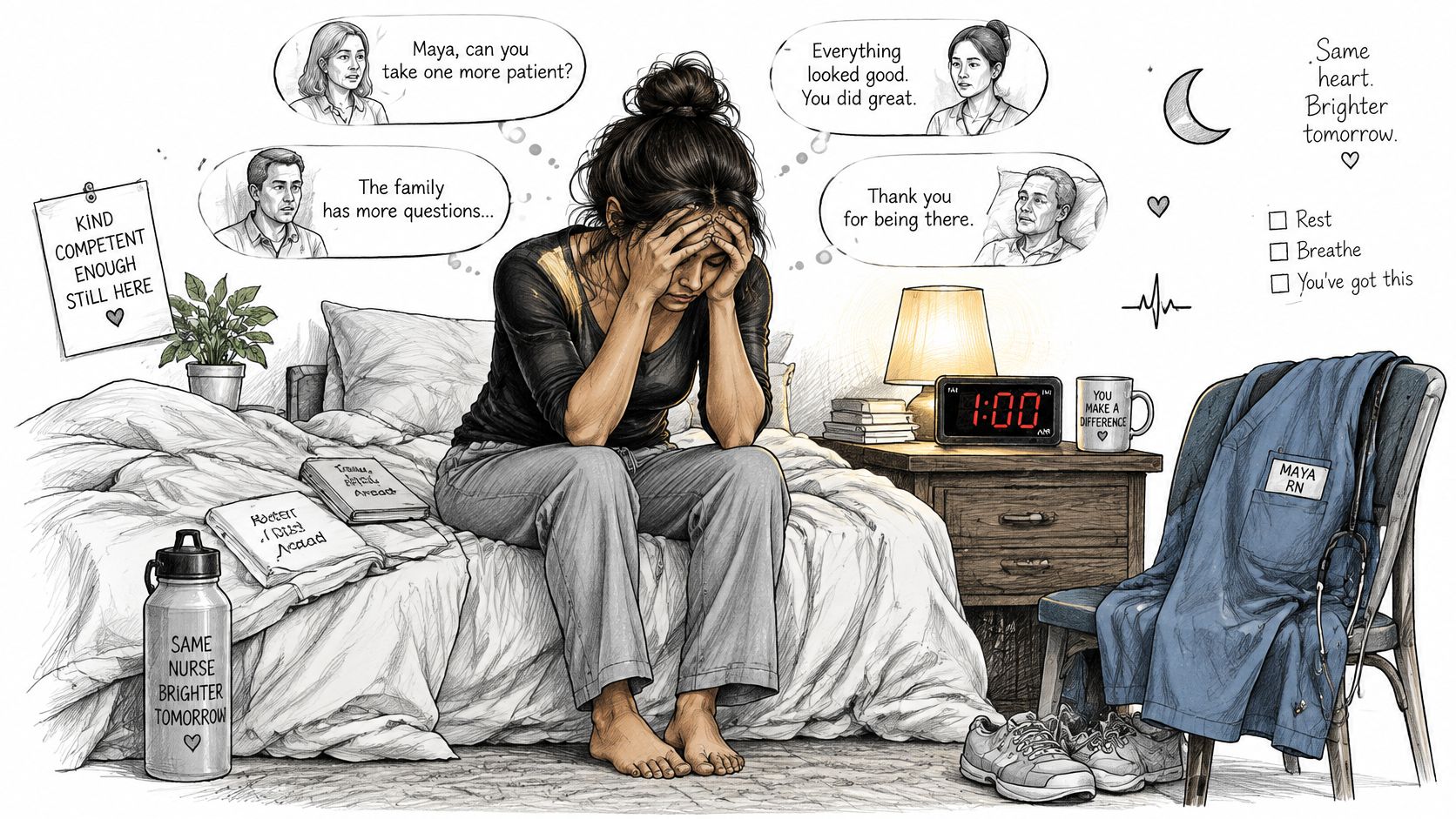
Consider Maya, a fictional nurse on rotating shifts who struggles to sleep after a difficult patient loss. When she finally gets into bed, she replays conversations, checks the clock, and reaches for her phone to avoid being alone with her thoughts.
The loss matters. But so do grief, changing work hours, rumination, and the new bedtime habits that follow it.
Counting Stressors Misses Their Impact
A 2026 Sleep journal study abstract involving 134 participants linked greater recent stressor severity with more severe insomnia symptoms, but found an unexpected negative association between the presence or number of recent stressors and insomnia severity; lifetime stress exposure and severity weren't significant predictors.
This doesn't mean additional stress protects sleep. A small observational finding can't establish that conclusion, and the unexpected direction needs cautious interpretation.
It does challenge a simplistic assumption: counting stressful events isn't necessarily a good way to understand someone's insomnia. A severe event may matter more than a longer list of manageable inconveniences.
Separate Rumination From Bedtime Delay
Rumination means repeatedly turning the same distressing thoughts over without reaching a useful next step. Maya might mentally replay a conversation even though she can't change it or take action that night.
Sleep procrastination means postponing bedtime despite having an opportunity to sleep. Someone may keep scrolling to reclaim personal time after a demanding day, then feel anxious about how little time remains before morning.
These patterns need different responses:
Repetitive replaying: Write down the concern and identify whether any action is possible tomorrow.
Avoiding bedtime: Choose a satisfying, low-stimulation activity earlier in the evening rather than relying on open-ended scrolling.
Grief or traumatic distress: Seek appropriate emotional support instead of treating the problem only as a bedtime habit.
Rotating shifts: Discuss a realistic sleep plan with a clinician or occupational health professional.
Building stress resilience doesn't mean blaming yourself for a strong reaction. It means identifying which parts of the response you can influence and where you need support.
When reducing the original stressor doesn't restore sleep, examine what now happens around bedtime. Learned habits and fear of another difficult night may need direct attention alongside the original problem.
Warning Signs That Stress Is Costing You Sleep
Look for recurring changes rather than judging yourself after an isolated bad night. These signs can accompany stress-related sleep disruption, but none identifies stress as the cause by itself.
Nighttime Signs
Difficulty settling: You feel sleepy before bed but become alert once you lie down.
Repeated waking: You wake during the night and struggle to return to sleep.
Mental rehearsal: You review conversations, unfinished tasks, or tomorrow's problems.
Physical tension: Your jaw feels clenched or your shoulders remain tight.
Sudden alarm: You wake with a pounding heart or a strong sense of unease.
Daytime Signs
Unrefreshing sleep: You feel sluggish despite allowing enough time in bed.
Mood changes: You're more irritable or emotionally reactive than usual.
Physical discomfort: Tension headaches accompany a difficult stretch.
Increasing stimulant use: You rely on caffeine to get through routine tasks.
Attention problems: You forget details or make small errors more often.
These symptoms deserve attention because short sleep and mental distress commonly overlap. A CDC study of U.S. adults found that adults averaging 6 hours or less nightly were approximately 2.52 times as likely to experience frequent mental distress as those sleeping more than 6 hours after adjustment for potential confounding factors; the CDC and American Academy of Sleep Medicine identify at least 7 hours nightly as adequate adult sleep.
That benchmark is a starting point, not a guarantee of restful sleep. Frequent awakenings or an untreated sleep disorder can leave you impaired despite an apparently adequate sleep opportunity.
The association also doesn't prove that stress caused the short sleep. Pain, medication effects, anxiety, sleep apnea, and other conditions may contribute.
Record which symptoms recur, how often you notice them, and whether they affect work, relationships, or safety. Don't drive when you're struggling to stay awake, and don't assume gasping or pronounced daytime sleepiness is just stress.
A Wind-Down Routine for Stressful Nights
A useful routine makes bedtime less demanding. You don't need to complete an elaborate ritual or feel perfectly calm before sleep becomes possible.
Use this visual as a reminder to simplify your evening.

Build a Routine You Can Repeat
Choose a consistent wake time. A regular morning schedule helps stabilize your sleep rhythm, even after a disappointing night. The usual slip is sleeping much later, then expecting to feel sleepy at the usual bedtime.
Give worries a place before bed. During an earlier part of the evening, write each open concern beside a realistic next action. Avoid turning this into an extended planning session that keeps you mentally at work.
Put unfinished thoughts on paper. Keep a notebook outside the bed and briefly record anything you're afraid of forgetting. The slip is repeatedly rereading the list or treating every thought as something that must be solved immediately.
Lower light and stimulation. Dim lamps, stop work email, and choose something low-stakes, such as familiar fiction or quiet music. Keeping the phone beside your pillow makes it easy to restart an emotionally activating conversation.
Breathe slowly and comfortably. Let your exhale last a little longer than your inhale without forcing deep breaths or holding your breath. If you feel dizzy or uncomfortable, return to normal breathing rather than pushing through.
Leave bed when wakefulness becomes frustrating. Sit somewhere safe in dim light and do a quiet activity, then return when you feel sleepy. This is stimulus control: helping your bed become associated with sleep rather than prolonged struggling and clock-checking.
Review caffeine and alcohol. Move caffeine earlier if you're sensitive to it, and don't use alcohol as a sleep aid. Feeling sedated at bedtime isn't the same as sleeping continuously through the night.
Keep the room comfortably cool, dark, and quiet, and turn the clock away. If mobility or fall risk makes getting out of bed unsafe, ask a clinician how to adapt stimulus control.
Measure the Pattern, Not Your Performance
A simple diary can include estimated time to fall asleep, remembered awakenings, wake time, and daytime sleepiness. Estimate in the morning rather than monitoring the clock overnight.
Pair the routine with practical daytime approaches to reducing stress naturally, such as manageable movement and a clearer stopping point for work. Don't add so many tasks that relaxation becomes another obligation.
If a guided format suits you, consider this video as an optional addition to your evening routine.
Practical rule: Judge the routine by whether it becomes easier to repeat and whether your overall sleep pattern improves, not whether it produces instant sleep tonight.
Choose Your Next Step Based on How Long Sleep Has Suffered
Next Step by Situation
Situation | Duration | Next step |
|---|---|---|
Short-term stress disrupting sleep | Recent, with a clear trigger | Use a manageable wind-down routine and keep a sleep diary |
Ongoing stress with sleep trouble most nights | Continuing rather than settling | Add a worry window and stimulus control; review caffeine and alcohol |
Recurrent insomnia symptoms | Persistent or affecting daytime functioning | Ask a clinician about cognitive behavioral therapy for insomnia, or CBT-I |
Loud snoring, gasping, or marked daytime sleepiness | Any duration | Request a sleep evaluation rather than assuming stress is responsible |
Severe anxiety, low mood, or thoughts of self-harm | Any duration | Seek prompt professional support; use emergency services or a crisis line if you can't stay safe |
Considering a supplement | Before starting | Discuss safety with a clinician or pharmacist, especially with medication use or pregnancy |
You don't need to wait for sleep problems to cross a particular time threshold before asking for help. Daytime impairment, safety concerns, and distress are sufficient reasons to make an appointment.
A human research review of sleep and HPA-axis functioning concluded that poorer sleep quality can amplify cortisol responses to laboratory stress, while ordinary variation in sleep duration doesn't consistently alter that response. Merely extending time in bed may therefore miss the practical problem of interrupted, unsatisfying sleep.
Keep Supplements Secondary
CBT-I combines behavioral changes with work on sleep-related worry. Ask about it when insomnia persists rather than relying only on relaxation or a product.
The publisher's own River of Life Capsules contain turmeric extract with BioPerine, ashwagandha, ginger, and bromelain. Treat the formula as a discussion point with a clinician, not a substitute for insomnia treatment; check interactions, pregnancy-related safety, and independent product-quality testing.
The publisher's discussion of ashwagandha and sleep provides additional ingredient context, but no supplement should be assumed free of side effects. Start a sleep diary tonight and bring it, along with your medication and supplement list, to your appointment.
River of Life offers a multi-ingredient dietary supplement and educational resources on stress, sleep, and everyday wellness. Visit River of Life to review the formulation and prepare questions for your clinician while keeping behavioral sleep care at the center of your plan.