
Dietary Supplement NAC: Evidence-Based Guide for 2026

You're standing in a supplement aisle or scrolling through an online cart, and NAC shows up beside words like glutathione, detox, or brain support. The label looks familiar enough to feel safe, but the actual question is simple and annoying, what is this stuff, what does it really do, and is it even allowed where you live?
Dietary supplement NAC sits in a strange middle ground. It's not a trendy newcomer, and it's not just another plant extract with vague wellness promises. It has a long medical history, a real chemical identity, and a regulatory story that many product pages skip because it's awkward to explain. That mix is exactly why people get confused.
This guide keeps the path simple. You'll get the basic chemistry in plain English, the medical backstory, the evidence for the uses people care about most, the dose ranges that appear in clinical trial and reference material, and the legal gray areas that matter before you buy. The goal is to leave you with a clean mental model, not a pile of marketing terms.
Table of Contents
Beginning Your NAC Supplement Journey
A lot of people meet NAC the same way they meet most supplements, by accident. You're looking for something that might help with stress, recovery, or that cloudy, hard-to-describe feeling people call brain fog, and NAC appears in a product comparison as if everyone already knows what it is. That's where the confusion starts, because the label is short but the backstory is unusually complicated.
The fastest way to understand NAC is to stop thinking of it as a mystery wellness ingredient and start thinking of it as a cellular supply item. It has a long clinical history, including FDA approval in 1963 as a prescription medicine for acetaminophen overdose, and it also has a mucolytic role in respiratory care, which is part of why it bridges the pharmaceutical and supplement worlds Texas Health and Human Services NAC monograph. That dual identity matters, because it explains why NAC gets treated differently from many ordinary supplement ingredients.
A second source of confusion is the gap between what people hope NAC will do and what it's been studied for. Some uses are grounded in long-standing medical practice, while others are still more speculative or mixed. Regulatory status makes the picture even messier, especially in the U.S., where shoppers may see NAC sold openly even though the legal question is not settled in the same way everywhere FDA request for information on NAC in dietary supplements.
Practical rule: if a supplement's marketing sounds confident but its legal status is fuzzy, slow down and check the jurisdiction before you buy.
A useful way to read the rest of this guide is to separate three questions. First, what NAC is chemically. Second, what it has been used for. Third, whether the product you're looking at is legal, sensible, and appropriately dosed in your market. That sequence prevents most of the common mistakes people make when they buy NAC on impulse.
What Dietary Supplement NAC Is

NAC stands for N-acetylcysteine, and its chemical name is (2R)-2-acetamido-3-sulfanylpropanoic acid. Its molecular formula is C5H9NO3S, and its molecular weight is about 163.2 g/mol NAC monograph and reference data. The chemistry sounds dense, but the basic idea is simple. NAC functions as a cellular supply item that delivers cysteine-related material into antioxidant pathways, where the body can put it to work.
That connection to glutathione is the main reason NAC draws so much attention. Glutathione is often described as the body's master antioxidant, and NAC helps provide the raw material needed to build it. The relationship is more like bricks and a wall than a vague wellness promise. NAC supplies part of what the body uses to make glutathione, so it supports the system that keeps glutathione available.
That is also why NAC is usually grouped with antioxidants without being treated as a generic antioxidant powder. Its role is more specific. The body uses it as a precursor, which is why supplement discussions often connect NAC to oxidative stress support instead of broad “wellness” language. The chemistry matters because it gives the ingredient a clearer scientific identity than many products in the supplement aisle.
NAC is usually supplied as a white crystalline solid in ingredient-grade material, with purity specifications often listed at ≥95% in reference data Willner NAC reference sheet. It is also described as stable in ordinary light and able to tolerate temperatures up to 120°C, but it is nonhygroscopic and oxidizes in moist air Willner NAC reference sheet. In plain language, it does not like humidity. For manufacturers, that means moisture barriers, low-water excipients, and careful packaging matter if the goal is to keep quality steady during storage and transit.
In capsule form, those details are not trivia. They help explain why some NAC products hold up better than others. If a powder or capsule is exposed to too much moisture, the thiol part of the molecule can break down faster than shoppers expect. That is a formulation issue, not a marketing one.
NAC's Path From Medicine to Supplement
NAC didn't begin its life on a wellness shelf. It entered medicine first, and that history still shapes how people trust it today. A clinical review notes that NAC was first approved by the U.S. Food and Drug Administration in 1963 as a prescription medicine for acetaminophen overdose, and the same review also identifies its mucolytic role in respiratory care Texas Health and Human Services NAC monograph. That makes NAC unusual. Most supplements borrow credibility from herbs, tradition, or trendy online chatter. NAC inherited it from drug use.
That background matters because dose-defined medical use creates a different kind of confidence. The same monograph reports that clinical trial doses have ranged from 600 mg to 3,000 mg per day, usually divided into two or three doses Texas Health and Human Services NAC monograph. That doesn't mean every consumer should take that range casually. It means the ingredient has been studied in a dose framework, which is more concrete than the loose language many supplements use.
There's also a commercial twist. NAC isn't an essential nutrient, and it has no established recommended daily allowance Texas Health and Human Services NAC monograph. So its supplement identity isn't built on filling a deficiency the way vitamin C or iron might. Instead, its appeal comes from medical familiarity, ingredient specificity, and the sense that this is a compound with a real clinical past, not just a branding story.
That's why NAC tends to show up in both capsule and oral-solution formats, especially in markets where consumers recognize its pharmaceutical roots Texas Health and Human Services NAC monograph. The product format changes, but the underlying ingredient reputation stays the same. In practice, that history helps sustain demand in the U.S., Europe, and other major markets where consumers are comfortable with supplement ingredients that also have medical baggage.
NAC is one of the few ingredients where a shopper can be looking at a supplement bottle and, at the same time, looking at a compound with decades of prescription history.
That's a big part of why NAC feels different from a typical herb blend. It's not just “natural” or “synthetic.” It's medically familiar, chemically defined, and commercially positioned in a way that still reflects its original drug status.
Clinically Studied Uses and Evidence Strength
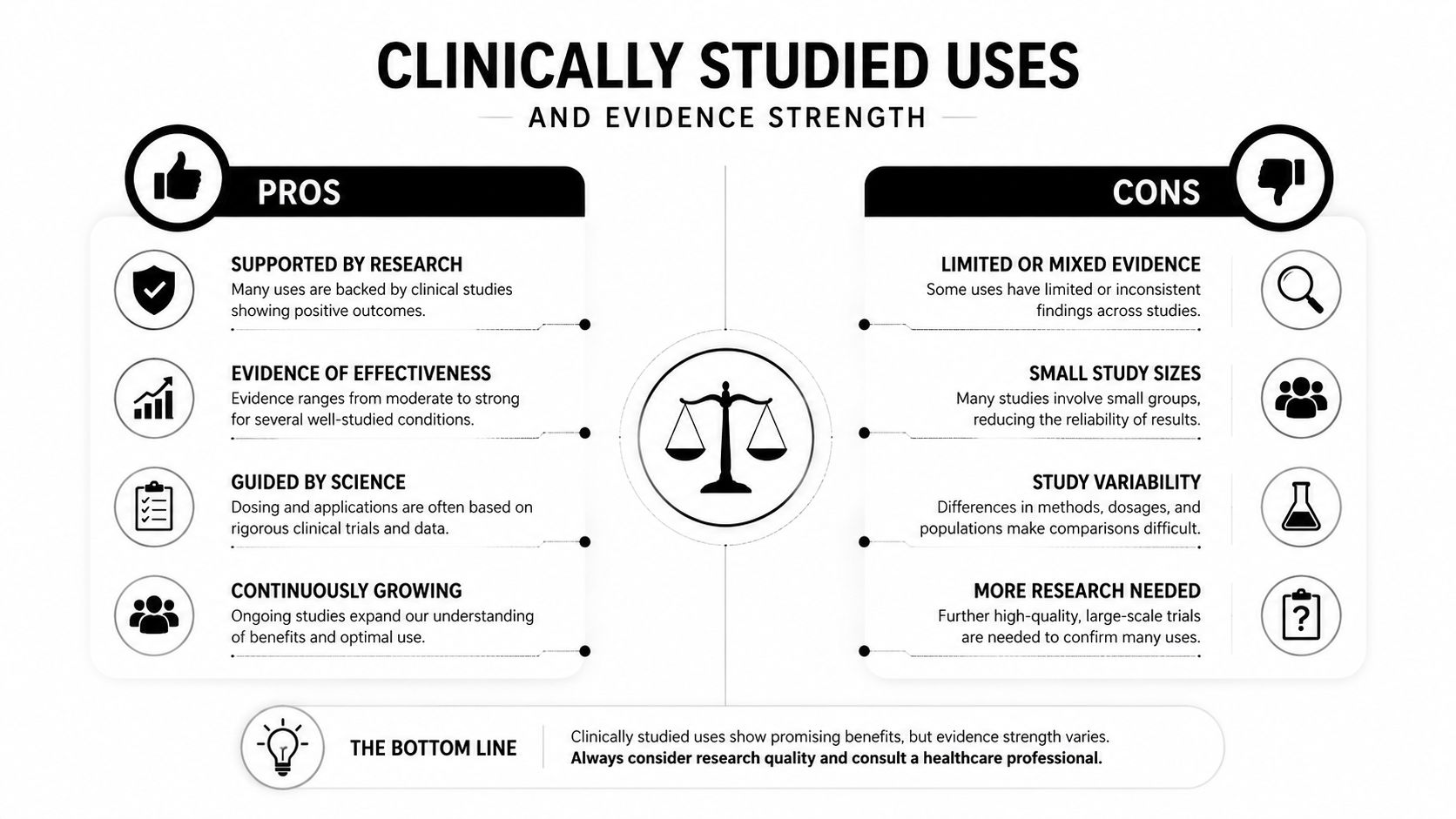
A good way to read NAC's evidence is to separate the uses that have clear medical footing from the ones that are still more promise than proof. The strongest case is still the one that put NAC on the map, acetaminophen overdose treatment Texas Health and Human Services NAC monograph. Its mucolytic use in respiratory care also has a long clinical history, which is why NAC is often described as a compound with a real hospital record rather than a trendy wellness ingredient. In everyday terms, NAC has already been tested in the settings where doctors need reliable results, not just a plausible story.
Outside those classic uses, the picture gets less tidy. NAC is marketed for antioxidant support, mood, brain fog, sleep, and recovery, but the evidence behind those claims is uneven WebMD NAC overview. That matters because a supplement can have a sensible chemical role and still fall short in actual human outcomes. Glutathione support, for example, sounds tidy on paper, but the step from “this may help the body make more of a useful molecule” to “people feel better in daily life” is where a lot of supplement claims get shaky.
Exercise recovery shows that gap clearly. Fitness posts often treat NAC like a shortcut for bouncing back after training, yet the clinical record does not support that kind of confidence. A 2017 meta-analysis found no evidence of performance benefits in exercise settings, which is a useful correction for anyone expecting a workout boost WebMD NAC overview. That does not make NAC irrelevant for active people, it just means the recovery story is weaker than the marketing usually suggests.
Brain fog and sleep are similar. They are common reasons shoppers reach for NAC, but the available evidence is still mixed rather than settled WebMD NAC overview. That is partly why these uses can feel confusing. If a compound helps a biochemical pathway, people naturally assume it will help the symptom attached to that pathway, yet real-world response does not always follow that neat logic. A person looking for sharper mornings or better sleep may be reading a mechanistic theory, not a proven outcome.
Mental health is another area where the interest is real and the conclusions are still cautious. NAC continues to be studied for depression, schizophrenia, and substance use disorders, but ongoing research is different from established everyday use WebMD NAC overview. That is the point many supplement descriptions skip. A compound can be scientifically interesting, widely discussed, and still not have strong enough evidence to support broad consumer expectations.
For shoppers trying to sort signal from noise, the best summary is straightforward. NAC has credible medical uses, reasonable biological plausibility for broader applications, and mixed evidence for many of the outcomes people care about in daily life. That includes brain fog, sleep, stress resilience, and recovery. If you want a comparison point for how another supplement gets framed around evidence and practical use, a separate look at berberine coverage on River of Life's journal shows the same pattern. Chemistry gets attention first, clinical proof comes later, and the gap between the two is where consumers need to be careful.
Typical Dosages and Safety Profile
The clearest dose information for NAC comes from clinical and reference material, not influencer-style advice. A clinical review notes that oral trial doses have ranged from 600 mg to 3,000 mg per day, usually split into two or three doses Texas Health and Human Services NAC monograph. That split matters because NAC is often handled better when the day's amount isn't shoved into one giant serving.
A smaller, real-world lens helps too. WebMD notes that common studied doses are typically 600 mg to 1,800 mg/day, with some studies using up to 3,000 mg/day WebMD NAC overview. The best starting point for a consumer is not “the highest dose on the internet.” It's the lowest reasonable dose that matches the goal and the label directions, then a doctor's input if the situation is complex.
Here's the most important thing to keep in mind. NAC is also an FDA-approved drug for acetaminophen toxicity treatment Texas Health and Human Services NAC monograph. That doesn't make every supplement bottle a medication, but it does mean you shouldn't treat NAC like a casual flavor booster. It has real pharmacology.
NAC Dosage and Safety at a Glance | ||
|---|---|---|
Use Case | Typical Daily Dose | Key Safety Notes |
Acetaminophen toxicity treatment | Clinician-directed | Drug use, not self-directed supplement use |
General oral supplement use | 600 mg to 3,000 mg/day, divided | Lower starts are common, divide doses when appropriate |
Studied everyday use ranges | 600 mg to 1,800 mg/day | Some studies use higher amounts, medical guidance matters |
Higher-dose trial settings | Up to 3,000 mg/day | Monitor tolerance closely |
NAC can cause nausea and a noticeable sulfur-like odor, which is one reason some people stop before they ever reach a meaningful trial period. Drug interactions matter too. If you use nitroglycerin, or if your clinician has told you to avoid certain combinations, NAC needs a real conversation rather than a guess. The same is true if you're already managing another supplement routine and want to check for overlap, especially with formulas that affect stress, sleep, or blood pressure. A separate guide on ashwagandha interactions is useful for comparison, because many shoppers stack products without checking how they fit together.
Never exceed the labeled dose without medical advice, especially if you take prescription medicine or have liver, lung, or cardiovascular concerns.
The safest consumer habit is boring but effective. Read the label, divide doses if the product calls for it, and ask a pharmacist or clinician before starting if your medication list is already full.
NAC Compared With Glutathione and Others
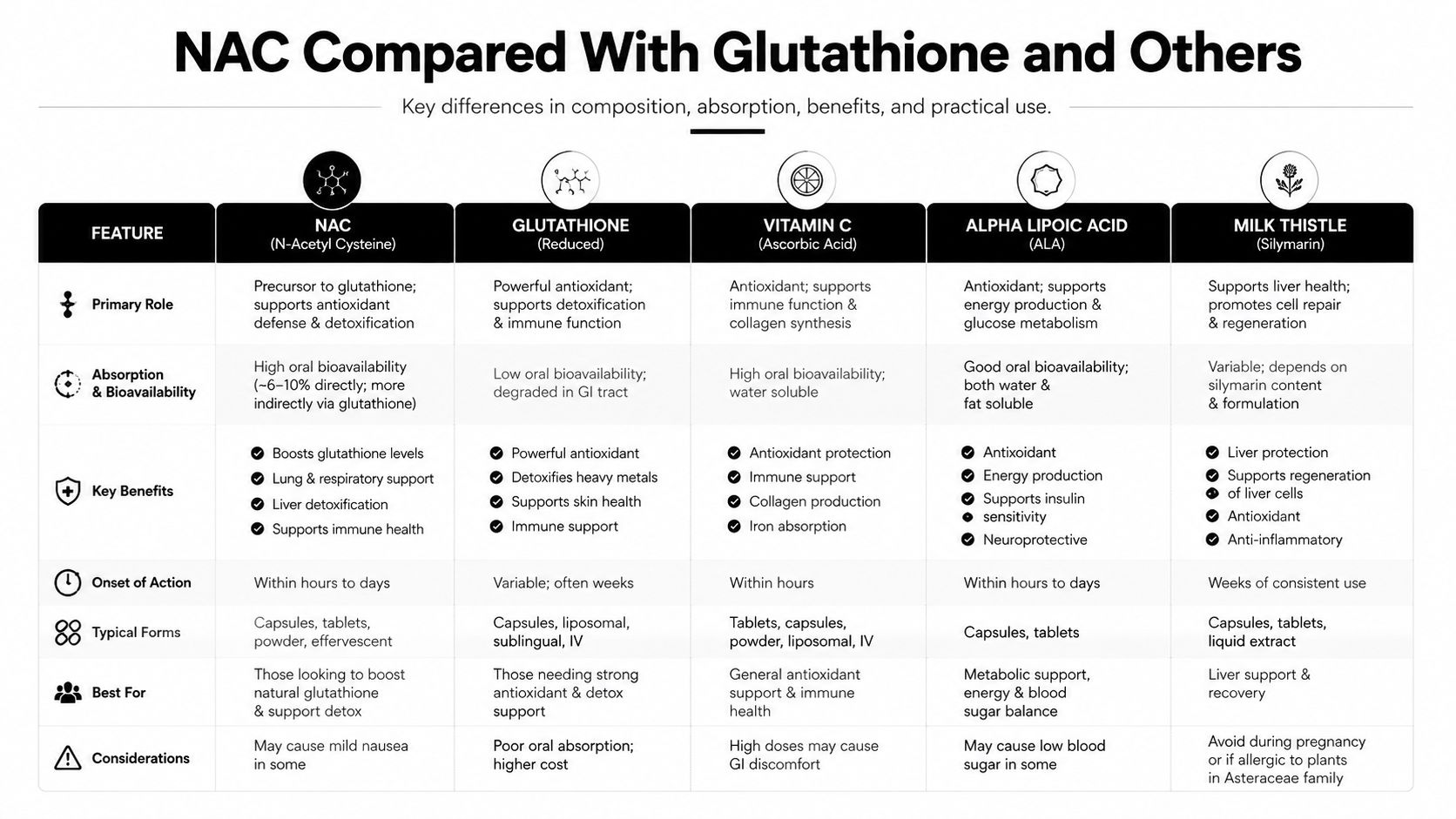
People often ask whether they should just take glutathione instead of NAC. The short answer is that they serve different roles. NAC is a precursor, so it supplies the raw material your body can use to make glutathione. Glutathione is the antioxidant your body already uses directly. NAC works more like the ingredient list and prep work before dinner, while glutathione is the meal itself on the table.
That difference matters for practical shopping choices. NAC is usually the more familiar supplement option because it has a long clinical history and a clearer dose framework. Glutathione products can sound more direct, but direct does not always mean better for a specific goal. For many shoppers, the better question is which ingredient fits what they are trying to support, not which label sounds more advanced.
The broader market also shows NAC's move from niche ingredient to mainstream category. One market analysis estimated the global N-acetyl-L-cysteine supplements market at USD 667.3 million in 2024, with a projection to about USD 1.07 billion by 2030 Market.us NAC supplement market. That does not prove effectiveness on its own, but it does show consumer demand is no longer tiny or experimental.
For shoppers comparing NAC with other popular options, the decision often comes down to the goal. Vitamin C is a more familiar antioxidant choice. Alpha lipoic acid is often marketed around metabolic or antioxidant themes. Milk thistle is usually tied to liver-focused discussions. NAC sits in the middle, with a stronger medical backstory than many of these ingredients and a very specific role in the glutathione pathway. If you have ever bought a supplement stack that repeated the same promise three times, the smarter move is to compare ingredients instead of just reading the front of the bottle.
Real-world use cases can differ in the same way. One person may be looking at brain fog, another at sleep quality, and another at recovery after training, but the ingredient choice still depends on what the supplement is meant to do. For a side-by-side example of how one ingredient can be framed differently from another, this tart cherry guide shows how the same broad category can serve a very different purpose. NAC follows that same pattern, just with more medical baggage attached.
Regulatory Status and Consumer Guidance
NAC is where supplement shopping gets legally awkward. The FDA has explicitly said it was seeking information on NAC's earliest marketing as a supplement, its safe use, and safety concerns FDA request for information on NAC in dietary supplements. At the same time, WebMD notes the FDA's position that NAC use in supplements is illegal because NAC is an approved drug WebMD NAC overview. That's the core of the ambiguity. Consumers see the product for sale, but the legal logic behind that sale isn't simple.
In Europe, the picture is different again. The Netherlands' RIVM risk assessment recommends an adult maximum of 1,200 mg/day and notes that supplement exposures commonly range from 500 to 2,000 mg/day [RIVM risk assessment summary in the verified brief]. That doesn't give you a universal European rule, because regulation can vary by country, but it does show that some regulators are actively thinking in dose-cap terms rather than just asking whether NAC exists on the shelf.
The practical takeaway is jurisdiction-first shopping. Before you buy, check whether NAC is allowed where you live, whether the product is being sold as a dietary supplement or in another regulatory category, and whether the claimed dose fits local norms. If a product is imported, that check matters even more. Cross-border shopping can turn a casual purchase into a compliance headache fast.
A smart buying checklist keeps the decision grounded:
Verify local legality: Confirm whether NAC can be sold as a dietary supplement in your country.
Check the serving size: Compare the label against the dose range the product is claiming.
Prefer clear labeling: Look for ingredient amounts, form, and serving instructions that make sense.
Review your medications: If you take nitroglycerin or other prescription drugs, ask a clinician first.
Avoid guesswork with stacks: If NAC is one part of a larger routine, make sure the pieces don't overlap in ways you don't want.
The confusing part isn't just the law, it's trust. A product can be widely available and still sit in a gray zone. That's why the best consumer move is not panic. It's verification.
Summary and Frequently Asked Questions
NAC is best understood as a medically grounded compound that later found a place in the supplement market. It has a real chemical identity, a long clinical history, and a dose range that has been studied more carefully than most wellness ingredients Texas Health and Human Services NAC monograph. It also has real limits. The uses people talk about most, especially brain fog, sleep, and recovery, are not all supported equally, and some claims run ahead of the data WebMD NAC overview.
Can NAC be combined with other supplements?
Sometimes, but stacking should be deliberate, not automatic. NAC is often discussed alongside antioxidants and stress-support ingredients, yet overlap can happen fast if you're already taking multi-ingredient products. If another formula already covers the same general goal, adding NAC may not give you a cleaner result, just a more crowded cabinet.
How long can someone take NAC?
There isn't a one-size-fits-all answer in the verified data, and that's part of the point. NAC has long clinical use, but consumer use should still be matched to the product label and your own medical context. If you're using it for a specific reason, a clinician can help decide whether it belongs in a short trial, a longer routine, or not at all.
What are the main signs NAC isn't agreeing with you?
The most common practical issues are digestive discomfort and the sulfur-like smell people notice right away. If you feel off after starting, don't assume you need to “push through” it. Stop, read the label again, and check with a pharmacist or doctor if you're unsure whether the reaction is expected or a reason to quit.
Is NAC a good choice for brain fog, sleep, or recovery?
It depends on what you mean by “good.” NAC has plausible biology, but the evidence for everyday wellness goals is mixed, and the exercise data are not the same thing as a proven recovery benefit WebMD NAC overview. For sleep and focus, the honest answer is that NAC is still more of a candidate than a guaranteed fix.
Bottom line: NAC is not a miracle capsule, and it isn't just another trend ingredient. It's a well-studied compound with specific medical roots, a real dose history, and a regulatory story you should check before buying.
If you want supplements explained in plain English, with the legal and practical details stripped of hype, visit River of Life for more educational guides and product information that make ingredient choices easier to evaluate.