
Herbal Supplement for Stress: A Complete 2026 Guide

Your shoulders are tight. Your mind is running through tomorrow's list before today is even over. Maybe your sleep has gotten lighter, your patience shorter, and your body feels achy in ways that make everything seem harder than it should.
That's often where people start looking for a herbal supplement for stress. Not because they want a miracle. Because they want something practical that helps them feel steadier, clearer, and less stuck in that wired-but-tired state.
The mistake many guides make is treating stress like a purely mental problem. In practice, it rarely is. Stress can show up as poor sleep, tension, mental fog, irritability, and a body that feels inflamed or sore. When joint discomfort, stiffness, or general inflammation are part of the picture, stress often feels louder. The reverse is true too. A stressed body can feel more physically reactive.
That's why the most useful herbal strategies aren't always about picking a single calming herb and hoping for the best. Often, the better approach is broader. Support the stress response itself, and also lower the physical burden that keeps feeding it.
Table of Contents
Feeling Stressed and Overwhelmed You Are Not Alone
Stress today often looks ordinary from the outside. You get through work. You answer messages. You handle family, chores, errands, and appointments. But underneath that normal routine, your system may be running hot all day.
A lot of people describe the same cluster of symptoms. They feel tired but can't settle. They wake up unrefreshed. Their focus slips. Small problems hit harder than they used to. They may even notice their body hurts more when life gets busy.
That last part matters. Stress isn't just “in your head.” Your brain, hormones, sleep, muscles, and immune system all get involved. When those systems stay activated too long, the result can feel like anxiety, exhaustion, irritability, body tension, and low resilience all at once.
Stress often feels emotional first, but the body usually keeps score alongside the mind.
That's why herbal support can be useful when it's chosen well. The right herbs don't just knock you out or mask symptoms for a few hours. Some work more like regulators. They help the body respond to pressure with less overreaction and less fallout.
For many adults, especially those also dealing with stiffness, joint discomfort, or general inflammation, the best question isn't just “What herb calms nerves?” It's “What combination helps my whole system stop acting like it's under attack?”
A grounded herbal plan can help with that. It can support steadier stress hormone patterns, calmer evenings, clearer thinking, and in some cases better sleep quality. But it also comes with trade-offs. Some herbs are better for daytime resilience. Some are more useful when sleep is part of the problem. Some formulas look impressive on the label and still aren't built well enough to do much.
The goal is not to collect trendy ingredients. It's to choose the ones that fit the kind of stress you're living with.
How Herbal Supplements Actually Work Against Stress
Stress is a body process, not just a mood
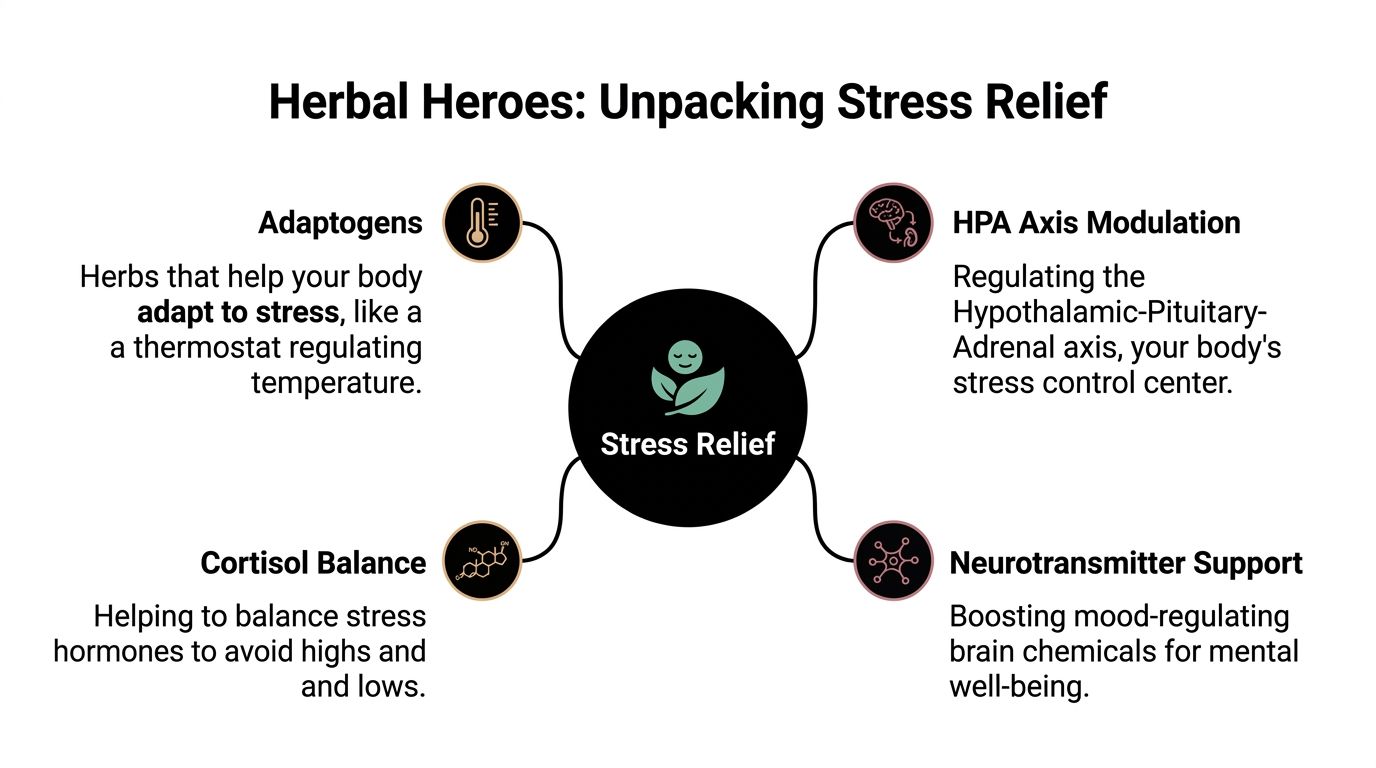
When people hear “stress,” they often think of emotions first. Biology gets there faster. Your body reads pressure, uncertainty, pain, poor sleep, and overload as signals to activate its stress-response network. One major part of that network is the HPA axis, which stands for the hypothalamic-pituitary-adrenal axis.
You don't need to memorize the term. Think of it as your internal stress command chain. When it senses challenge, it helps direct the release of stress hormones like cortisol. In the short term, that response is useful. It helps you react, stay alert, and push through.
The problem starts when the signal doesn't switch off cleanly. Then the system can stay too “on.” You feel tired and wired. Sleep gets lighter. Your mood gets less flexible. Recovery gets worse.
That's where adaptogens come in. I often explain them like a thermostat for stress. A thermostat doesn't eliminate heat or cold. It helps keep the environment from swinging too far in one direction. Adaptogens work in a similar way. They don't erase life's demands, but they may help the body respond with better balance.
Why some herbs feel steady instead of sedating
Not every herb for stress works the same way. Some are calming in a direct, noticeable sense. Others are subtler. Ashwagandha is the clearest evidence-backed example in this category. According to the NIH Office of Dietary Supplements fact sheet on ashwagandha, ashwagandha root extract standardized to 5% withanolides at 300 to 600 mg daily has been provisionally recommended by an international taskforce for generalized anxiety disorder, with the mechanism tied to adaptogenic modulation of the HPA axis and better outcomes seen at the higher end of that range.
That matters because it gives you a more useful frame than “this herb is calming.” It suggests that some herbs help by changing how the body handles stress signals in the first place.
For readers who want a deeper primer on that adaptogenic model, this guide on adaptogens for anxiety is a helpful companion.
From a practical standpoint:
Fast-feeling herbs may be better when the main problem is evening tension or difficulty winding down.
Adaptogenic herbs are often better when stress feels chronic, your recovery is poor, or you're stuck in a pattern of overactivation.
Combination formulas can make sense when stress overlaps with pain, inflammation, or sleep disruption.
Practical rule: Match the herb to the pattern. A bedtime herb won't fix an all-day stress response by itself, and a daytime adaptogen may not be enough if your real issue is that you can't settle at night.
The Top 5 Evidence-Backed Herbs for Stress Relief
What stands out about each herb
If you search for a herbal supplement for stress, you'll see the same names repeated over and over. That doesn't mean they're interchangeable. Each herb has a different personality, and the best choice depends on whether you need better daytime resilience, less evening tension, or support for sleep.
1. Ashwagandha
Ashwagandha is the anchor herb in many serious stress formulas, and for good reason. It's an adaptogen, so its role is less about sedation and more about helping the body regulate its stress response.
A review summarized in Nutritional Outlook's discussion of stress-relief herbs and botanicals notes that ashwagandha root has been clinically proven to reduce stress biomarkers by attenuating the increase of glucocorticoids such as cortisol and corticosterone. The same source describes a randomized, placebo-controlled, double-blind study in which participants taking ashwagandha had a measurable reduction in stress compared with placebo. It also reports that, in a study involving college students over 30 days, a moderate dose was linked to a significant increase in perceived mental clarity, energy levels, and a “sense of calm,” with participants noticing a shift toward better sleep starting around day nine. That source also lists dosage recommendations ranging from 500 mg to 1,500 mg divided into three to four doses.
Ashwagandha is the herb I'd think about first when stress feels systemic. Not just nerves. The whole picture. Mental strain, poor recovery, light sleep, and a body that seems to stay braced.
2. Rhodiola rosea
Rhodiola is often a better fit when stress shows up as fatigue, low drive, or mental drag. It's usually thought of as a daytime herb. People who feel flattened by constant pressure may prefer it to heavier calming herbs.
The trade-off is that rhodiola isn't always ideal for someone who already feels overstimulated or has trouble settling in the evening. In practice, it tends to suit the person who says, “Stress has worn me out,” more than the person who says, “My mind won't stop.”
3. Valerian root
Valerian sits on the other end of the spectrum. It's used more for relaxation and sleep support than for all-day resilience. If your main complaint is bedtime tension or lying awake with a buzzing mind, valerian may be more relevant than a classic adaptogen.
The downside is obvious. It can be too heavy for daytime use, and some people don't like how it makes them feel. This is not usually the herb for productivity, composure under pressure, or mental clarity at work.
If you need to function sharply all day, don't assume the strongest calming herb is the smartest choice.
4. Chamomile
Chamomile is gentle and familiar, which is part of its appeal. It makes sense for people who want a milder option and don't need a strong adaptogenic effect. Tea is the classic form, but extracts and capsules are also common.
Chamomile is rarely the whole answer for chronic stress. It's more of a softening herb. Useful around the edges. Helpful for evening rituals, digestive tension, and taking the sharpness off a stressful day.
5. Lavender
Lavender is often overlooked because people think of it only as a scent. But it can fit into a broader calming strategy, especially for tension that feels both mental and physical. Some people prefer it as part of an evening routine. Others like it because it feels calming without the heaviness they get from sedative herbs.
Lavender's limitation is that it may not be strong enough on its own when the core issue is ongoing stress physiology rather than situational tension.
At-a-glance comparison of top stress-relief herbs
Herb | Primary Use | Key Benefit | Common Form |
|---|---|---|---|
Ashwagandha | Chronic stress support | Helps regulate the stress response and supports calm, clarity, and sleep quality | Standardized extract capsules, powder |
Rhodiola rosea | Stress with fatigue | Often chosen for energy, stamina, and mental endurance | Capsules, tincture |
Valerian root | Nighttime tension | More useful for relaxation and sleep support | Capsules, tea, tincture |
Chamomile | Mild stress and evening settling | Gentle calming support | Tea, capsules, extract |
Lavender | Tension and mood softening | Can help create a calmer mental state | Softgels, tea, aromatherapy |
A few practical distinctions matter more than “top five” lists usually admit:
Best all-around evidence fit: Ashwagandha is the most convincing option here when you want a clinically grounded herb for stress itself, not just a sleepy feeling at night.
Best for tired-stressed people: Rhodiola often suits depleted, overworked people better than those who already feel revved up.
Best for bedtime only: Valerian is more of a sleep companion than an all-day stress herb.
Best gentle option: Chamomile is approachable and easy to layer into daily life.
Best sensory support: Lavender works well when ritual and nervous-system settling matter.
Choosing among them comes down to one question. Do you need your system to adapt better, or do you need it to slow down right now? Those are not the same job, and the herb should match the job.
The Hidden Link Between Physical Inflammation and Mental Stress
Pain can keep the stress response switched on
One of the biggest blind spots in stress advice is the body. Many people don't just feel mentally overloaded. They also feel physically aggravated. Their joints ache, their muscles stay tense, or they carry a low-grade soreness that never quite resolves.
That matters because the body doesn't separate those experiences as neatly as wellness articles do. Ongoing physical discomfort can keep the stress response active. When the system keeps reading irritation, pain, or inflammation, it becomes harder to feel calm, sleep soundly, or recover fully.
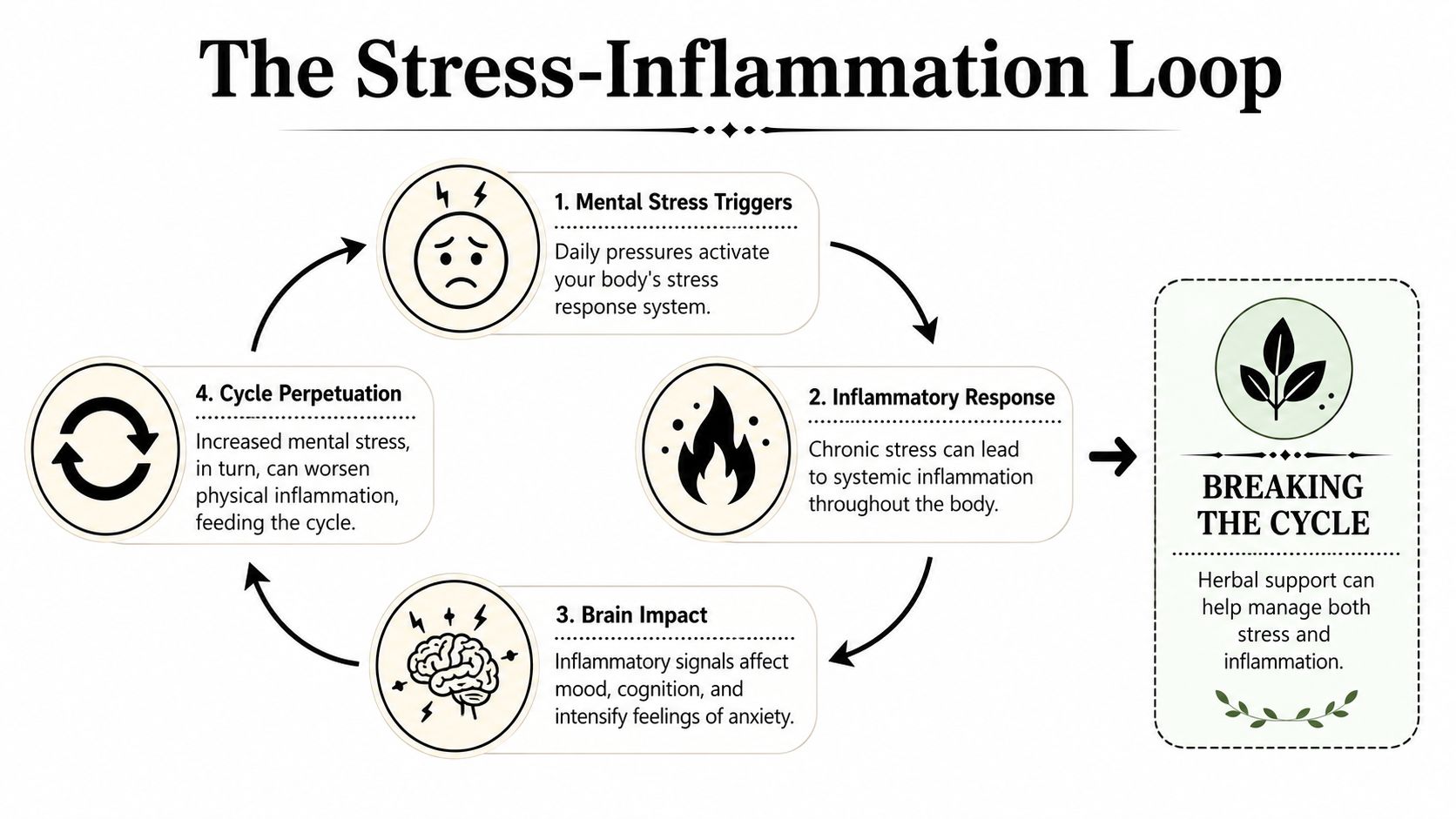
This is why the question “Can lowering physical pain naturally reduce my anxiety?” is more important than it looks. According to Dr. Brighten's discussion of anxiety and supplements, a critical underserved angle is the synergistic interaction between anti-inflammatory botanicals like turmeric and ginger and adaptogens like ashwagandha for stress management. That source notes that systemic inflammation drives cortisol elevation and that inflammation biomarkers correlate with stress symptoms, which helps explain why reducing physical pain may indirectly improve stress resilience by supporting the HPA axis.
If your stress rises on the same days your body hurts more, that isn't random. It fits the pattern.
Why pairing turmeric and ashwagandha makes sense
Single-ingredient thinking can fall short. Specifically, if you only choose a calming herb, but your body is still broadcasting pain and inflammation signals all day, you may feel like the supplement “doesn't work” well enough. In reality, it may be addressing only half the problem.
A smarter strategy for some people is a layered one:
Adaptogen support: Ashwagandha helps regulate the stress-response side of the equation.
Anti-inflammatory support: Turmeric and ginger are often used when joint discomfort, stiffness, or physical wear-and-tear are part of the picture.
Combined logic: Lower the physical aggravation while supporting stress resilience, so the system has fewer reasons to stay activated.
For readers focused on that physical side, this overview of natural anti-inflammatory supplements including turmeric adds useful context.
A stressed mind can tighten the body. A painful body can keep the mind on alert. In real life, many people are dealing with both at once.
That's why combination formulas can be reasonable, provided the ingredients are there in meaningful forms and the label is transparent. One example is River of Life Capsules, which combine turmeric extract with BioPerine black pepper, alongside ashwagandha root, ginger, and bromelain. That kind of formula is relevant for adults who don't want separate products for stress support and joint-focused support.
The bigger point isn't any one brand. It's the model. If stress and inflammation keep feeding each other in your body, you'll often do better with a plan that acknowledges both.
How to Choose a High-Quality Herbal Supplement
A stressed person standing in the supplement aisle usually sees the same promises repeated over and over. Calm. Balance. Relax. What matters is not the front-of-bottle language. What matters is whether the label tells you enough to judge what is in the bottle, how much of it you are getting, and why those ingredients were paired together.

Read the front label, then the supplement facts
The front label is marketing. The supplement facts panel is where the useful information lives.
With stress products, the first question is simple. Does the company identify the herb clearly enough for you to compare it with clinical use? For ashwagandha, that means the label should tell you whether it is a root extract, how much is in each serving, and whether it is standardized. A label that says only “ashwagandha blend” leaves too much unanswered.
That same standard applies across the formula. If turmeric is included because stress and body aches often travel together, the form matters. Plain turmeric powder and a concentrated turmeric extract are not interchangeable in practice. If black pepper extract is added to support absorption, the label should say so plainly.
Good formulas are specific, not vague
Use this checklist when you compare products:
Name the plant part: Root, leaf, or rhizome can matter, depending on the herb.
State the form clearly: Powder, extract, tincture, and tea do not perform the same way.
Show standardization when relevant: This helps you judge consistency from one bottle to the next.
Avoid hidden dosing: Proprietary blends make it hard to tell whether each ingredient is present in a meaningful amount.
Check whether the formula has a job: A stress blend with ashwagandha for resilience and turmeric or ginger for inflammation can make sense. A long ingredient list with no clear rationale usually does not.
I tell clients to read a label the way they would read a recipe. If the ingredients are vague, the amounts are hidden, and the logic is hard to follow, it is harder to trust the result.
The best label answers practical questions before you have to ask them.
Website clues matter too
A good product page should confirm what the bottle suggests. Look for plain information on:
Testing: Does the company mention third-party testing, identity testing, or contaminant screening?
Manufacturing: Is there any indication of quality control standards?
Directions: Are the serving instructions clear?
Ingredient purpose: Does the company explain why each herb is there?
This matters even more with combination products. A single-herb capsule is usually easier to evaluate and easier to troubleshoot if it does not agree with you. A multi-ingredient formula can be more practical if your stress comes with poor sleep, muscle tension, or joint discomfort. That is a real trade-off. Convenience goes up, but it becomes harder to tell which ingredient is helping, or causing side effects.
This short video gives a useful visual refresher on what to notice when you're evaluating supplements.
One more point is often missed. If your stress rises alongside stiffness, soreness, or low-grade inflammatory discomfort, a formula that combines an adaptogen such as ashwagandha with anti-inflammatory support such as turmeric may fit the problem better than a product aimed at mood alone. The body and mind rarely stay in separate lanes. A well-built formula respects that connection, and the label should make that strategy easy to see.
Personalizing Your Herbal Strategy for Your Lifestyle
The right herbal supplement for stress depends as much on your daily pattern as on the herb itself. “Stress” is a broad word. A desk worker with brain fog, a recreational athlete dealing with soreness, and an older adult with restless sleep may all use that word, but they aren't asking the same thing of a supplement.
If your stress feels like mental overdrive
This is the person who says, “My body is tired, but my mind keeps running.” Work pressure, notifications, multitasking, and poor boundaries tend to create a wound-up pattern.
For that person, a daytime adaptogenic approach often makes more sense than a heavy calming herb. You want support that helps your system stay more even without making you dull. A sedating herb may help at night, but it won't necessarily improve how resilient you feel at noon on a hard day.
A useful routine here usually includes:
Morning consistency: Take the herb at the same time each day instead of using it only when stress spikes.
Low-stimulation evenings: Don't expect a supplement to overpower late caffeine, screens, and a chaotic bedtime.
Clear expectations: Adaptogenic herbs are often felt as steadier coping, not a dramatic knockout effect.
If your stress is tied to aches, recovery, or aging joints
The inflammation-stress connection gains practical significance. If your body hurts, your patience usually shrinks with it. People in this group often tell me they aren't just stressed by life. They're stressed by how their body feels inside life.
That changes the strategy. A formula that combines stress-supportive herbs with anti-inflammatory botanicals may be more relevant than a narrow “calm” product.
This group includes:
Active adults: Exercise is healthy, but soreness and recovery load can still raise overall stress.
Older adults: Mobility limits can create frustration, poor sleep, and a feeling of losing ease in daily life.
People with chronic stiffness: If getting comfortable is hard, relaxing fully is hard too.
If sleep is the weak link
Some people don't need much daytime support. They need nights that restore them. If stress mainly shows up as difficulty winding down, lying awake, or waking too early and never dropping back into deep rest, your herb choice should reflect that.
In these cases, it helps to separate two jobs:
All-day stress regulation
Evening nervous-system settling
Those jobs can overlap, but they aren't identical. Chamomile, valerian, and lavender tend to fit the second job better. Adaptogens fit the first one better.
If your sleep is broken, don't judge a formula only by whether it makes you sleepy. Judge it by whether you wake up less frayed over time.
The best personalization is often boring in the best way. Match the formula to the pattern. Use it consistently. Keep your routine stable enough that you can tell what's helping. Most supplement frustration comes from mismatch, not from herbs being useless.
Frequently Asked Questions About Herbal Stress Supplements
How long do herbal stress supplements take to work
A person might take an herb for three days, feel nothing dramatic, and assume it is not helping. That is often the wrong test.
Timing depends on the herb and on what you want it to do. Calming herbs used for winding down can feel noticeable the same day. Adaptogens such as ashwagandha usually work more like a thermostat than a sedative. They help regulate the stress response over time, so the change is usually gradual.
A systematic review of adaptogenic plants published in ScienceDirect reported that Withania somnifera clinically relevantly decreases perceived stress scores after 56 to 60 days of continuous treatment. In practice, that means judging an adaptogen over weeks, not over one hard afternoon.
Can you combine more than one herb
Yes, if the formula has a clear job.
A useful combination often covers more than one layer of stress. For example, an adaptogen for daytime stress resilience can pair well with a gentler evening herb for sleep support. Another smart pairing is stress support plus anti-inflammatory herbs when stress is tied to physical discomfort. I see this pattern often in people with joint pain, post-exercise soreness, or chronic stiffness. If the body stays irritated, the nervous system rarely settles fully.
That is where combinations like ashwagandha and turmeric can make sense. Ashwagandha supports stress regulation. Turmeric helps address inflammatory load that may be feeding the stress loop from the body side. The goal is not to pile on relaxing ingredients. The goal is to match the blend to the pattern.
Start carefully with any multi-ingredient product. More herbs can mean broader support, but they can also mean more overlap, more sedation, or a harder time figuring out what is helping.
What side effects or interactions should you watch for
Natural does not mean risk-free. Herbs can interact with medications, health conditions, and other supplements.
This matters most for people who take prescription drugs, are pregnant or breastfeeding, have a thyroid or autoimmune condition, or are preparing for surgery. Ashwagandha deserves extra care here. Read this guide to ashwagandha interactions and medication concerns before adding it to your routine.
A few habits lower the chance of problems:
Start one new product at a time: You can tell what is helping and what is not.
Follow the label dose: Taking more rarely speeds up the benefit and may raise side effects.
Watch for body feedback: Digestive upset, unusual drowsiness, headaches, or feeling wired are all reasons to reconsider the product.
Ask a pharmacist or clinician if your case is complicated: That step matters if you use medications, have several diagnoses, or are combining multiple supplements.
Herbs deserve the same respect as any other tool that can change sleep, mood, pain, or energy.
If you want a simpler way to support stress resilience while also addressing the physical side of the stress-inflammation loop, River of Life offers a multi-ingredient capsule built around turmeric extract, ashwagandha root, ginger, bromelain, and BioPerine. It is a practical option for adults who prefer one well-structured formula over several separate products.