

Best Vegan Joint Supplement: 2026 Buyer's Guide

You're probably here because your joints have started talking back. Maybe it's your knees after a walk, your hands in the morning, or that stiff first minute when you stand up after sitting too long. You want something vegan. You want something clean. And you don't want to waste money on a bottle filled with trendy ingredients that look good on the front label and do very little once they hit your stomach.
That's the core issue with finding the best vegan joint supplement. It's not just about spotting plant-based ingredients. It's about finding a formula your body can use. A weak ingredient in a shiny bottle is still a weak ingredient. A strong ingredient with poor absorption can be almost as disappointing.
The labels that matter most aren't the ones screaming “joint support” on the front. They're the ones that tell you the form, the dose, the supporting compounds, and whether the formula was built with any logic at all.
Table of Contents
Why Most Joint Supplements Are Not Vegan-Friendly
Walk down any supplement aisle and most joint formulas follow the same old script. Glucosamine. Chondroitin. Collagen. The problem is that these are often sourced from shellfish, cartilage, fish, or animal tissue. A lot of people assume they can just swap in a vegan version and get the same outcome. That's where things get murky.

The hidden animal ingredients most people miss
Some labels make it obvious. Others don't. You'll often see a plant-forward front panel, then find non-vegan materials buried in the details.
Here's where people get caught:
Glucosamine: Commonly sourced from shellfish.
Chondroitin: Often derived from animal cartilage.
Collagen: Traditionally sourced from animal hides, bones, or marine tissue.
Capsules and excipients: Even when active ingredients are vegan, the capsule shell or processing aids may not be.
That's why “plant-based” and “vegan-friendly” aren't always the same thing. You have to read the full label, not just the headline.
A vegan swap is not always an evidence-based swap
This is the part most brands skip. They know consumers want a plant-based replacement for familiar joint ingredients. But familiarity isn't proof.
A review in the NIH article on vegan glucosamine and osteoarthritis evidence states that there is currently insufficient clinical data to support the use of vegan glucosamine specifically for osteoarthritis patients, due to the absence of direct clinical trials in OA populations, shortcomings in bioequivalence studies, and a lack of complete safety and toxicity data for the plant-derived form.
Bottom line: Vegan glucosamine may sound like the perfect replacement, but the direct evidence for osteoarthritis support isn't there yet.
That doesn't mean every vegan joint product is weak. It means you shouldn't assume that “vegan version of a famous ingredient” automatically equals “best option.”
What to avoid when shopping
A better filter is simple. Skip formulas built around legacy animal ingredients that were awkwardly converted into plant-based marketing stories. Instead, look for compounds with a stronger plant-based case on their own terms.
A few red flags:
Old-school formulas in vegan clothing: Same ingredient story, new label, thin support.
Mystery blends: If the brand hides exact ingredient amounts, you can't judge whether the formula is serious.
Collagen confusion: Vegan products don't contain actual collagen. If you want clarity on how traditional collagen differs, this explainer on undenatured type II collagen helps show why source matters.
The smartest buyer doesn't ask, “Is this the vegan version of what everyone already knows?” They ask, “What plant-based ingredients have a valid reason to be here?”
The Best Plant-Powered Ingredients for Joint Health
You pick up a vegan joint supplement and the front label looks strong. Turmeric. Ginger. Collagen support. Then you turn the bottle around and realize the formula is a mixed bag. One useful ingredient. Two token add-ons. No clear logic. That is why the best plant-based formulas are not defined by a long ingredient list. They are defined by how well the ingredients work together.

Curcumin deserves the front seat
If I am reviewing a vegan joint supplement, curcumin is usually the first ingredient I assess. It is the main active compound in turmeric, and it has a clear job. It helps reduce inflammatory activity that often drives joint pain and stiffness.
The Arthritis Foundation review of curcumin for arthritis support summarizes human research showing curcumin can support pain relief in knee osteoarthritis, with less stomach irritation than some common pain medicines. The same review also notes curcumin's chondroprotective potential and its effect on inflammatory markers.
That combination matters. Pain support is useful. Support for the joint environment matters too.
A strong formula usually treats curcumin as the anchor, not decoration.
Ginger and bromelain earn their place when the doses are serious
I like seeing ginger extract next to curcumin because the pairing is practical. Ginger has a long track record for comfort support, especially in people dealing with soreness, stiffness, or post-exercise flare-ups.
Bromelain can also make sense. It is a pineapple-derived enzyme often used in recovery formulas aimed at swelling and soft-tissue irritation. It is not a replacement for curcumin. It is a supporting player.
That distinction helps when you read labels. A formula with curcumin, ginger, and bromelain can be smarter than a formula with six random botanicals, but only if each ingredient has enough room to do its job.
Vegan collagen builders can help, but the label needs scrutiny
This category gets marketed poorly. Vegan collagen builders do not contain collagen. They provide nutrients your body uses to make collagen on its own.
That usually means a mix of amino acids or protein building blocks plus cofactors such as vitamin C, zinc, and copper. Some brands also add botanicals such as gotu kola. The idea is reasonable. Connective tissue support depends on raw materials, not branding.
The trade-off is simple. These formulas are less direct than animal collagen, so the quality of the full stack matters more. If a product uses the phrase “vegan collagen” but skimps on protein building blocks or leaves out key cofactors, it is selling a concept more than a formula. For a useful overview of the effectiveness of vegan collagen for joints, the Cleveland Clinic's explanation of collagen builders and collagen-support nutrients is a better reference point than marketing copy.
Boswellia is another ingredient worth recognizing
One plant ingredient that deserves more attention is boswellia serrata. It shows up less often than turmeric, but I view it as a serious option for joint formulas focused on comfort and mobility. It is especially useful in products built for people with daily stiffness rather than occasional post-workout soreness.
Boswellia is also a good example of why ingredient combinations matter. Curcumin, boswellia, and ginger can complement each other because they target overlapping parts of the inflammation process from different angles. That is a smarter design than stuffing a capsule with trendy herbs that have no clear role.
What a smart ingredient stack looks like
The best vegan joint supplement usually follows a clear plan.
A practical formula often includes:
A lead ingredient: Curcumin should be the main driver, not a label prop.
A support layer for comfort: Ginger, boswellia, or bromelain can strengthen the formula when used with purpose.
Structural support: Collagen-building nutrients only make sense if the product supplies enough of the right raw materials.
Cofactors that finish the job: Vitamin C and trace minerals matter because tissue repair is a team process.
A good label reads like a treatment plan. Every ingredient has a reason to be there. If the formula looks impressive at a glance but falls apart when you ask what each piece is doing, keep shopping.
Why Ingredient Absorption Is Your Top Priority
A supplement can have the right ingredients and still underperform. That usually comes down to absorption, also called bioavailability. If your body can't absorb the active compounds well, the label looks stronger than the experience.
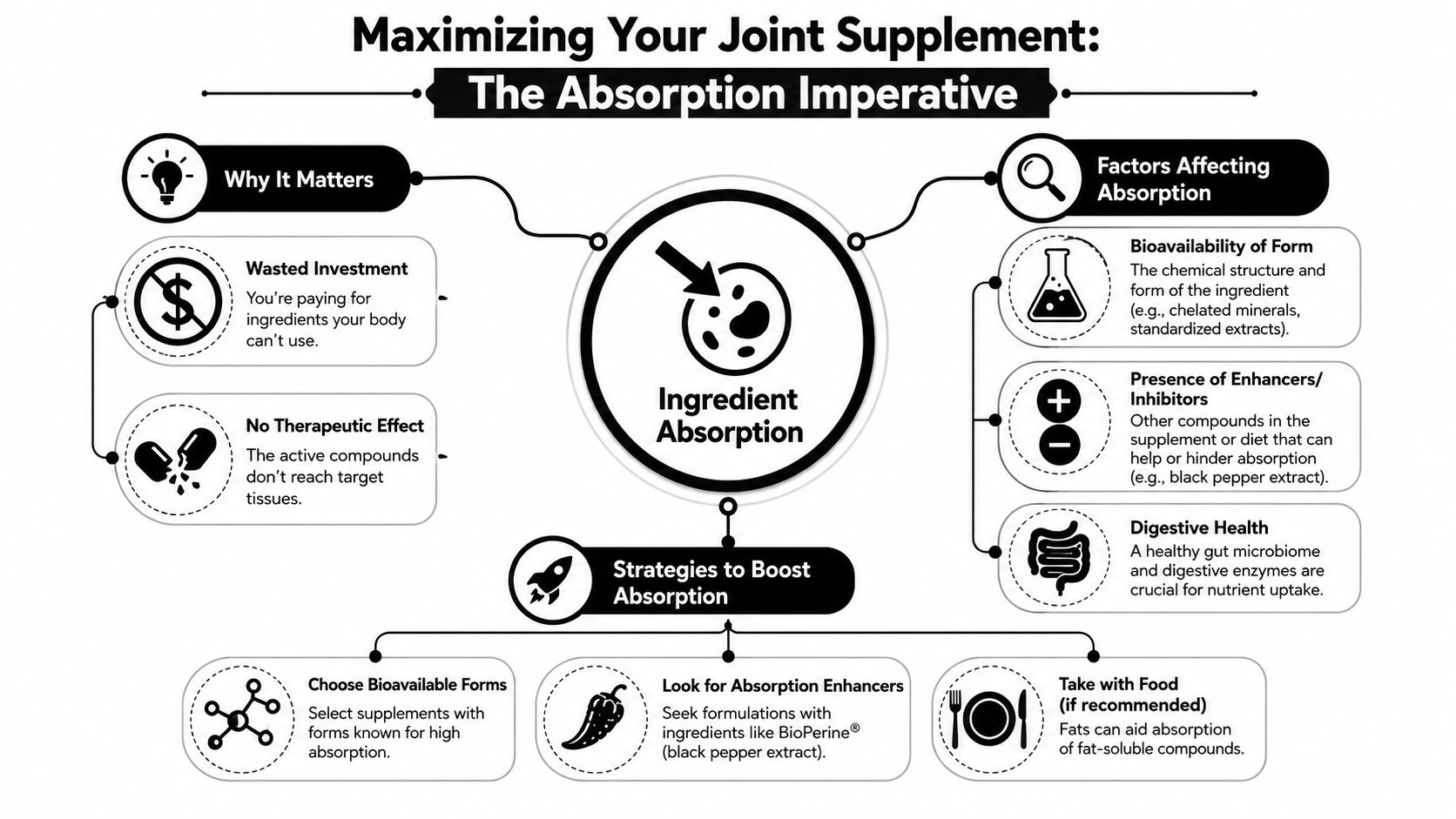
To illustrate. Curcumin is valuable. But raw curcumin on its own can be like money locked in a safe. If the formula doesn't include the key, your body gets limited access to what you paid for.
Why good ingredients still fail
This is one of the biggest reasons people say a supplement “did nothing.” The problem may not be the ingredient itself. The problem may be the form, the delivery system, or the lack of supporting compounds that help uptake.
A weak formula often has one or more of these issues:
Poorly absorbed actives: Some compounds are harder for the body to use in plain form.
No enhancer included: The brand adds a popular ingredient but ignores how it's absorbed.
Bad formulation logic: Ingredients compete, clutter the capsule, or show up in token amounts.
Practical rule: Don't judge a supplement by the ingredient list alone. Judge it by whether the formula was built for use inside the body, not just for marketing on a label.
What to look for on the bottle
A smart formula gives the main ingredient some help. With turmeric products, that usually means pairing curcumin or turmeric extract with black pepper extract, often listed as BioPerine on product labels.
You asked for practical authority, so here it is plainly. If a vegan joint supplement leans heavily on turmeric but has no absorption strategy, I move on.
This short video helps illustrate why absorption gets so much attention in supplement design:
The easiest way to separate average from effective
When two products both say “turmeric” on the front, the one with a clear absorption plan usually has the better chance of delivering a real-world effect. That doesn't guarantee results for every person, but it does show the formulator understood the assignment.
Use this quick screen:
What to check | Why it matters |
|---|---|
Turmeric or curcumin form | Raw powder and targeted extract aren't the same thing |
Black pepper extract or similar enhancer | Supports uptake of key compounds |
Serving instructions | Some formulas work better with food |
Simplicity of formula | Cleaner formulas are often easier to evaluate |
The best vegan joint supplement isn't the one with the longest ingredient panel. It's the one where the ingredients help each other get absorbed and used.
How to Read a Supplement Label Like an Expert
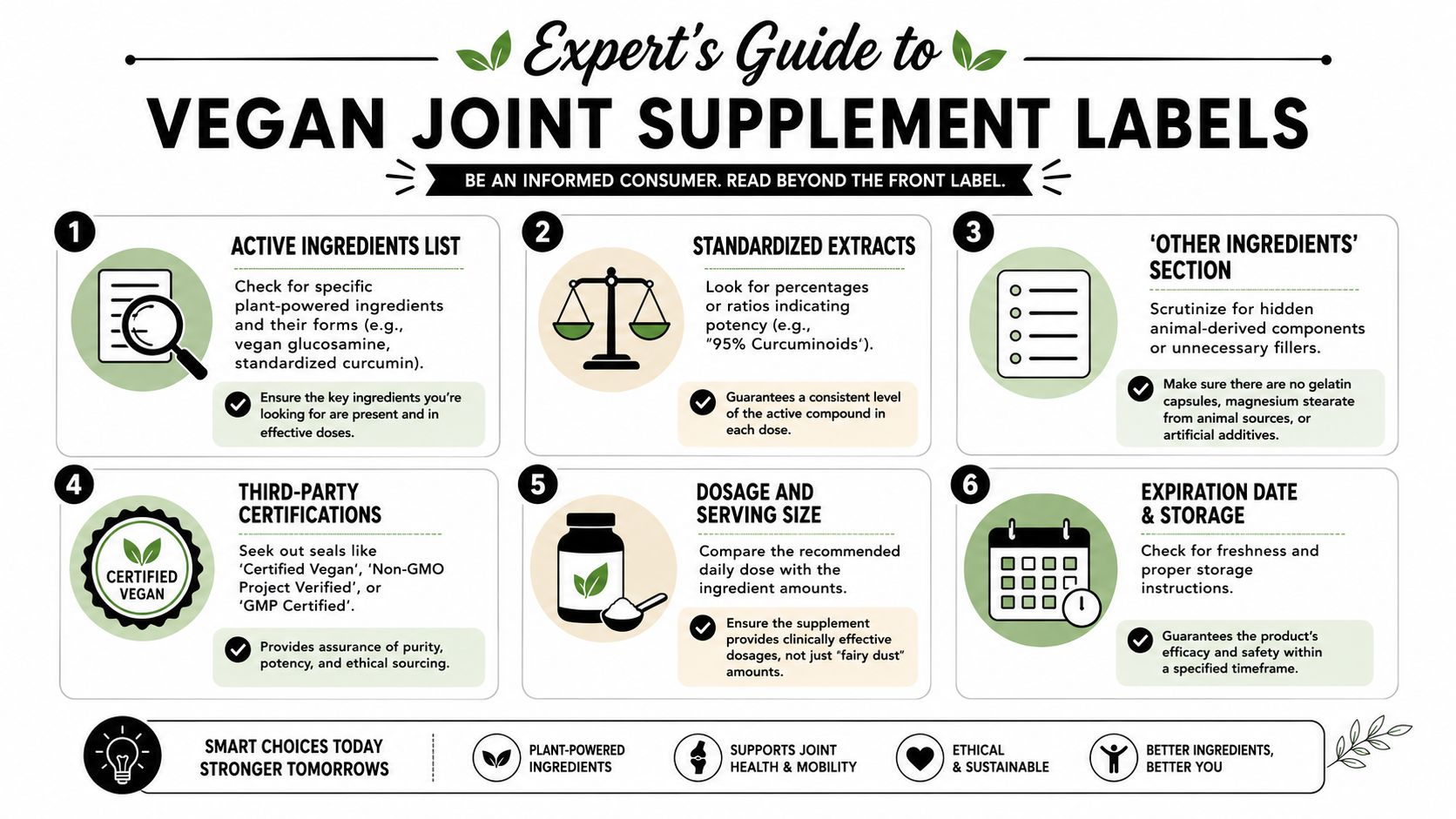
Front labels sell emotion. Side labels sell truth. If you want to shop like someone who knows what they're doing, spend most of your time on the Supplement Facts panel and the “Other Ingredients” list.
Start with the active ingredients
Look for named ingredients, not vague wellness language. “Joint blend” tells you nothing. “Turmeric extract” is better. “Standardized turmeric extract” is better still because it suggests the brand is trying to control potency rather than tossing in a generic plant powder.
A useful first pass looks like this:
Specific ingredient names: You want to know exactly what plant or compound is included.
Recognizable forms: Extracts, enzymes, and support nutrients should be clearly identified.
No fairy-dust formulas: If the amounts look tiny or hidden, be skeptical.
Standardized extracts matter
A lot of consumers miss this point. There's a major difference between a root powder and a standardized extract. Powder can be fine in some contexts, but extract usually tells you the formula is trying to deliver a more concentrated active compound.
That matters most with ingredients like turmeric. If a brand wants credit for curcumin-driven effects, the label should make the extract quality and form easy to understand.
A label should answer your questions before you have to email the company.
Read the other ingredients like a detective
Non-vegan materials and junk additives often hide in the unseen parts of a supplement. The active blend may look clean, but the rest of the formula can still be sloppy.
Check for:
Capsule material: Vegan capsules should be clearly stated.
Animal-derived add-ons: Don't assume a plant-focused front panel means every ingredient is vegan.
Artificial extras: Colors, sweeteners, or filler-heavy formulas don't improve joint support.
A clean label usually reflects a cleaner formulation mindset.
Look for quality signals, not just branding
I give extra credit to brands that show they care about consistency and manufacturing standards. You're trying to reduce uncertainty, not just buy hope in a bottle.
Here's the checklist I'd use:
Third-party testing
This helps verify that the contents match the label.Clear dosing directions
If the serving size is confusing, the product is harder to use correctly.Expiration and storage details
Freshness matters, especially with botanical formulas.Vegan certification or transparent vegan claims
This helps when you're trying to avoid hidden animal inputs.
For a practical example of how combination formulas are positioned, this guide on ginger turmeric capsules is worth a look.
The fast filter I use before recommending any product
When I scan a label, I'm asking four simple questions:
Question | What a good answer looks like |
|---|---|
Is it actually vegan? | Capsule and active ingredients are clearly plant-based |
Are the ingredients doing real jobs? | Curcumin, ginger, bromelain, and support nutrients each have a purpose |
Is the formula designed for potency? | Standardized extracts and clear forms are listed |
Is the brand hiding anything? | No proprietary fog, no messy filler list, no confusion |
Once you learn this, you stop buying based on front-label promises. You start buying based on formulation quality. That's where better decisions usually begin.
Dosing Guidelines and Safety Considerations
A good formula can still disappoint if the dose is too low, the schedule is sloppy, or the ingredient form is weak. This is the point where label-reading pays off. A bottle may list impressive ingredients, but the serving has to match the form used in research and the formula has to be something you can take consistently.
What Dose Ranges Tell You
Dose ranges are a starting point, not a shortcut.
For vegan joint support, broad serving ranges are common because products are built differently. A collagen-support blend, a curcumin formula, and a ginger-bromelain combo should not be judged by the same number on the label. The better question is whether the dose fits the ingredient form and whether the formula includes anything that improves absorption.
Curcumin is the clearest example. A capsule may look strong on the front label, but plain turmeric powder and a standardized curcumin extract are not interchangeable. The Arthritis Foundation's guide to supplements for arthritis notes that turmeric and curcumin products vary widely, which is why form and dosing instructions matter so much in practice.
That is why I do not treat milligrams as the whole story. I look at the ingredient form first. Then I check the serving size, whether it should be taken with food, and whether the brand gives clear directions you can follow for weeks, not just a few days.
How to use supplements without sabotaging the result
Three mistakes show up over and over. People switch products too fast. They skip doses on better days. Or they expect a joint formula to work like a fast-acting pain reliever.
A better approach looks like this:
Take it daily. Joint support formulas usually work best with steady use.
Use the full serving. Half-dosing a formula often means you never reach a meaningful intake.
Follow food instructions. Some ingredients absorb better with a meal.
Track two simple markers. Morning stiffness and walking comfort are useful because they are easy to notice week to week.
If you want practical habits that pair well with supplements, this guide to natural pain relief strategies for everyday discomfort adds useful context.
Natural joint support works more like a steady training plan than a quick fix.
Safety comes first
Plant-based does not mean risk-free. Ginger, turmeric, boswellia, and other common joint ingredients can interact with medications or aggravate certain conditions in some people. Blood thinners are the big one, but they are not the only concern.
Start with the label. Check active ingredients, serving size, allergen notes, and any warnings about pregnancy, medical conditions, or medication use. If a formula bundles several botanicals together, be more careful, not less. Combination products can be helpful, but they also make it harder to tell which ingredient is causing a problem if you react poorly.
I also prefer simple formulas for first-time users. They make troubleshooting easier if you get bloating, reflux, or mild stomach upset. That matters more than people realize. A supplement only helps if you can tolerate it long enough to see whether it is working.
Tailoring Support to Your Specific Needs
The best vegan joint supplement for one person may be the wrong pick for another. The label has to match the life it's entering. A retiree with morning stiffness doesn't need the exact same support strategy as a runner who feels beat up after training.
If you deal with daily stiffness
This is the person who notices discomfort during ordinary life. Getting out of bed. Standing after a long drive. Opening jars. For this group, a formula centered on anti-inflammatory botanicals often makes the most practical sense.
The goal isn't to chase a dramatic feeling on day one. It's to support more comfortable movement across normal routines. That usually means choosing a formula you can take daily and tolerate well.
If you're active and sore after workouts
Athletes and regular exercisers tend to notice a different pattern. The issue may be less about constant pain and more about recovery, swelling, or that heavy, irritated feeling after repeated training.
A thoughtful vegan formula can fit here when it includes ingredients commonly used for comfort and recovery support, especially compounds like curcumin, ginger, and bromelain. In plain English, you want help calming the post-exercise fire without loading your routine with ingredients that don't earn their keep.
If you want long-term support as you age
Older adults often want one thing above all else. They want to keep moving without feeling fragile. That changes the buying decision.
For this group, simplicity wins:
Choose a formula you will take every day
Prioritize clear labels over marketing hype
Value absorption, not ingredient count
Pair supplements with movement, protein, and basic recovery habits
A simple way to match the product to the person
Here's my perspective on this:
Your situation | What matters most |
|---|---|
Morning stiffness and creaky joints | Daily comfort support and a tolerable routine |
Exercise-related soreness | Recovery-friendly botanicals and a clean formula |
Staying active with age | Consistency, absorption, and simple label quality |
Buy for the pattern you live with most often, not the one that sounds most dramatic in an ad.
That one shift can save a lot of money and frustration.
The Takeaway: Choose Smart and Move Better
The best vegan joint supplement is rarely the one with the flashiest bottle or the longest ingredient list. It's the one built with clear intent. Strong plant-based ingredients. Smart combinations. Better absorption. Clean labeling. Real quality signals.
Curcumin stands out. Supporting ingredients like ginger and bromelain can make a formula more useful. Vegan collagen builders can also make sense when they provide the raw materials your body uses for collagen synthesis. But a key separator is synergy. Ingredients need to work together, and the formula has to help your body absorb them.
Read labels like a skeptic. Buy like a practitioner. Your joints don't care about marketing. They care about what reaches the tissue and what you use consistently.
If you want a vegan capsule formula built around turmeric extract, BioPerine, ginger, and bromelain, take a look at River of Life. The brand focuses on a multi-ingredient approach designed for joint comfort, recovery, and daily use, without filler-heavy clutter.