


Natural Dog Pain Reliever: Vet-Approved Options

Your dog used to hop onto the couch without thinking. Now there's a pause. A small hesitation before the jump. Maybe they circle their bed longer before lying down, or they hang back when you reach for the leash. Those quiet changes are often how pain first shows up.
Most owners don't miss the big signs. Limping, crying, refusing to walk. The hard part is catching the earlier ones, when your dog is still trying to carry on normally. That's where natural pain relief becomes worth discussing. Not as a shortcut, and not as a replacement for proper veterinary care, but as part of a thoughtful plan to keep a dog comfortable and mobile.
A good natural dog pain reliever plan isn't built on hype. It's built on observation, safe dosing, realistic expectations, and professional guidance. That matters even more with ingredients like turmeric, where absorption boosters such as black pepper may help a formula work better, but also raise important safety questions in dogs that many online guides gloss over.
Table of Contents
Your Guide to Natural Dog Pain Relief
When owners ask me for a natural dog pain reliever, they're usually asking two questions at once. First, “What can help?” Second, “What can I use without making things worse?” Those are not the same question, and both deserve a careful answer.
Natural options can absolutely have a place in pain management. Some support inflammation control. Some help maintain joint comfort. Others work best when paired with weight control, rehab exercise, traction at home, or better bedding. Pain relief is rarely one supplement doing all the work. It's more like building a stable table. If one leg is weak, the whole thing wobbles.
Practical rule: If your dog seems painful for more than a short stretch, or suddenly gets much worse, treat that like a medical issue first and a supplement question second.
There's also a major safety issue that gets oversimplified online. Human wellness products are often marketed as if they can be copied directly for dogs. They can't. A good example is turmeric. Curcumin can be useful, but whether it helps depends heavily on formulation and dose. Add a bioavailability enhancer like black pepper, and the conversation changes from “Will it absorb?” to “Is this specific combination appropriate for this dog?”
Natural care works best when it's honest about trade-offs. Some remedies are mild. Some are promising but need tighter product selection. Some are useful for long-term support, not fast relief. And some home remedies should stay off the internet and out of your dog's bowl unless your veterinarian approves them.
First Signs Understanding Your Dog's Pain
Dogs often treat pain like a dashboard warning light you almost ignore because the car still runs. The check engine light doesn't always mean smoke is pouring out of the hood. It means something is off and needs attention. Pain behaves the same way in dogs.
What pain often looks like in real life
A painful dog may not cry. More often, they compensate.
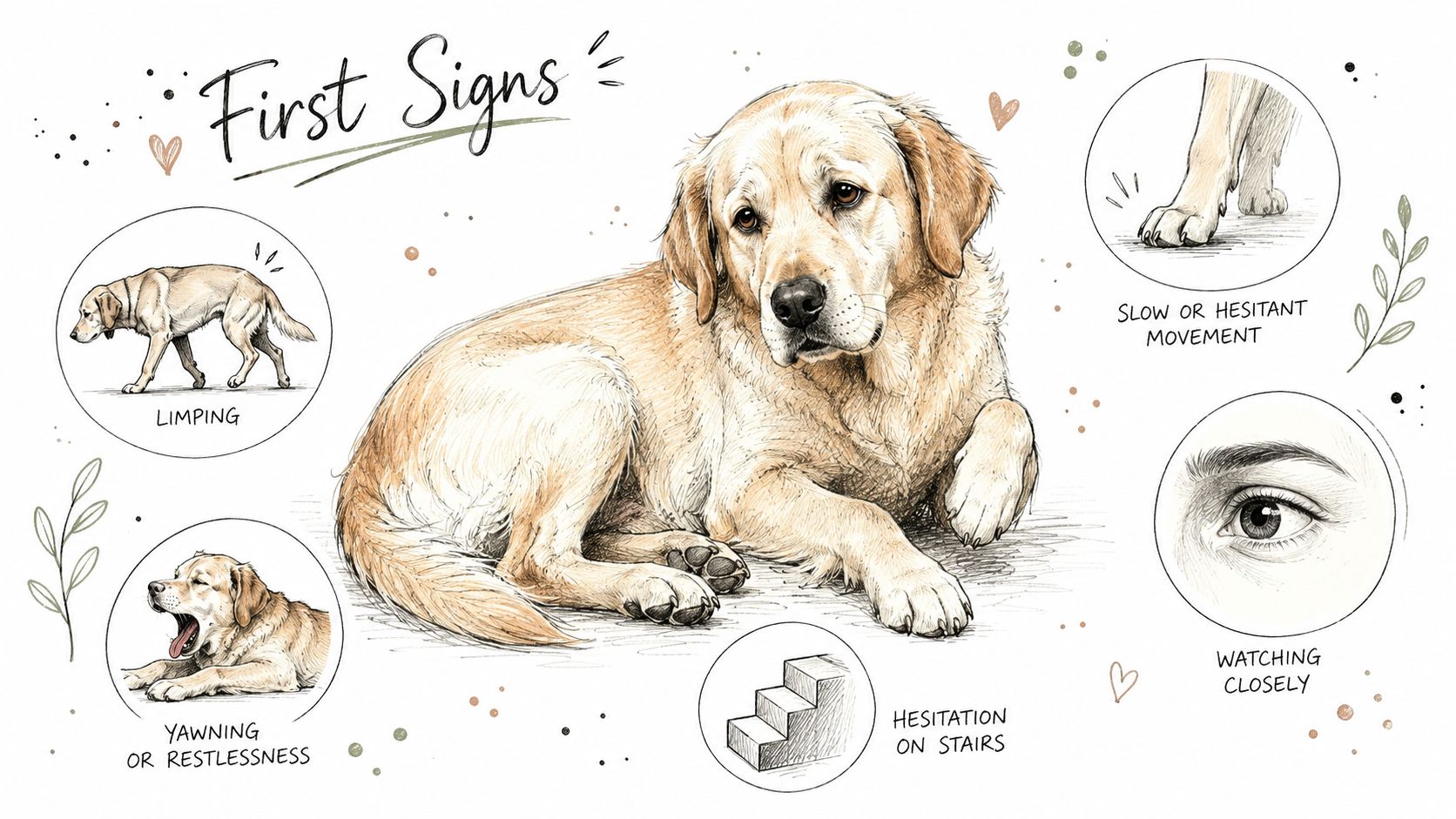
Watch for patterns such as:
Hesitation with routine movement like jumping on furniture, getting into the car, or taking stairs
Changes in posture including a hunched back, tucked abdomen, or a stiff way of turning
Reduced enthusiasm for walks, play, or greeting people at the door
Repeated licking or chewing at one area, especially a paw, hip, or joint
Mood changes such as irritability, clinginess, restlessness, or wanting to be left alone
Sleep disruption where your dog can't seem to settle, or shifts position often
One missed jump doesn't prove pain. A cluster of small changes over days or weeks often does.
Many dogs don't advertise discomfort. They just start negotiating with it.
If you want to help your vet quickly, keep a simple note on your phone. Write down what changed, when it started, whether it's worse after rest or exercise, and what movements your dog avoids. A short video of your dog walking, rising from bed, or taking stairs is often more useful than a perfect description.
Common causes behind those changes
In adult and senior dogs, osteoarthritis is one of the most common reasons for chronic pain. It tends to show up as stiffness after rest, slower walks, reluctance to jump, and soreness after activity. In a randomized, double-blinded, controlled pilot study, a proprietary herbal blend significantly reduced canine osteoarthritis pain, with treated dogs showing measurable improvements in mobility and comfort scores compared with placebo. That finding matters because it supports the idea that some natural interventions can play a real role in arthritis care.
Other common causes include soft tissue strains, cruciate ligament problems, spinal pain, paw injuries, dental pain, and post-surgical discomfort. Younger dogs can hurt too, especially athletic ones who pivot hard, launch off furniture, or overdo weekend activity.
A quick way to think about it is this:
Situation | Pain pattern often seen |
|---|---|
Arthritis | Slow rise, stiff gait, less jumping |
Soft tissue injury | Sudden reluctance, uneven stride, soreness after activity |
Back or neck pain | Trembling, guarded posture, yelping on movement |
Post-surgical pain | Reduced activity, tension, reluctance to use an area normally |
Pain that appears suddenly, pain with swelling, pain that prevents weight-bearing, or pain paired with appetite loss needs prompt veterinary attention. Natural support may still be part of the plan, but first you need to know what problem you're treating.
Evaluating Natural Supplements for Pain Management
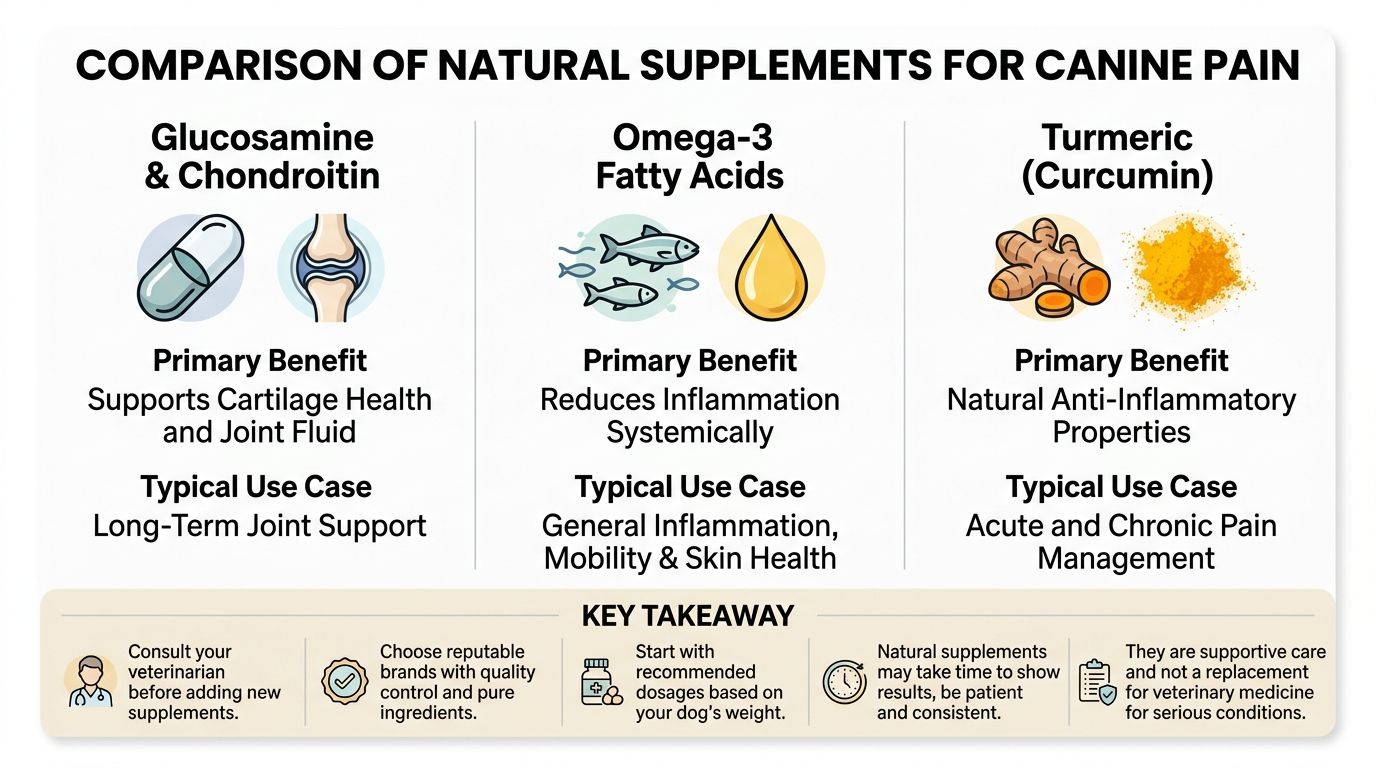
Supplements get discussed as if they all belong in one bucket. They don't. Some target inflammation. Some support joints over time. Some affect pain signaling. Some are overpromised and underdosed. The smarter approach is to judge each category by mechanism, evidence, and safety.
Botanicals
Turmeric and curcumin get the most attention, and for good reason. Curcumin is the active compound most closely tied to turmeric's anti-inflammatory effect. According to WebMD's veterinary medication overview, 30 milligrams of curcumin per day produces a mild but measurable anti-inflammatory effect in dogs. That tells you two important things. First, curcumin can do something. Second, at that dose the effect is mild, not dramatic.
That's where formulation becomes critical. Curcumin is notoriously hard to absorb. If a product contains turmeric powder but doesn't address absorption, the label may sound impressive while the dog gets very little practical benefit. Owners who want to understand the ingredient better can review this explanation of how turmeric curcumin helps with arthritis and joint pain, but for dogs the decision still has to run through your veterinarian.
Ginger and boswellia are also commonly included in joint blends. In practice, I view them as supportive ingredients rather than automatic stand-alone pain relievers. They may fit well in a broader plan, but they still need to be judged in the context of the whole formula, the dog's stomach tolerance, and any concurrent medications.
A useful question to ask is not “Does this botanical work in theory?” It's “Is this product standardized, absorbable, and appropriate for my dog?”
Later in the decision process, a quick product video can help owners recognize how supplement marketing frames these options:
Omega-3 fatty acids and green-lipped mussel
This category is often more practical than flashy. Fish oil is commonly used for general inflammation support. Green-lipped mussel is more targeted to joint care and is distinct from generic fish oil. As described by ToeGrips' review of natural pain relief for dogs, green-lipped mussel from New Zealand is rich in omega-3 fatty acids and unique glycolipids, and has been validated in meta-analyses of clinical trials to significantly ease arthritis symptoms.
I like to explain the difference this way. Fish oil is broad support. Green-lipped mussel is more like a joint-focused ingredient with a different toolkit. That doesn't mean one is always better. It means they aren't interchangeable.
For dogs with chronic stiffness, especially those with hip or elbow arthritis, this category often makes sense as part of a long-range plan. It's less about a sudden visible change and more about building a steadier baseline.
Joint support compounds
Glucosamine and chondroitin are household names for a reason. They're usually aimed at joint support, not rapid pain relief. Owners get frustrated when they expect them to work like a fast anti-inflammatory. That's a mismatch in expectations, not necessarily a bad product.
These compounds are usually most sensible when your goals are maintenance, cartilage support, and a layered approach. I don't reach for them as the only answer in a dog already struggling significantly. I'm more likely to see them as one piece of a larger strategy that also addresses activity, home setup, and targeted anti-inflammatory support.
Cannabinoids
CBD and hemp products deserve a more disciplined conversation than they often get online. Product quality varies widely, and the label matters.
One of the stronger pieces of data in this area comes from a Frontiers in Veterinary Science study where full-spectrum hemp oil standardized to 15 mg phytocannabinoids, dosed at 2 mg/kg twice daily, produced a 46.2% reduction in owner-reported pain scores and a 25.9% increase in overall daily activity in dogs with chronic osteoarthritis over eight weeks, along with significant improvement in stair-climbing ability compared with placebo.
That doesn't mean every CBD product on a store shelf will do the same thing. It means dose, formulation, and standardization matter. A vague “hemp chews” label is not the same thing as a studied protocol.
Clinical mindset: A supplement category may be promising, but the wrong product can still be the wrong choice.
Beyond Supplements Physical and Lifestyle Therapies
Supplements can help. They also get too much credit for jobs that belong to daily management. If your dog slips on smooth floors, struggles to stand from a thin bed, and carries more body weight than their joints can handle, no capsule is going to outwork that environment.
Home changes that matter every day
The most effective comfort plans usually start with ordinary things owners control at home.
Better footing: Non-slip rugs or runners help a painful dog stop bracing every step.
Supportive bedding: Thick, stable bedding reduces pressure on sore joints and makes rising easier.
Ramps and step aids: These lower the strain of climbing into cars or onto furniture.
Controlled exercise: Short, consistent leash walks usually beat sporadic bursts of intense activity.
Weight management: Less load on a painful joint usually means less daily strain.
This part isn't glamorous, but it works because it reduces repeated aggravation. Think of it as removing pebbles from a shoe. The shoe may still fit, but every step feels better once the irritants are gone.
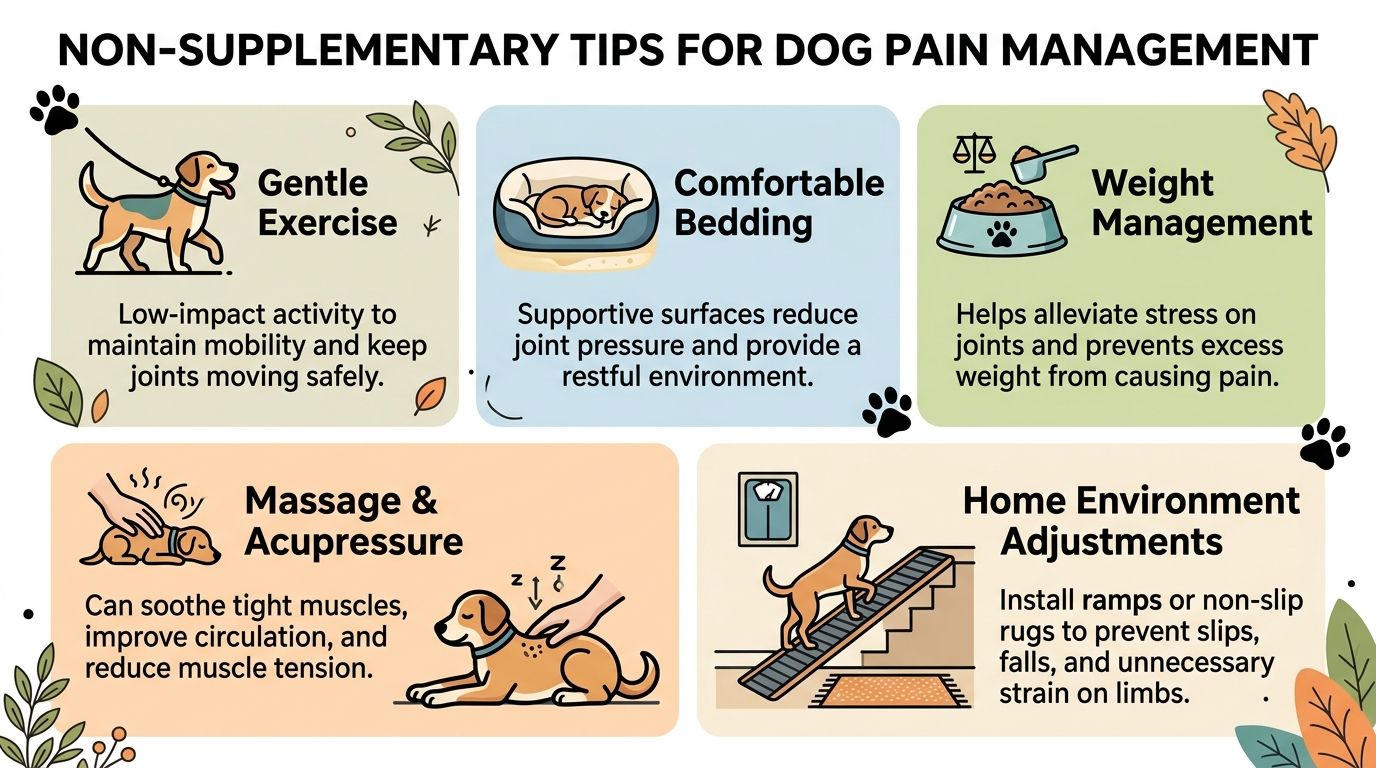
A dog with arthritis often does best with movement that's regular and low-impact. Long weekend hikes can backfire. The goal is to keep joints moving without asking inflamed tissues to absorb too much force at once.
Hands-on and device-based therapies
Massage, rehabilitation exercises, acupuncture, and structured physical therapy can all fit a natural pain plan when the dog's diagnosis supports them. These options are especially useful for dogs who've become weak, guarded, or uneven in how they move.
One therapy owners should hear more about is red light therapy, also called photobiomodulation. According to MedCoVet's review of red light therapy for pain relief, recent data shows up to 65% pain reduction in canine hip dysplasia cases. That's a strong reminder that “natural” doesn't only mean herbs and oils. It can also mean non-invasive physical treatment.
Here's how I'd frame the trade-offs:
Approach | Best use |
|---|---|
Massage and manual work | Muscle tension, stiffness, relaxation |
Rehab exercise | Weakness, poor joint support, recovery after injury |
Acupuncture | Dogs needing an additional non-drug option |
Red light therapy | Cases where non-invasive targeted pain relief may help |
Sometimes the biggest improvement comes from asking less of a painful body, not from adding more products.
How to Choose Safe Products and Work With Your Vet
The supplement aisle rewards attractive labels, not necessarily safe plans. A dog in pain needs more than a product recommendation. They need the right ingredient, the right dose, the right formulation, and a veterinarian who knows what else is in the picture.
What a good label should tell you
Start by reading labels like you're checking a recipe and a dosing instruction at the same time.
Look for:
Named active ingredients: “Turmeric blend” is less useful than a label that specifies curcumin or standardized extract.
Clear dosing guidance: If the product doesn't tell you how much is intended for a given body size, that's a problem.
Canine-specific use: Human supplement logic does not automatically transfer to dogs.
Manufacturing transparency: Reputable brands usually make it easier to understand what's in the bottle and why.
The bigger point is that dogs don't need impressive-sounding labels. They need products that let your veterinarian calculate and monitor what your dog is getting.
Why human formulas can create dog-specific problems
Turmeric is the clearest example of where owners can get misled. A high-bioavailability curcumin formula may sound better because more of the ingredient is absorbed. But absorption enhancers change the safety conversation.
According to this discussion of natural pain relief and formulation issues, many owners are drawn to products that promise stronger absorption without realizing that formulation details may matter more in pets than in people. That concern lines up with a YouTube source discussing curcumin dosing and piperine, which notes that high-bioavailability curcumin formulations for dogs often require specific doses such as 100 mg per 10 pounds, and that black pepper extract can increase absorption by up to 2,000% by inhibiting liver processes.
That last point is the part owners often don't hear. If a compound changes liver handling, you don't get to assume it's automatically fine for every dog, especially seniors, dogs on other medications, or dogs with known liver concerns.
A few essential rules help:
Never dose by internet comment thread. Dogs differ by size, condition, age, and medical history.
Don't copy human “golden paste” recipes. Homemade blends often skip the safety part and focus only on absorption.
Tell your vet everything your dog gets. Supplements, chews, oils, powders, and treats all count.
Reassess if your dog changes. New lethargy, GI upset, or behavior shifts mean the plan may need to be adjusted.
A good veterinarian isn't there to block natural care. They're there to keep a reasonable idea from becoming an unsafe one.
Sample Care Plans for Common Scenarios
Real care plans look less like a miracle ingredient and more like a coordinated routine. These examples are illustrative only. Each should be developed and monitored by a veterinarian.

An older large-breed dog with stiffness
Charlie is an older Labrador who's slower rising in the morning and no longer wants to jump into the car. A sensible plan might include weight review, traction rugs, a joint-focused supplement that includes green-lipped mussel, and short daily walks on even ground. If his vet wants more structural support in the broader joint plan, owners sometimes explore options such as undenatured type II collagen as part of that conversation.
The point isn't to pile on products. It's to reduce strain while supporting the joints from more than one angle.
A younger athletic dog recovering from a strain
Luna is a young Border Collie who tweaked a front leg during hard play. Her plan might focus first on diagnosis, temporary rest, controlled return to activity, and prevention of reinjury at home. Depending on veterinary guidance, a mild anti-inflammatory botanical may be considered, but the bigger win usually comes from avoiding the “she seemed better, so we did too much” mistake.
For these dogs, patience is part of pain control.
A senior dog who needs more traction and less effort
Milo is a smaller senior dog who still enjoys walks but slips on slick floors and struggles with stairs. His best plan may be mostly environmental. Runners through the house, a supportive bed, ramps, and steady low-impact exercise can do more than owners expect.
That's often the surprise. The strongest natural dog pain reliever plan may be the one that asks your dog to fight gravity and friction less often every day.
FAQ Common Myths About Natural Dog Pain Relief
Can I give my dog my own human supplements?
Not safely by default. Human products may use different concentrations, sweeteners, flavoring agents, or absorption enhancers. The ingredient itself might be acceptable, but the formula or dose may not be.
Are golden paste recipes with black pepper safe for dogs?
Not something I'd recommend without veterinary guidance. As noted in this review discussing black pepper extract and dog safety concerns, many online guides fail to warn that while black pepper extract can improve curcumin absorption, there is insufficient data on its long-term safety for canine hepatic systems. That makes vet-calibrated dosing essential and DIY recipes potentially risky.
How long do natural remedies take to work?
It depends on what you're using and why. Some options are aimed at mild inflammation support. Others are part of long-term joint management. If someone promises immediate, dramatic pain relief from every natural product, that's marketing, not medicine.
Is “natural” always safer than prescription medication?
No. Natural and safe are not synonyms. A natural ingredient can still be underdosed, overdosed, poorly absorbed, mixed with the wrong additives, or inappropriate for your dog's condition.
Can I give my dog ibuprofen, acetaminophen, or other human pain medicine?
No. If your dog is painful enough that you're considering reaching into your medicine cabinet, call your veterinarian or an emergency clinic instead. That step can prevent a pain problem from becoming a poisoning problem.
Natural care has a real place in pain management. It just works best when it's treated like medicine, not folklore.
If you're comparing ingredient approaches and want to learn more about turmeric, BioPerine, and capsule-based formulations, River of Life offers educational resources alongside its supplement line. Use that information as a starting point for a conversation with your veterinarian, especially if you're considering any human-style curcumin product for a dog.