


How to Improve Mental Clarity and Focus Daily

30.5% of U.S. adults averaged less than 7 hours of sleep in 2024, while 15.4% had trouble falling asleep and 18.1% had trouble staying asleep most days or every day, according to the CDC's sleep indicators. Before treating brain fog as a motivation problem, consider whether you're asking yourself to concentrate without enough rest.
Learning how to improve mental clarity and focus starts with choosing the right problem to work on. A practical approach is to address sleep first, build regular movement, practice attention deliberately, and make eating routines easier to maintain. Supplements belong behind those foundations, not ahead of them.
Table of Contents
Why Mental Clarity Starts with the Basics
When you're mentally foggy, a new productivity app or supplement can feel more appealing than changing your evening routine. It offers something concrete to buy or start. But the useful question isn't which intervention sounds most impressive. It's what's currently interfering with your ability to function.
The CDC findings above make sleep an obvious place to investigate, but they don't prove that sleep explains every episode of brain fog. Poor concentration deserves attention without assuming that everyone has the same cause.
Choose the weakest foundation
Start by describing your difficulty in plain language. Are you fighting sleepiness, losing your place while reading, or repeatedly switching away from work you understand? Those descriptions give you something more useful to track than a general wish to feel sharper.
Use this priority order as a practical decision aid, not a diagnostic test:
Sleep opportunity: Check whether your schedule allows adequate rest before searching for a focus enhancer.
Movement: Look for an activity routine you can repeat rather than an exhausting workout you'll abandon.
Attention practice: Add deliberate practice without expecting it to compensate for an unmanageable workload.
Food routines: Make ordinary meals and access to water easier before chasing a perfect diet.
Supplements: Consider a specific purpose only after you've identified what remains unresolved.
The foundation-first approach is easy to keep in view.
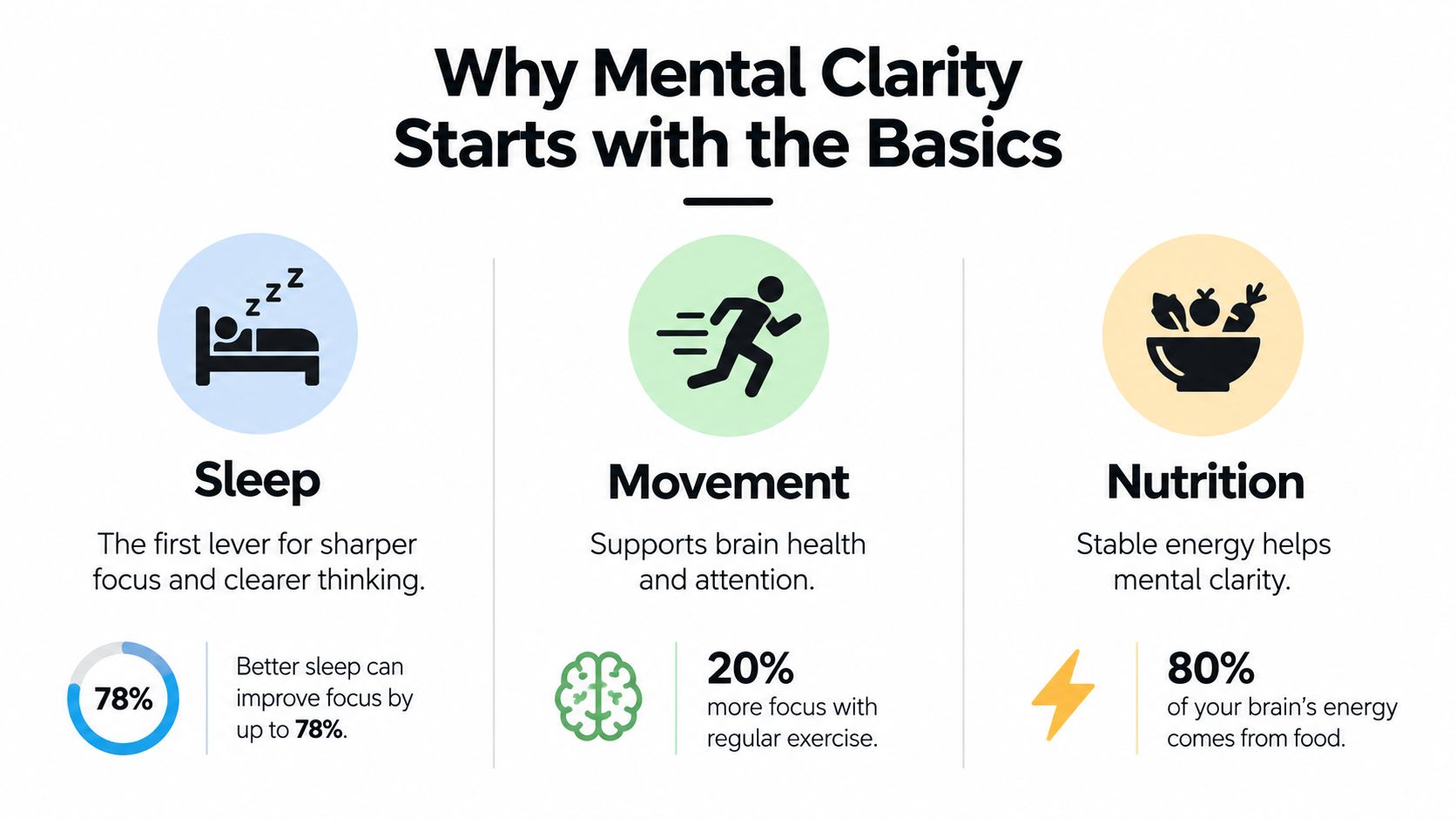
Separate improvement from activity
A complicated routine can keep you busy without making your day easier. Choose an outcome that matters, such as completing a familiar work task without repeatedly starting over.
Practical rule: Change the weakest foundation before adding another layer of optimization.
This sequence is a coaching framework, not a proven ranking of treatments. Its advantage is practical: you avoid buying something to solve a problem you haven't yet defined, and you make fewer simultaneous changes that leave you guessing about what helped.
Fixing Sleep Before Chasing Focus
When someone tells me they can't focus, the first thing I ask about is sleep. It isn't glamorous, and it rarely feels like a real answer, yet every other change in this guide works worse on a short night. Pick a wake time you can keep, including weekends, then work backward to an evening that leaves enough room for rest. Build around your real responsibilities, not an ideal routine you'll abandon by Thursday.
Use the checklist below as a starting point rather than another standard to hit perfectly.
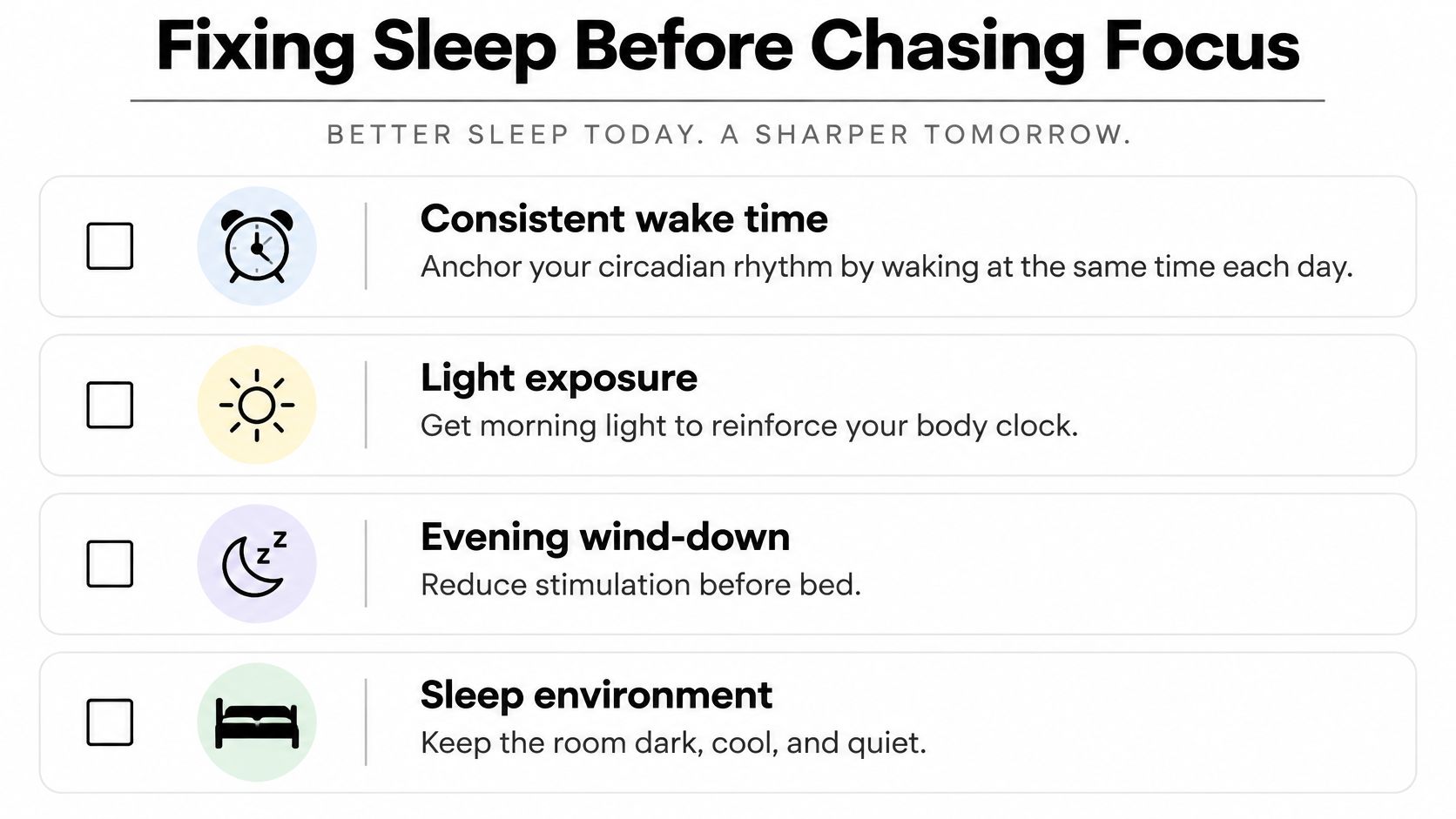
Match the change to the difficulty
Two complaints hide under the label "bad sleep," and they need different fixes. A longer bedtime routine won't rescue a schedule that leaves too little room for rest, and an earlier bedtime won't help someone who lies awake anyway.
If bedtime keeps slipping: Set an evening stopping point for work and household tasks. Decide what can wait until tomorrow before you get into bed.
If you arrive in bed mentally activated: Try a repeatable wind-down sequence, such as writing down unfinished tasks, washing up, and reading something undemanding.
If you wake repeatedly: Note interruptions, discomfort, noise, and other patterns instead of assuming that falling asleep faster fixes the whole night.
If your routine varies widely: Test a consistent wake time and morning outdoor light as habits, without treating them as guaranteed insomnia treatments.
Review caffeine timing while you're at it. People respond differently, so skip the universal cutoff. If late caffeine seems like the culprit, move it earlier and keep a simple record rather than stacking something else on top to counteract it.
Give each change a fair stretch before judging it, and change one thing at a time so you know what helped. The signal to watch is daytime: whether you can start work without the usual fog, not whether a tracker approves of your night.
Protect the schedule before optimizing the bedtime accessories.
Make the bedroom easier to use
A dark, quiet, comfortably cool room covers most of what matters, so handle the disturbances you can control first. A charger outside arm's reach and a place to write down tomorrow's tasks will do more than another sleep gadget.
Supplements sit downstream of all this. If your sleep pattern is still unclear, a guide to natural sleep aids without melatonin is a reasonable next read, though product exploration comes second to understanding what's disrupting your nights.
This accompanying video offers another format for reviewing sleep habits.
Persistent insomnia or severe daytime impairment warrants clinical evaluation, not a longer list of self-experiments. You don't need to exhaust every wellness option before asking for help.
Using Movement to Sharpen Executive Function
The World Health Organization's physical activity guidance identifies benefits for brain health, cognitive health, mental health, and sleep in adults and older adults. That makes movement a reasonable foundation for a clarity routine, even when weight loss or athletic performance isn't your goal.
The useful distinction is between feeling energized after activity and demonstrating a lasting change in performance. Both may matter to you, but they're not interchangeable.
Build a repeatable movement experiment
For sedentary adults without cognitive impairment, a systematic review and meta-analysis of aerobic exercise found a small post-intervention improvement in executive function (g = 0.37, 95% CI 0.04–0.69, across 6 studies) and a larger improvement in memory (g = 0.80, 95% CI 0.14–1.47, across 7 studies).
These are group-level effect sizes, not promised results for an individual. Use them as a reason to test a sustainable routine, not as a forecast of how much sharper you'll become.
Establish a baseline: Choose a brief, repeatable task involving working memory, reaction time, or resisting an automatic response. Alternatively, use a familiar work task with a clear finish.
Choose accessible activity: Try brisk walking, cycling, or another moderate aerobic activity that fits your circumstances. Attach it to an existing part of your day.
Keep the routine consistent: Give the exercise pattern several weeks rather than judging it after an unusually enjoyable session.
Retest fairly: Keep sleep, caffeine use, task difficulty, and time of day as similar as practical.
The diagram summarizes the intended relationship, not a guaranteed outcome at every stage.

Keep the benefits in perspective
Record illness, medication changes, sleep disruption, and unusually high caffeine intake alongside your results. Otherwise, you may credit or blame exercise for a change that occurred under very different conditions.
An energetic workout isn't proof of durable cognitive improvement. The cited research evaluated performance after a training period, not just the feeling immediately after exercise.
If focus doesn't improve, reconsider the routine or the outcome you're measuring. You may still choose to continue for other health benefits. Adults with medical limitations should obtain individualized guidance before increasing exercise intensity.
Training Attention with Short Daily Drills
Mindfulness is worth approaching as a practice, not a promise. The task is to notice when your attention has wandered and return deliberately, without turning every distraction into a judgment about your ability.
The evidence calls for modest expectations. A systematic review and meta-analysis of mindfulness-based programs found a small overall cognitive benefit (g = 0.15, 95% CI 0.05–0.24), with significant effects for executive function (g = 0.15, 95% CI 0.02–0.27) and working memory (g = 0.23, 95% CI 0.11–0.36), but no significant effects for attention, declarative memory, or cognitive aging.
Practice returning rather than perfect concentration
Choose a daily session you can complete without rushing. Sit somewhere manageable, use breathing or a bodily sensation as your anchor, and briefly label a distraction when you notice it.
Pick a simple anchor: Notice the sensation of breathing or the contact between your feet and the floor.
Acknowledge wandering: Use a brief mental label such as planning or remembering, then return.
Leave scoring until afterward: Don't evaluate your performance while practicing.
Record completion: Note whether you practiced and how you performed on a comparable work task later.
The image illustrates the basic cycle of breathing, noticing, and returning.
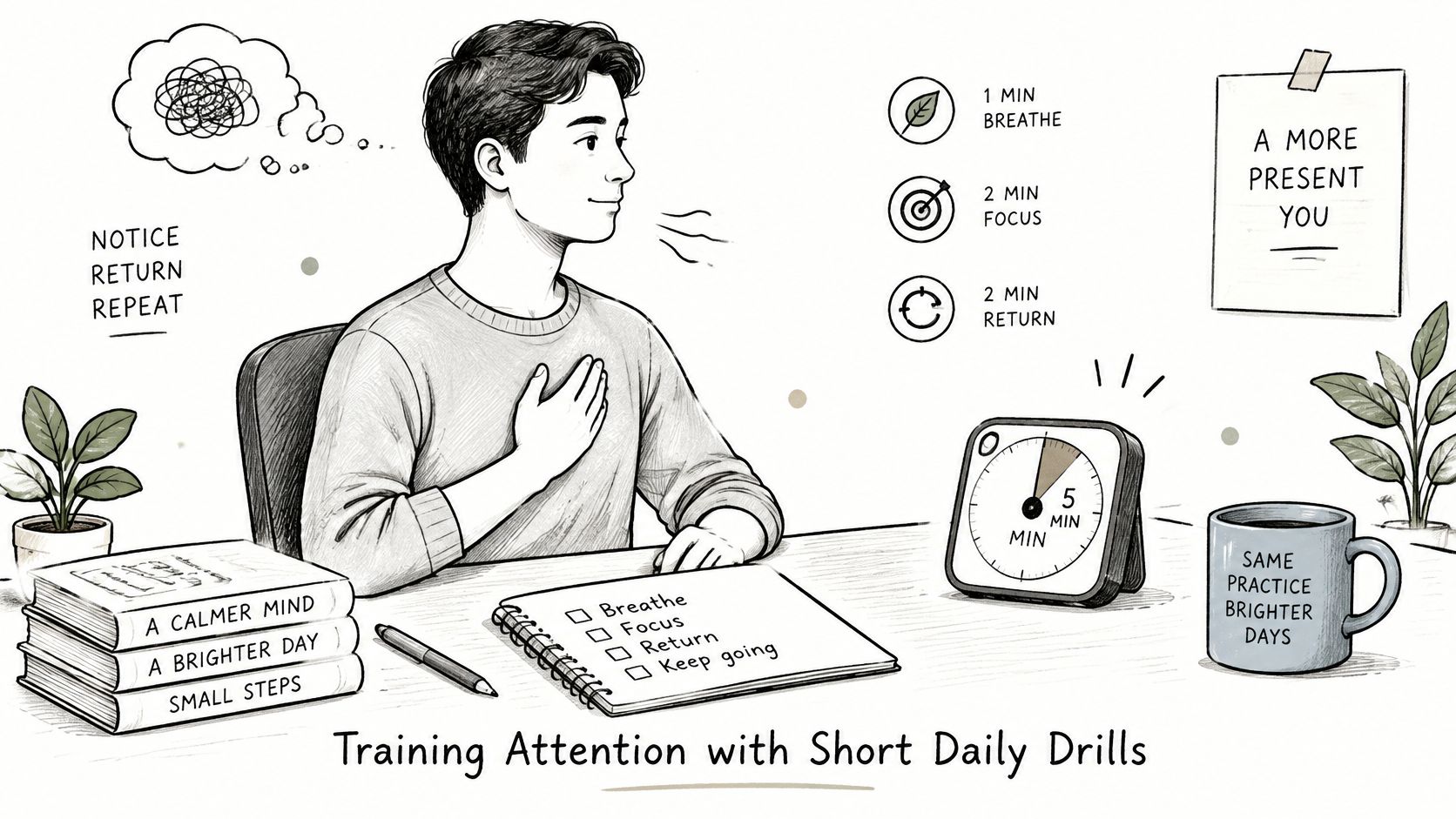
Don't confuse calm with accuracy
Feeling calmer can be worthwhile without proving that your attention has improved. Keep a subjective observation, such as feeling less rushed, separate from an objective outcome, such as fewer errors on a familiar task.
Measurement matters: A pleasant session and a better work result are different outcomes. Record them separately.
Evaluate your pattern across several weeks. Changing the task, difficulty, or conditions each time makes comparison less useful, and repeating the same test can introduce practice effects.
Use mindfulness alongside realistic workload management. Before a work session, define what finished looks like, close unrelated material, and choose where you'll put distracting thoughts that need attention later.
If the practice becomes another demanding obligation without a useful result, simplify or reconsider it. You don't need to persist indefinitely to prove that you're disciplined, and mindfulness shouldn't replace the earlier foundations or appropriate clinical care.
Eating for Steady Energy and Clear Thinking
Food advice for focus often becomes unnecessarily restrictive. A practical starting point is to examine what you eat during a working day, where meals become difficult, and whether your routine leaves you repeatedly improvising.
Don't treat a particular food as a brain-fog cure. The useful experiment is a manageable eating pattern, not a promise that breakfast will transform your concentration.
Use a flexible meal framework
Build meals around recognizable foods you enjoy: a protein source, vegetables or fruit, a fiber-containing carbohydrate, and a preferred fat or accompaniment. This is a planning template, not a prescribed ratio or treatment.
Examples include eggs with whole-grain toast and fruit, yogurt with oats and nuts, or beans with rice and vegetables. Choose foods that suit your preferences, budget, allergies, and any clinical dietary guidance.
Daily difficulty | Practical adjustment to test |
|---|---|
Breakfast becomes coffee alone | Prepare an easy meal you're willing to eat |
Lunch disappears during meetings | Reserve a meal break and keep a backup available |
Water is inconvenient to access | Keep a glass or refillable bottle near your workspace |
Afternoon eating feels chaotic | Review lunch timing and plan an available snack |
Evening habits complicate sleep tracking | Record food, caffeine, and alcohol alongside sleep observations |
Observe patterns without inventing mechanisms
If you feel foggy after lunch, don't automatically label it a blood-sugar problem. Record the meal, sleep quality, workload, and timing before deciding what to change.
The same caution applies to hydration. Make water accessible, but don't impose an arbitrary intake target or assume that drinking more will resolve persistent cognitive symptoms.
For this week, choose the adjustment that removes the most obvious friction:
If you skip meals unintentionally: Prepare a reliable backup.
If mornings are rushed: Decide on breakfast before the morning starts.
If your routine is already consistent: Avoid unnecessary restrictions and investigate other explanations.
You don't need a flawless diet to assess your focus. You need an eating routine you can maintain and observations that distinguish personal patterns from assumptions.
Choosing Supplements That Support Focus
By the time a supplement enters the picture, the foundations should already be carrying weight. Sleep addressed, movement scheduled, attention drills practiced, meals steady. A capsule added on top of chaos tells you nothing, because you have no clean baseline to judge it against.
So start with a specific purpose. Are you looking for support during a stressful stretch, exploring a botanical blend, or hoping to feel more awake? Those are different aims, and a broad mental-clarity label answers none of them.
Ingredient presence is not proof of a finished product's benefit. Neither an absorption claim nor a practitioner endorsement establishes that a formula will sharpen your concentration. Keep that filter on whenever you scan a label or a sales page.
Supplement Categories for Mental Clarity Compared
Approach | Primary Mechanism | Best Fit For | Typical Timing | Main Trade-Off |
|---|---|---|---|---|
Adaptogens such as ashwagandha | Marketed around stress-response support | Someone exploring a stress-focused option with professional guidance | Follow product directions | Marketing language doesn't establish individual benefit |
Turmeric with black pepper | Formulated with an absorption-focused ingredient pairing | Someone considering a botanical formula rather than an immediate alertness aid | Follow the label | Absorption and improved focus are different claims |
Stimulant-based options | Intended to increase alertness | Someone with a clearly defined short-term aim | Review timing against sleep concerns | Feeling stimulated isn't the same as performing better |
Multi-ingredient blends | Combine ingredients for several stated purposes | Someone who prefers a combined product after reviewing its contents | Use only as directed | A blend makes it harder to identify which ingredient helped or caused a problem |
Evaluate the formula before the purchase plan
River of Life Capsules are a botanical option from a Baton Rouge-based dietary supplement brand. The company describes a vegan capsule formula containing standardized turmeric extract, BioPerine black pepper, ashwagandha root, ginger, and bromelain, with no fillers stated.
The brand offers one-time and subscription purchases, including pause or cancellation flexibility, and international shipping. Verify current quantities, directions, delivery terms, and the unopened-bottle return policy before ordering. Replenishment convenience says nothing about effectiveness.
Use this guide to reading Supplement Facts to examine serving information, ingredient amounts, and warnings. A clinician or pharmacist can check a proposed product against your medications, health conditions, and anything else you already take.
Before you commit, run three checks. Define the observable change that would make the purchase worthwhile. Refuse to start a blend while changing several other parts of your routine, since you'd never know which variable moved. Read the actual disclaimer rather than reinterpreting support language as a claim to diagnose, treat, cure, or prevent disease.
Follow label directions rather than inventing a focus dose. If you do try something, give it a defined trial window alongside your usual clarity notes so the verdict rests on evidence rather than hope. And if the purpose stays vague, postponing the purchase is a reasonable decision.
Building Your Weekly Clarity Routine
A routine that survives a bad week beats an ambitious one that collapses by Wednesday. I have watched clients abandon detailed protocols within days, while a single scheduled change held for months. Judge your plan by whether you can repeat it and whether daily functioning gets easier, not by how impressive it looks on paper.
Sequence the changes, then measure each one
Start with the sleep change that addresses your actual difficulty. Once it feels manageable, layer in scheduled movement, then a short attention drill, then the food adjustment most relevant to your day. Stacking everything at once is the most common way these routines fail, since you can never tell which change produced which result.
A workable weekly rhythm:
Start of week: Choose one next change and put it on your calendar.
During the week: Record whether it happened, plus one comparable work outcome such as uninterrupted task time or error rate.
End of week: Note unusual circumstances and decide to continue, simplify, or seek guidance.
Give exercise and mindfulness drills several consistent weeks before judging their cognitive effects. There is no universal deadline for every habit, and a routine should never delay needed care.
Know when tracking should stop
Test yourself with a familiar task under similar conditions. Picking a harder assignment whenever you feel sharper produces numbers that flatter the routine without telling you anything. A two-line clarity note is enough. If the record itself becomes a chore, shrink it.
If stress keeps breaking the plan, the themes in this guide to stress and resilience may help you scale the commitment down rather than push harder. Persistent insomnia, severe daytime impairment, or ongoing cognitive difficulty warrant clinical evaluation. Sudden cognitive changes require prompt medical attention, not a new experiment.
As covered in the supplement section, a product earns its place only when you can state its role and how you will assess it. River of Life offers a multi-ingredient capsule formula and educational resources on sleep, stress, and everyday wellness, and you can review its ingredients, directions, and purchase options on the brand's site when deciding whether a supplement fits a defined supporting role in your routine.
Tonight, choose tomorrow's wake time, protect the evening space it requires, and write down the one work task you will use to assess your focus. Start there.