

What Is Adaptogenic Support? Herbs, Evidence and Limits

What does “adaptogenic support” on a bottle promise? The phrase points to a goal: helping the body respond to stress. It doesn't identify which herb is inside, how much it contains, or what outcome to expect.
Adaptogenic support describes an intended wellness benefit, not a specific ingredient or treatment. To judge the claim, look at the product's ingredient, dose, suggested duration, and evidence for the outcome it names.
Two products can use the same phrase and still differ in their ingredients and doses. One systematic review covered 19 clinical studies of ashwagandha and five of Rhodiola rosea. Those study counts describe research on two herbs; they do not establish that every product labeled “adaptogenic” works.
A useful comparison is a recipe label: “comforting” tells you the aim, while the ingredients and amounts tell you what's in the dish. Treat “adaptogenic support” the same way. Check the specific ingredient and dose, then ask whether research tested a similar product for a clear outcome over a stated period.
Table of Contents
What Adaptogenic Support Means in Plain Terms
Adaptogenic support describes the goal of using certain plants to help the body respond to stress while keeping its usual functions steady. It is a wellness claim, not a standardized treatment.
A shock absorber softens the bumps in a rough road; it doesn't remove them. Adaptogenic support makes a similar claim: a plant may help the body cope with stress, though the stressor remains.
The term has a history, but it does not identify one specific ingredient or proven result. Soviet toxicologist Nikolai Lazarev introduced the concept in the 1950s. Vladimir Brekhman and Israel Dardymov later described adaptogens as substances intended to increase resistance to different kinds of stress while helping normalize bodily functions.

That history explains the idea, not whether a product works. Early research and modern clinical trials can differ in study design and reporting, so the word adaptogen alone cannot establish how well an ingredient performs.
Treat the phrase as a claim to check. Look for the specific plant, its dose, how long it was studied, and the outcome being claimed. “Adaptogenic support” on a label does not, by itself, promise to prevent or treat a condition.
One-line test: Does the product name the herb, the dose, and the outcome it claims to affect?
How Adaptogens Are Thought to Work in the Body
A stressor hits, and a chain starts. The hypothalamus signals the pituitary, which signals the adrenal glands to release cortisol and adrenaline. A short burst helps you act, finish the hard conversation, or get out of the way. When that chain stays switched on for weeks, people often feel worn out, sleep poorly, and notice a flatter mood.

A furnace only adds heat. A thermostat holds the room near a set point, adding heat when it's cold and easing off when it's warm. Researchers propose that adaptogens behave more like the thermostat than the furnace. They don't erase the stressor. The hypothesis is that they dampen an overreaction and help the system drift back toward baseline. For a plain walk-through of that system in daily life, see how stress and resilience connect.
What researchers actually measure
The mechanisms under study aren't one switch. Teams look at several at once.
Cortisol levels: Whether the hormone spike is smaller, or whether it settles sooner after the stressor passes.
Neurotransmitter pathways: Activity tied to GABA and serotonin, which relate to calm and mood.
Inflammatory markers: Signals of low-grade inflammation that can rise when stress doesn't let up.
Cellular energy use: How cells handle fuel when demand stays high for days.
Much of this comes from laboratory work, animal studies, or small human trials. Treat the list as hypotheses, not settled proof. A label that says "balances cortisol" is borrowing a research question. It isn't reporting your lab result.
This short video sketches the same stress pathway in everyday language.
Three signals you can actually watch
You don't need a hormone panel to notice a pattern.
Recovery speed: How long it takes to feel settled after a hard day.
Sleep onset: How easily you fall asleep once you're in bed.
Afternoon energy: Whether energy stays usable or drops hard after lunch.
Those three are observations, not diagnoses. If one of them is why you're curious, write it down before you buy anything. A number you recorded yourself is harder for marketing language to talk over.
Common Adaptogens and What Each Is Known For
Herbs sold under one banner aren't interchangeable. This table lines up six common adaptogens by plant part, the use most often studied, and how deep that evidence runs.
Adaptogen | Plant part | Most studied for | Evidence depth |
|---|---|---|---|
Ashwagandha | Withania somnifera root | Stress, sleep, perceived anxiety | Most clinical trials of any adaptogen |
Rhodiola rosea | Roseroot rhizome and roots | Fatigue and mental effort under stress | Several small to mid-size trials |
Eleutherococcus senticosus | Siberian ginseng root | Fatigue and physical endurance | Large early research base, fewer modern trials |
Panax ginseng | Asian ginseng root | Energy, focus and fatigue | Moderate, with mixed results |
Holy basil (tulsi) | Ocimum tenuiflorum leaves | Stress and mood | Small or preliminary trials |
Schisandra chinensis | Schisandra berry | Fatigue and stress endurance | Limited, mostly small studies |
How to read the rows
Ashwagandha (Withania somnifera) sits at the top because it has the most clinical work, mostly on stress, sleep, and perceived anxiety. Rhodiola rosea is the other frequently studied herb, aimed mainly at fatigue and mental effort when you're already under pressure. If a friend says "adaptogens worked for me," the useful follow-up is which of these two, and at what amount.
Eleutherococcus senticosus has the longest paper trail. As covered above, that history is volume more than modern trial quality. Panax ginseng has a moderate set of studies, and the results don't line up cleanly from one trial to the next. One person may feel a bit sharper. Another may feel nothing. Mixed is the honest word.
Holy basil (tulsi) and Schisandra chinensis rest on small or preliminary trials. That doesn't make them useless in a tea or a traditional formula. It means a label that treats them as proven equals of ashwagandha is ahead of the evidence. Depth isn't a moral score. It's a warning about how far you can stretch a claim.
The name isn't the strength
An herb's common name doesn't tell you its strength. Species, plant part, extract type, and dose decide what a product can plausibly do.
Check each of those on the label. Root isn't the same material as root plus leaf. A pinch inside a twelve-herb blend isn't the preparation used in a trial of one standardized extract. If the Supplement Facts panel hides the amount of each plant, you can't test the claim. You're only trusting the category word, which is the gap this whole question starts from.
A practical habit is to photograph the panel before the first dose. When week six feels vague, you'll still know what you took.
What Trials Show for Stress and Sleep
A stress score can shift without a change in sleep, and the reverse can happen too. That distinction matters when judging adaptogenic support: the word describes a goal, while trials test a particular ingredient, preparation, dose, and outcome.
Stress findings and where they stop
A systematic review of clinical studies examined ashwagandha and rhodiola for stress-related outcomes. Across the studies, researchers measured different things, including perceived stress, anxiety, fatigue, and biological markers. The varied methods make it hard to treat the results as one clear answer about “stress resilience.”
For ashwagandha, some trials report improvements in perceived stress or anxiety scores. Rhodiola trials have examined stress-related fatigue and mental performance, with findings that vary by study and outcome. Neither herb's results establish that every product containing it will have the same effect.
A trial result applies most directly to the preparation and dose tested, over the duration studied, in the people who took part. A blend with different ingredients or undisclosed amounts is not the same test. And a change on an anxiety scale does not automatically mean a person sleeps better.
Sleep from a small pooled set
Sleep is a separate outcome. A 2025 review in Sports Medicine and Health Science reported that a meta-analysis of five randomized controlled trials, involving 400 participants, found improved overall sleep and several sleep measures with ashwagandha compared with placebo, as described in the review.
Trials in that area track practical measures:
Self-rated sleep quality: How rested a person says they feel.
Time to fall asleep: How long it takes to drift off.
Total sleep time: How long a person spends asleep.
Night waking: How often sleep is interrupted.
The pooled evidence comes from a small set of trials, and many sleep measures rely on participants' own reports. The results do not establish ashwagandha as a fast-acting sleep aid or show that every extract works the same way. It is more like comparing one recipe tested in a kitchen with another product that only shares a few ingredients: the name alone cannot tell you whether the result will match.
One check for both goals
Choose one outcome to track. Before trying a product, record a simple stress rating and sleep notes; continue using the same measures while taking it. That gives you a clearer comparison than relying on a general impression.
If stress changes but sleep does not, those are different results. Bring persistent concerns, or ongoing exhaustion, to a clinician.
What Adaptogenic Support Cannot Promise
Adaptogenic support is a broad, loosely defined claim. It isn't a precise medical promise. The traditional idea describes substances meant to help the body adapt to stress, exert broadly protective effects, and normalize function. The evidence is too mixed to lock in a universal definition, one best dose, or a reliable long-term benefit for every adaptogen.
Studies usually test one extract, one dose, one group of people, and one outcome at a time. The European Medicines Agency has indicated that "adaptogen" isn't appropriate as a marketing-authorization term, and that evidence should address clearly defined clinical conditions, as summarized in a review of the concept. Consumer pages often skip that limit and promise balanced cortisol, better energy, a calmer mood, and better sleep as if they were one result.
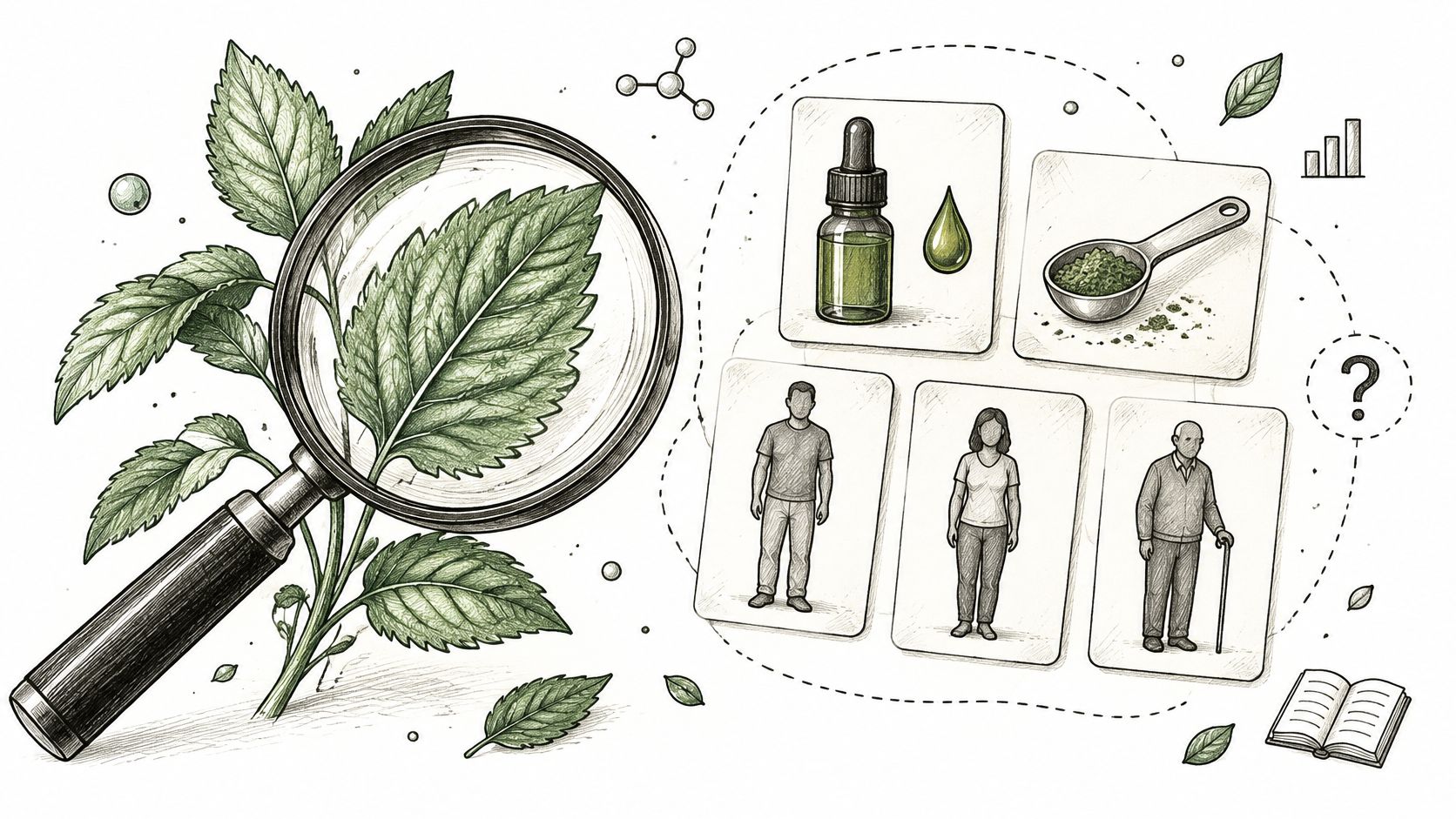
Five ideas the label implies
"Natural means safe." Plant origin doesn't cancel side effects, drug interactions, or rare liver injury. Safety still depends on the person and the product.
"More is better." Trials use a set preparation for a set time. Taking extra doesn't inherit a bigger result, and it can raise the chance of stomach upset or drowsiness.
"A blend inherits each ingredient's evidence." It doesn't. A formula can't automatically borrow trials run on ashwagandha alone. Learning how to read a Supplement Facts panel is the practical fix.
"It works on everyone within a week." People differ, and the better studies look over weeks, not a single evening. Perceived stress, sleep quality, fatigue, and anxiety aren't swap-in words.
"It balances hormones on its own." Some trials measure cortisol, with uneven results. That isn't the same as correcting a hormone disorder.
Label claim | What evidence can support | What to check |
|---|---|---|
Balances cortisol | Some trials measure cortisol, with varied results | Whether the study measured cortisol in people like you |
Boosts energy | Fatigue scores improved in some small trials | Daytime energy against your own two-week baseline |
Calms anxiety | Perceived-anxiety scales improved in some randomized trials | Dose and duration match the studies cited |
Improves sleep | Five randomized trials pooled showed modest gains over placebo | Sleep log at 4, 8 and 12 weeks |
Treats or prevents a disease | No basis for disease treatment claims | Treat as a red flag and avoid the product |
Adaptogen blend works like ashwagandha alone | Ingredient-specific evidence does not transfer to blends | Amount of each ingredient listed on the label |
A realistic expectation is modest change, tracked over a defined period such as 8 to 12 weeks, before you decide the product is doing anything. If nothing moves on the measure you chose, stop. Raising the dose because the category sounds promising isn't a plan.
Deciding Whether Adaptogenic Support Fits You
Efficacy is the second question. The first is who shouldn't experiment alone. U.S. guidance treats short-term ashwagandha use, up to about three months, as something many adults may tolerate, while long-term safety isn't established, per the NIH consumer fact sheet on ashwagandha. Reported effects include drowsiness, stomach upset, diarrhea, and vomiting. Rare cases have linked supplements to liver injury, and there are possible effects on thyroid function.
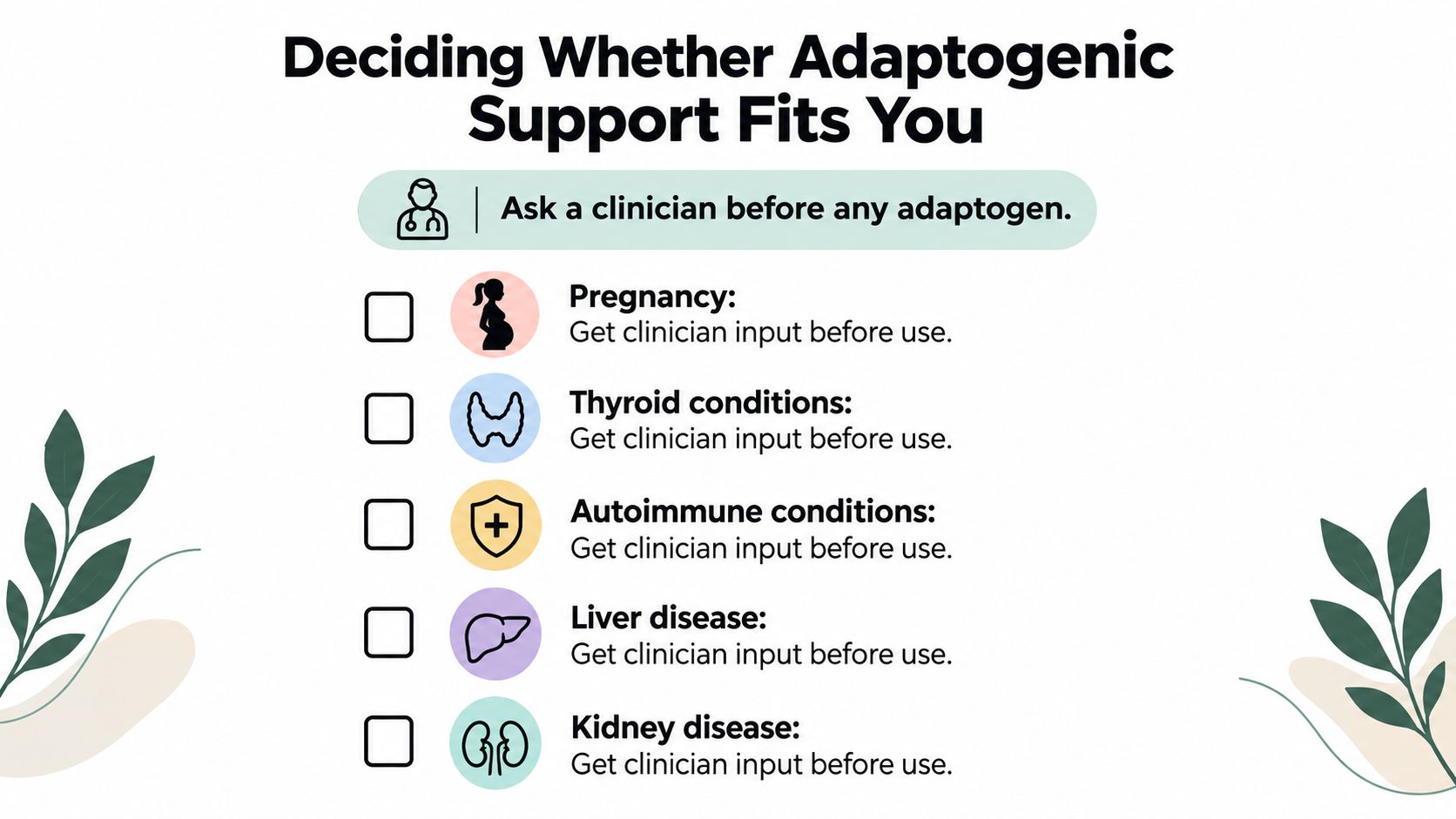
Group | Why caution applies | Practical step |
|---|---|---|
Pregnant or breastfeeding | NCCIH advises caution or avoidance | Skip unless a clinician approves |
Thyroid disorder or thyroid medication | Possible effects on thyroid function and interactions | Ask a prescriber before starting |
Autoimmune disorder | NCCIH advises caution | Get clinician review first |
Liver or kidney disorder | Rare liver injury reports; limited long-term data | Clinician review and monitoring |
Taking sedatives, anticonvulsants or immunosuppressants | Possible interactions and added drowsiness | Pharmacist check before the first dose |
Diabetes or blood-pressure medication | Possible interactions | Monitor readings and tell the prescriber |
Scheduled surgery | NCCIH advises caution before surgery | Tell the surgical team and follow its instructions |
A five-step way to test the claim
Name the goal. Stress, sleep, or fatigue. Not a disease, and not all three at once.
Read the label. Ingredient name, root only versus root and leaf, dose per serving, and whether the maker documents batch testing and identity. Don't copy a result from one standardized extract onto every ashwagandha preparation.
Keep the trial short. Stay inside the window where short-term use is considered something many adults tolerate. Longer use isn't well established, and commercial blends aren't the same as the single preparations used in trials.
Watch for problems. Drowsiness, stomach upset, diarrhea, or vomiting are reasons to pause. Dark urine, yellowing skin, or abdominal pain means stop and get care the same day.
Review first if you match a caution row. A pharmacist or clinician should see the plan before the first capsule. Interactions can include thyroid hormones, sedatives, anticonvulsants, immunosuppressants, and some diabetes or blood-pressure medicines. More detail sits in this guide to ashwagandha interactions.
Sleep problems that aren't a supplement question
Get clinical care if sleep trouble lasts more than a few weeks, if there's loud snoring with breathing pauses, or if daytime function is clearly impaired. Those patterns need a diagnosis. Another botanical won't sort out breathing pauses or a mood disorder that has been building for months.
Where a multi-ingredient capsule fits
River of Life Capsules are one vegan option in this category. The formula pairs ashwagandha root with turmeric extract and BioPerine, ginger, and bromelain. The ashwagandha is only one factor to check. Turmeric, pepper extract, ginger, and bromelain each raise their own interaction questions, so the blend isn't equivalent to the evidence for ashwagandha alone. Judge it the same way you'd judge any other bottle. Herb, amount per serving, how long you plan to try it, and whether your medicines or conditions put you in a caution row.
River of Life publishes The ROL Journal with plain-language pieces on stress, sleep, and botanicals, and it sells a vegan capsule you can check ingredient by ingredient instead of trusting a category word. Bring the questions from this article, the herb, the dose, the duration, and who should skip it, to the label before you start a short tracked trial. Visit River of Life and read the Supplement Facts before you decide whether a bottle belongs in that trial.