


Balance Hormone Supplement Guide: What Works

Most advice about a balance hormone supplement starts in the wrong place. It treats hormones like a single dial you can turn up or down, when the issue is usually a mix of stress load, sleep quality, and inflammation showing up as the same tired, foggy, irritable feeling.
Hormones are chemical messengers, and they work in feedback loops, not isolation. Change one pathway, and others shift with it. That's why a supplement that helps one person sleep better might do almost nothing for someone whose main issue is blood sugar swings, perimenopause, or a thyroid problem.
The smarter question is simpler: what symptom pattern do you have, and what pathway is most likely involved? That's how to separate a useful supplement from a generic wellness product.
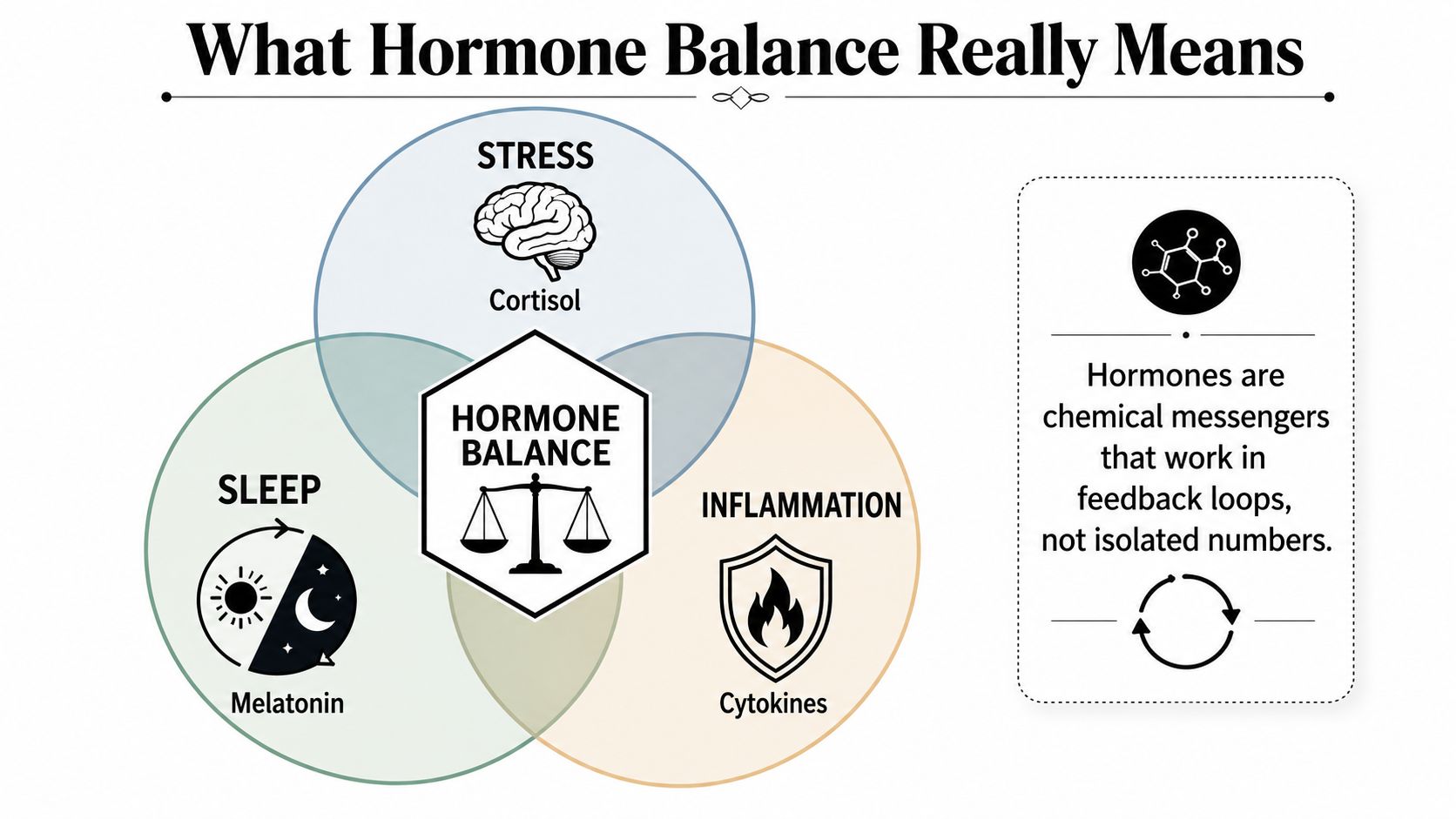
Table of Contents
What Hormone Balance Really Means
A balance hormone supplement usually gets marketed like a fix for one broken switch. Hormone balance is more like keeping several dials in sync. Cortisol, thyroid hormones, insulin, estrogen, progesterone, and testosterone all influence one another, so a formula that focuses on only one pathway can miss the reason someone feels off.
That is why symptoms matter more than buzzwords. People usually look for hormone support because of fatigue, mood swings, sleep trouble, cravings, weight changes, or cycle shifts, long before any lab work gives a tidy answer. Those patterns can look similar even when the cause is different.
Menopause and perimenopause show how broad the picture can be. The CDC says most women experience menopause between 45 and 55, and about 1.3 million women reach menopause each year in the U.S. The NIH/StatPearls summary notes that 75% to 80% of women experience vasomotor symptoms, 50% to 75% experience genitourinary syndrome of menopause, and psychogenic symptoms can occur in up to 70% during perimenopause and menopause. For a wider context on women's health needs, see River of Life's women's wellness resources.
A useful way to think about hormone support is pathway-first. Some ingredients fit stress-axis support, others fit inflammation, sleep quality, or metabolic support. That is why a broad “balance” claim can be misleading. It may sound inclusive while hiding a mismatch between the ingredient and the problem.
Practical rule: choose a supplement for the symptom cluster first, then check whether the ingredient profile fits that cluster.
A person whose symptoms come from stress-driven burnout needs a different product than someone in perimenopause. Someone whose fatigue is tied to thyroid disease needs a different conversation again. The label matters less than the pattern underneath it.
Common Causes and Signs of Hormonal Imbalance
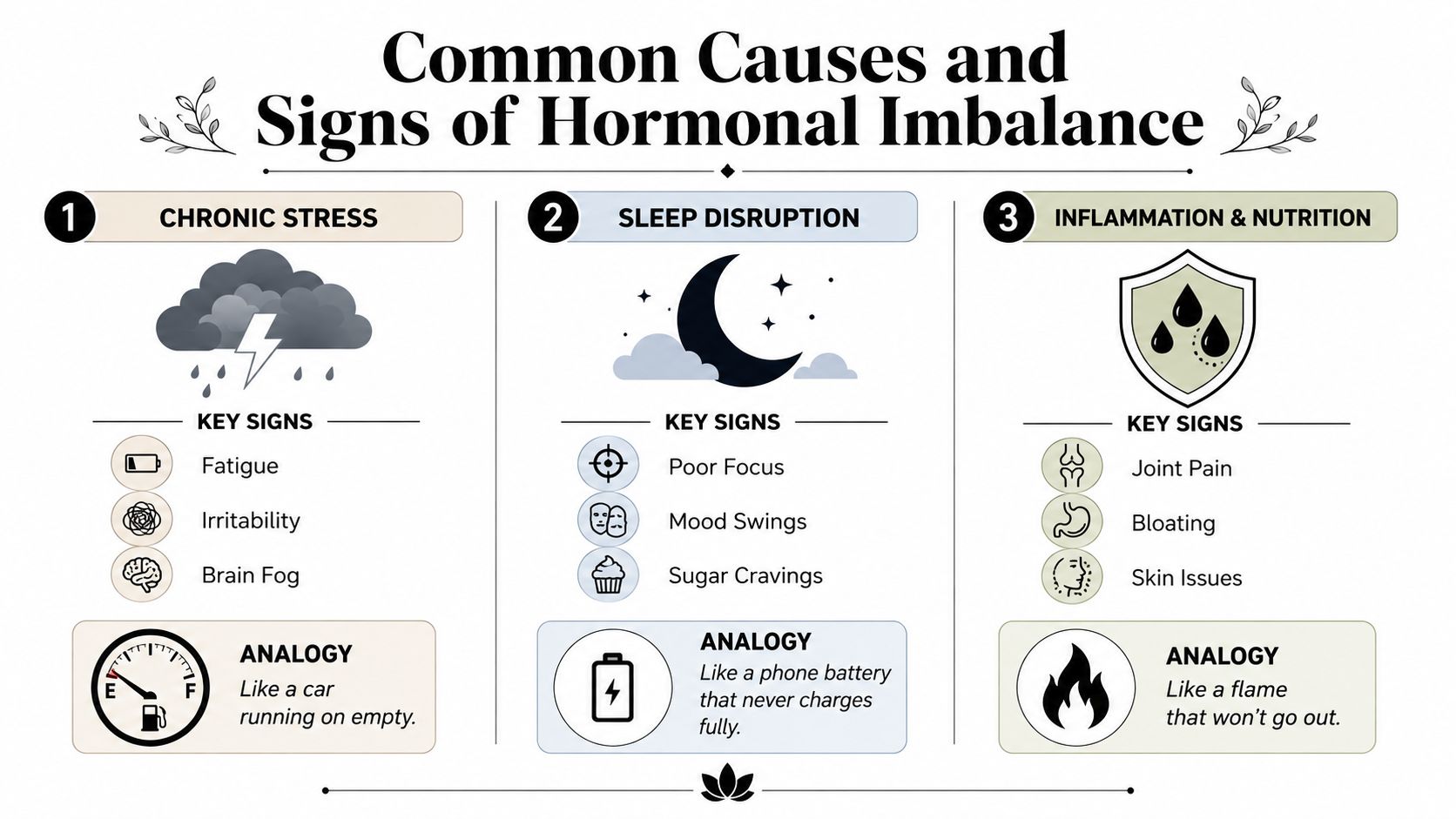
A useful balance hormone supplement starts with pattern recognition, not guesswork. Three clusters show up again and again, stress, blood sugar, and inflammation, and each one leaves a different trail. Sorting the trail first makes it easier to know what kind of support might fit.
Stress that keeps the body switched on
Chronic stress can act like a thermostat stuck too high. The body stays in alert mode, and the result can be afternoon crashes, brain fog, poor sleep, irritability, and that wired but tired feeling. When stress signals stay high or mistimed, recovery takes longer and sleep tends to feel lighter than it should.
Blood sugar swings that drain energy
Blood sugar instability often looks like a battery that never finishes charging. Energy starts out steady, then dips, cravings show up, and the cycle repeats. People often notice cravings, shakier energy, stubborn belly weight, and trouble focusing after meals, which is why insulin support can matter more than a vague promise of “hormone balance.”
Inflammation that shows up everywhere
Inflammation is less obvious, but it can touch many systems at once. It may show up as bloating, joint discomfort, skin issues, and a general sense of heaviness. Symptoms also overlap a lot. The NIH/StatPearls summary describes how hot flashes, joint or muscular discomfort, and depression can all appear in the same broad symptom picture, which is one reason a single label rarely tells the whole story.
Pattern recognition beats self-diagnosis. Cycle irregularity, acne, or hair shedding can point in a different direction from stress-heavy fatigue. Perimenopause, thyroid issues, and PCOS can overlap with these buckets, but they are not the same thing.
Evidence-Backed Ingredients Worth Knowing
A balance hormone supplement works best when it matches the problem you are trying to solve. If stress, sleep disruption, and inflammation overlap, the formula should be built around those pathways instead of promising a generic hormone fix. That is why ingredient quality matters more than a long label, and why the most useful products usually pair a few ingredients with clear jobs, such as calming stress signaling, improving absorption, or supporting sleep and inflammatory tone. One of the clearest examples is ashwagandha, which has human trial data tied to standardized extract and dose, not vague “root powder” language randomized trial.
What each ingredient does
Ashwagandha fits the stress-axis side of the picture. In a randomized, double-blind, placebo-controlled study of stressed adults, 240 mg/day of standardized extract lowered morning cortisol more than placebo, with a 23% cortisol reduction versus a 0.5% increase in placebo, and it also lowered DHEA-S randomized trial. That does not make it a hormone replacer, but it does make it relevant when stress physiology is part of the pattern. For readers who want a plain-language overview of practical use, this dosage-focused guide is a useful place to start.
Turmeric or curcumin belongs in the inflammation conversation. Curcumin by itself is poorly absorbed, so the formulation matters as much as the ingredient. Piperine helps here by increasing bioavailability, and the monograph notes a human finding of up to a 2,000% increase in curcumin absorption when 2 g curcumin was combined with 20 mg piperine piperine review.
Magnesium glycinate or citrate is often used when the pattern feels like tension, light sleep, or energy swings. It is a practical choice because those symptoms often travel together. Vitamin D3 with K2 and omega-3 EPA and DHA are also common choices for broader endocrine and inflammatory support, though the right fit depends on status, diet, and the symptom pattern in front of you.
Best evidence tends to show up in symptoms, not dramatic hormone shifts. People often notice calmer stress response, clearer sleep, or less discomfort before anything resembling a lab transformation.
Evidence backed ingredients at a glance
Ingredient | Studied Dose | Primary Mechanism | Best Evidence For |
|---|---|---|---|
Ashwagandha extract | 240 mg/day in one trial | Stress-axis support, cortisol modulation | Perceived stress support, sleep-adjacent calm |
Curcumin with piperine | Example cited at 2 g curcumin + 20 mg piperine | Better absorption, inflammatory tone | Inflammation-linked discomfort |
Magnesium glycinate or citrate | Use depends on elemental magnesium content | Nervous system and metabolic support | Sleep quality, tension, steadying support |
Vitamin D3 with K2 | Status dependent | Endocrine and bone-related support | General hormone-related wellness support |
Omega-3 EPA and DHA | Dose depends on formula | Inflammatory balance | Inflammation-linked symptoms and recovery |
The takeaway is simple. Standardization matters more than buzzwords. A label that names the extract and dose gives you more to work with than one that only says “proprietary blend.”
How Multi-Ingredient Formulas Work Together
A good multi-ingredient formula is not just a longer ingredient list. It works more like a small team, with complementary mechanisms, absorption support, and sometimes buffering. That matters because stress, inflammation, and sleep problems often overlap, so one ingredient rarely explains the whole picture.
Why combination formulas can make more sense
One ingredient can calm stress signaling while another supports inflammatory tone. That is a better model than expecting a single botanical to do everything. In the River of Life formula, the public ingredient positioning centers on turmeric extract with BioPerine, ashwagandha root, ginger, and bromelain, which fits the idea of addressing comfort, stress, and recovery pathways together without claiming one ingredient fixes every symptom.
Bioavailability is one of the clearest synergy principles. Piperine is not a hormone balancer itself, but it can help curcumin reach the body more effectively, which matters if the ingredient's job is downstream inflammation support. Without that support, a formula may look advanced on the label and still underdeliver in the body.
Another useful principle is ratio over count. Ten low-dose ingredients can look impressive and do very little. Three or four well-chosen ingredients, each at a meaningful dose and with a clear purpose, usually tell you more about the brand's formulation discipline.
What to watch for in a formula
Complementary pathways: one ingredient for stress, another for inflammation, another for digestion or sleep.
Absorption logic: ingredients that help other ingredients reach circulation.
Realistic dosing: enough of each ingredient to matter, not just enough to decorate the label.
What gets mistaken for science
A kitchen-sink label can hide weak dosing behind big claims. That is why you should read the ingredient story, not just count the items listed. A focused formula can be smarter than a crowded one.
How to Choose a Quality Balance Hormone Supplement
A good balance hormone supplement starts with a clearer question than the label usually asks: what is the product trying to support, stress, sleep, or inflammation, and does the formula match that goal? If a bottle promises everything, it often explains very little. Quality begins with evidence you can see.
Look first at the ingredient panel. Standardized extracts tell you whether the herb includes the compounds people study, such as withanolides in ashwagandha or curcuminoids in turmeric. A proprietary blend hides that detail, so you cannot tell whether the formula uses a useful amount or just enough to decorate the label.
Dose matters just as much as ingredient choice. A meaningful formula lists the amount per capsule or serving, not only a total blend weight. That makes it easier to compare products and judge whether the label lines up with human data.
Third-party testing is another filter worth using. Verification from NSF, USP, or an independent lab can help show that what is on the label is closer to what is in the capsule. If a company offers a certificate of analysis, that is a stronger sign of quality control than a polished claim page.
Clean label signals that matter
A cleaner label can make day-to-day use easier to trust, but the details matter more than the marketing. Non-GMO verification, minimal fillers, and clear sourcing or manufacturing information all help you understand how the product is made. If those signals are missing, that does not automatically make the supplement poor, but it does mean you need more proof from the company.
A simple comparison test helps cut through the noise. If two products claim the same benefit, choose the one that states the extract standardization, the capsule dose, and the testing standard in plain language.
Here is a short checklist you can screenshot:
Standardized extract listed
Dose shown per capsule or serving
Third-party testing disclosed
Minimal fillers and clear excipients
Brand explains sourcing and manufacturing
If one product checks all five boxes and the other does not, the choice usually becomes clear.
Dosing Duration and What to Expect Over Time
Supplements that support stress, sleep, or inflammation usually need time before you can tell whether they're helping in a real, repeatable way. If you change five habits at once and start a new capsule on Monday, you'll have no idea what worked. Quitting too early or judging too fast undermines your progress.
What a realistic timeline looks like
Early subjective changes often show up in two to four weeks, especially with better sleep continuity, calmer evenings, or less day-to-day tension. More measurable shifts usually take longer, often six to twelve weeks, because body systems don't reset overnight. If the goal is chronic stress support or a perimenopausal pattern, the supplement may need ongoing use before you can judge whether it's worth keeping.
Track the right things. A simple weekly journal works better than obsessing over scale weight or one dramatic symptom. Write down sleep quality, cycle regularity, energy, mood, digestion, and how often symptoms interrupt your day.
How to judge whether it's working
If you're sleeping better but your energy is still flat, the formula may be helping one pathway while missing another. If mood improves but bloating doesn't budge, that tells you something too. Results should be read as a pattern, not a single good night or a single bad one.
Supplements are inputs, not outputs. They work best when sleep, movement, and nutrition are already moving in the right direction, even if imperfectly. That doesn't mean you need a perfect lifestyle before starting one, but it does mean no capsule can outrun a chaotic baseline forever.
If you're using a formula continuously and the same symptoms keep returning after a fair trial, it's time to reassess the stack. Some people do better with cycling, some with ongoing use, and some with a different ingredient match altogether.
Safety Interactions and When to See a Clinician
Plant-based doesn't mean risk-free. That's the biggest misconception in this category, and it causes real problems when people stack supplements on top of prescriptions or an undiagnosed condition. The right move is not fear, it's fit.
Ashwagandha is a good example. Independent guidance flags caution for pregnancy, hyperthyroidism, thyroid medication, sedatives, immunosuppressants, and liver disease, which is a reminder that a supplement aimed at stress support can still affect other systems ashwagandha safety guide. For more on interaction questions, see this ashwagandha interaction guide.
Common red flags
See a clinician instead of self-supplementing if you have:
New or worsening fatigue
Unexplained weight changes
Hair loss in clumps
Persistent mood shifts
Severe cycle irregularities
Postpartum symptoms
Perimenopausal symptoms that feel intense or rapidly changing
Those symptoms can overlap with thyroid disease, diabetes, perimenopause, or other conditions that need evaluation. A supplement may still have a role later, but not before the basics are clear.
Labs that may help, and why
A doctor may look at TSH, free T3, free T4, cortisol rhythm, sex hormones, or fasting insulin depending on the symptom pattern. Those tests help map the problem, but no single panel tells the whole story. Symptoms, timing, medication use, and medical history still matter.
If you're pregnant, nursing, or taking prescription medication, the safest approach is to check compatibility before starting anything. If you already have a diagnosed condition, bring the supplement label to the appointment instead of trying to interpret the panel alone.
For many, the best next step is straightforward. If the symptoms are mild and pattern-based, choose a focused formula and track it. If the symptoms are broad, severe, or changing fast, get the clinical picture first.
River of Life formulates around the overlap between stress, sleep, inflammation, and daily comfort, which is exactly where many people start looking for a balance hormone supplement in the first place. If you want a capsule-based, education-first approach that fits that kind of routine, visit River of Life and read the product details before you decide what belongs in your stack.