


Best Supplements for Joint Stiffness: Top Picks 2026

You wake up, swing your legs out of bed, and your knees feel older than the rest of you. Or maybe you stand after a long drive and your hips need a minute to cooperate. That's the kind of stiffness that sends people searching for the best supplements for joint stiffness.
The problem is that most lists mash everything together. Morning stiffness. Workout soreness. Osteoarthritis. Inflammatory arthritis. Aging joints. They're not the same issue, so they shouldn't get the same answer.
A better approach is simple. First ask why you're stiff. Then look for ingredients that match that pattern. Then check the label for the details that decide whether a supplement has a real shot at helping, especially absorption and quality testing.
Table of Contents
Exploring Omega-3s Collagen and Other Joint Support Compounds
Beyond the Bottle Making Sure Your Supplements Actually Work
Why Your Joints Feel Stiff and How Supplements Can Help
You get up from the couch and your knees argue for the first ten steps. Or your hands feel thick and slow first thing in the morning, then loosen as the day goes on. Those details matter. Stiffness is a symptom, not a diagnosis, and the pattern often gives the best clue about which supplement category is worth your time.
A few common drivers show up again and again. Mechanical irritation from osteoarthritis. Inflammatory activity. Training-related soreness. Long periods of inactivity. These can feel similar in daily life, but they do not respond the same way.
If stiffness is strongest after sitting and improves with movement, that often lines up with age-related joint changes or mechanical wear. If you also notice warmth, visible swelling, or prolonged morning stiffness, get that assessed. If the problem spikes after hard workouts, recovery support may fit better than a cartilage-focused formula.
The practical takeaway is simple. Match the supplement to the reason you feel stiff.
Use this filter before you buy:
Osteoarthritis-type stiffness: Focus on ingredients studied for pain, function, and mobility in osteoarthritis.
Inflammatory patterns: Look for products discussed in inflammatory joint conditions, not just generic “joint comfort.”
Post-exercise stiffness: Prioritize recovery support and ingredients used for inflammatory soreness.
General age-related stiffness: Put symptom relief, mobility, and product quality at the top of the list.
Label reading matters too. A promising ingredient is less useful if the form is weak or the dose is vague. For turmeric, for example, it helps to know how curcumin is used for arthritis and joint pain support and why formulas often include absorption enhancers. The same logic applies across the board. Standardized extracts, clearly listed amounts, and forms with better bioavailability tend to give you a fairer shot at seeing results.
Practical rule: Supplements can support comfort and movement. They do not replace diagnosis, rehab, or prescribed treatment.
Research on joint supplements is mixed, which is why I push readers to stay realistic. Some ingredients show useful short-term symptom relief in the right setting. Others are overhyped, underdosed, or studied in forms that do not match what is sold on the shelf. That gap is where many people waste money.
A good supplement plan aims for something more modest and more useful. Less stiffness when you stand up. Better comfort on stairs. Easier movement in the morning. If you choose based on the cause, and you pay attention to form, dose, and absorption, your odds improve.
The Power Botanicals Turmeric Ginger and Bromelain
If I had to narrow the field fast, I'd start with botanicals that target inflammatory signaling. That's where many people with daily stiffness get the most practical value.
Think of inflammation as the body's alarm system. In stiff joints, that alarm can stay louder than it needs to be. Certain botanicals help turn the volume down.
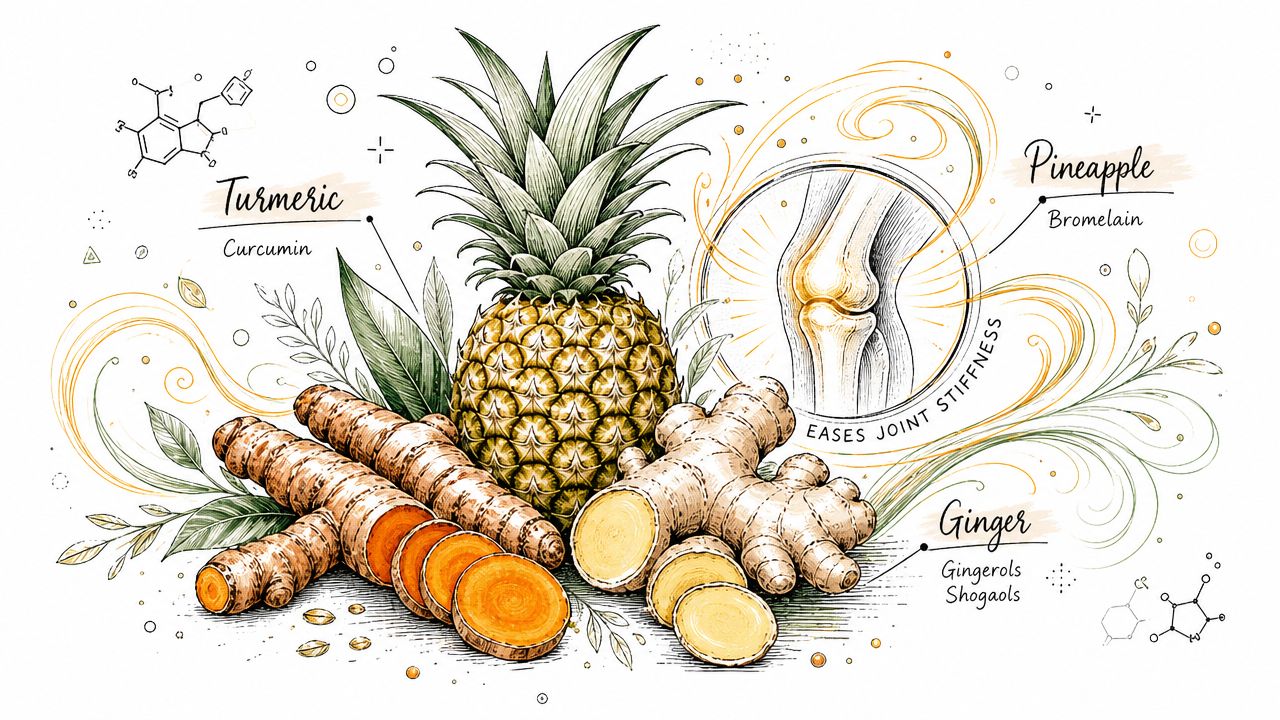
Turmeric and curcumin lead the conversation
Turmeric, and more specifically curcumin, has become a first-choice natural option in many evidence summaries for knee osteoarthritis. In one widely cited 2022 meta-analysis discussed in joint-health coverage, curcumin significantly reduced pain and improved function in people with knee osteoarthritis, reinforcing earlier findings that turmeric extracts can help with joint pain and stiffness.
That matters because people usually don't care about lab wording. They care whether their knees feel less stubborn when they walk, squat, or get up from a chair.
A few practical points make turmeric more useful in practice:
Choose extracts, not vague spice marketing: You want a supplement that makes clear what form of turmeric it uses.
Take formulation seriously: Turmeric's reputation now depends as much on absorption strategy as on the ingredient itself.
Use it for symptom support: The evidence fits day-to-day comfort better than structural joint repair.
If you want a plain-language breakdown of that mechanism, this guide on how turmeric curcumin helps with arthritis joint pain is a useful companion read.
Ginger is underrated for stiffness
Ginger often gets overshadowed by turmeric, but it deserves a place in the discussion. An arthritis resource referenced in the verified data notes that ginger has anti-inflammatory effects similar to COX-2 inhibitors, and that specific ginger extracts reduced knee osteoarthritis pain over time.
That doesn't mean ginger is a drug substitute. It means it has a credible role in symptom support, especially when stiffness and soreness travel together.
Ginger makes sense for people who feel stiff and achy, not just stiff.
Bromelain works differently
Bromelain, an enzyme derived from pineapple, is a different kind of tool. It's often used in formulas aimed at swelling, soreness, and recovery. It doesn't carry the same headline research profile here as curcumin, but it fits well in combination formulas because it addresses a different part of the discomfort picture.
A smart blend can use:
Curcumin for broad anti-inflammatory support
Ginger for additional inflammatory pathway support
Bromelain for soreness and tissue-recovery support
Who these botanicals fit best
Here's the simple decision logic:
Stiffness pattern | Most relevant botanical angle |
|---|---|
Knee stiffness with osteoarthritis-type symptoms | Curcumin is the clearest first look |
Achy stiffness after activity | Ginger and bromelain can make sense |
General daily stiffness with movement | A combination formula is often more practical |
The label still matters as much as the ingredient list. A weak turmeric product with poor absorption can disappoint even if the ingredient sounds impressive.
Exploring Omega-3s Collagen and Other Joint Support Compounds
A lot of joint products end up in the same mental bucket. That's a mistake.
These compounds do different jobs. The smarter question is not, “Which joint supplement is best?” It's, “Why am I stiff, and which ingredient matches that pattern?”

Omega-3s fit inflammatory stiffness better
Omega-3s make more sense when stiffness comes with an inflammatory arthritis picture, especially rheumatoid arthritis. The Arthritis Foundation's supplement guidance points to evidence for omega-3s in rheumatoid arthritis-related stiffness and swelling. The same guidance also notes that curcumin research has focused more heavily on osteoarthritis, and that antioxidant vitamins have not shown meaningful arthritis symptom benefit.
That distinction matters in practice. If your hands or joints feel puffy, hot, and prolonged in their morning stiffness, omega-3s deserve a closer look than a generic “joint blend.”
Collagen plays a slower, structural role
Collagen attracts people for a fair reason. It is a structural protein, and joint tissues depend on structure.
Its role is usually about connective tissue support and longer-range maintenance. That is a different target from ingredients chosen for day-to-day stiffness relief. If someone tells me their main problem is getting loose in the morning or easing soreness after activity, collagen is rarely my first pick. If the goal is broader support for cartilage, tendons, or overall joint tissue quality, it becomes more relevant.
This is also where label reading starts to matter. Hydrolyzed collagen peptides are generally easier to use than vague “collagen complex” wording, and a product should tell you clearly what type and dose you are getting.
Glucosamine and chondroitin need a more realistic expectation
Glucosamine and chondroitin still have strong name recognition. Shelf presence is not the same as dependable results.
The research picture for these older staples is mixed, and many clinicians now treat them as optional rather than automatic. Some people report benefit. Many do not notice much. Evidence-based reviews have generally left more uncertainty here than with stronger osteoarthritis candidates discussed earlier.
That puts them in the “reasonable trial, modest expectations” category.
A practical way to choose
Use the symptom pattern first, then check the label.
Omega-3s: Better fit for inflammatory stiffness, especially when swelling is part of the picture
Collagen: Better fit for connective tissue support and longer-term structural goals
Glucosamine and chondroitin: Possible option, but results are less predictable
Turmeric-centered formulas: Often a stronger first look for osteoarthritis-type stiffness
If you want a broader look at symptom-based options, this guide to natural pain relief approaches for joint discomfort can help you compare where supplements fit.
The best choice depends less on shelf popularity and more on matching the ingredient to the reason your joints feel stiff in the first place.
Beyond the Bottle Making Sure Your Supplements Actually Work
A supplement can have a strong ingredient list and still fall flat. The reason is often bioavailability, which is just a technical way of asking whether your body can absorb enough of the active compound to use it.
Consider mail. The message matters, but delivery matters too. If the package never reaches the address, the message doesn't help anyone.

Why absorption matters so much with turmeric
This is especially important with curcumin. Stanford Lifestyle Medicine notes that curcumin does not absorb efficiently on its own, and that adding piperine from black pepper increases bioavailability. The same source also highlights a second issue consumers overlook. Supplement labels are not always accurate, so product quality and testing matter.
That changes how you read a label. Don't just ask, “How many milligrams?” Ask, “What form is this, and what helps it absorb?”
If you're trying to understand that bigger picture around symptom support and formulation, this article on natural pain relief approaches gives more context.
What to check on the label
A better supplement label usually includes a few useful clues:
Standardized extract: This suggests the ingredient has been prepared with a more consistent active profile.
Bioavailability enhancer: For turmeric, black pepper extract or piperine is the classic example.
Third-party testing: This helps address purity and label accuracy concerns.
Clear dosing language: Avoid labels that hide behind “proprietary blend” wording without enough detail.
A cheap bottle with a famous ingredient can be less useful than a well-formulated bottle with a smarter delivery strategy.
Red flags that deserve caution
Some labels make a product sound more scientific than it is. Be careful if you see:
Disease-treatment promises: Supplements should not be pitched like a cure.
No clarity on form: “Turmeric blend” tells you less than a defined extract.
No quality signals: If the company says nothing about testing, that's worth noticing.
This part isn't glamorous, but it's often the difference between a product that looks good online and one that's worth trying.
Building a Safe and Effective Supplement Plan
Choosing a supplement gets easier when you use a checklist instead of shopping by hype. Start with your symptom pattern. Then match the ingredients. Then audit the label.
That order matters because a well-made product for the wrong problem still misses the point.

A practical buying checklist
Use this when comparing products:
Match the formula to the reason you're stiff
If your pattern looks osteoarthritis-related, a turmeric-centered formula usually makes more sense than starting with glucosamine. If inflammatory arthritis is in the picture, the decision tree changes.Look for dose transparency
The practical ranges cited in AARP's joint-pain review include 100 to 250 mg per day for Boswellia, 1,500 mg per day for glucosamine, and 1,200 mg per day for chondroitin. The same review also notes that for ingredients like turmeric, the focus has shifted toward effective absorption, often using black pepper extract.Prefer formulas with a purpose, not kitchen-sink blends
A long ingredient list isn't automatically better. The components should work toward the same goal.Check safety against your medication list
UMass and other clinical resources raise valid concern about interactions. That matters even more if you take arthritis medication, blood thinners, or multiple daily supplements.
What a sensible all-in-one formula looks like
A practical example is River of Life Capsules, which combines turmeric extract, BioPerine black pepper, ginger, and bromelain in one capsule-based formula. That's relevant because it pairs an anti-inflammatory botanical with a bioavailability strategy, instead of relying on turmeric alone.
That doesn't make it the only option. It makes it a clear example of what to look for in a multi-ingredient product.
Here's a useful way to pressure-test any supplement before you buy:
Does the main ingredient fit my type of stiffness?
Is there anything in the formula that helps absorption?
Can I tell what form and amount I'm getting?
Would I feel comfortable showing this label to my clinician?
A quick visual overview can help if you want to see the broader discussion around turmeric and joint comfort:
How to use supplements responsibly
A good trial is structured. Take the product as directed. Keep the rest of your routine steady so you can judge it fairly. Pay attention to movement quality, morning stiffness, and how you feel after sitting, not just pain alone.
If a supplement helps, the change is usually practical. You move easier, warm up faster, and think less about the joint.
Lifestyle Strategies to Complement Your Supplement Routine
Supplements work better when your daily habits stop aggravating the same joints you're trying to help. That doesn't mean you need a perfect routine. It means the basics matter more than people think.
Movement comes first. Gentle, regular motion helps stiff joints far more than long stretches of complete rest. Walking, cycling, swimming, yoga, and mobility work are all reasonable options if they don't provoke a flare.
Food matters too. A pattern built around whole foods, fatty fish, plants, and less ultra-processed intake gives joint support a better foundation than any capsule can provide on its own. If you want a broader look at how food and supplementation connect, River of Life has a helpful post on functional nutrition trends for joint health and turmeric's role in anti-inflammatory diets.
A few habits usually pull the most weight:
Keep joints moving: Short walks and easy mobility breaks beat sitting for hours.
Build support around the joint: Strength work helps the muscles do more of the load-sharing.
Watch body strain: Extra load on irritated joints tends to amplify stiffness.
Respect recovery: Sleep and pacing matter, especially when soreness follows training.
A supplement should support your routine, not try to rescue a routine that keeps making the problem worse.
Your Next Steps for Managing Joint Stiffness
The best supplement choice usually gets clearer once you stop asking, “What's the top product?” and start asking, “Why am I stiff?”
If your symptoms look like osteoarthritis-type stiffness, turmeric or curcumin-based support is often the most evidence-aware place to start. If the picture looks more inflammatory, the logic changes. If you're dealing with post-exercise soreness, recovery-oriented ingredients may fit better than cartilage-focused ones. And whatever you choose, label quality matters. Absorption support, clear ingredient forms, and testing standards aren't extras.
Use a simple framework:
Identify the pattern: Morning stiffness, sitting stiffness, swelling, post-workout soreness.
Match the ingredient: Don't assume every joint product does the same job.
Audit the label: Look for absorption support and quality signals.
Track real-life function: Walking, stairs, standing up, and range of motion matter.
There's also a clear point where self-directed supplement use should pause and a clinician should step in. Get evaluated if you have sudden severe pain, major swelling, redness, warmth, fever, a clear injury, or a sudden loss of mobility. Also get checked if stiffness keeps worsening, wakes you regularly, or comes with symptoms that suggest something more systemic.
The goal isn't to chase every trending ingredient. It's to make a calm, informed choice that fits your body and your daily life.
If you want a simple joint-support option built around the principles in this guide, River of Life offers a turmeric-based capsule that combines black pepper extract for absorption with ginger and bromelain for broader daily support.
Written with Outrank