

How to Choose a Supplement for Chronic Inflammation

The most popular advice about a supplement for chronic inflammation is to find the capsule with the biggest CRP claim. But if your knees still make the stairs feel like a climb, or you're awake at night with an aching shoulder, a prettier lab result hasn't necessarily made your day better. The useful choice is the one aimed at a symptom you can track, taken only after a safety check, and judged after a defined trial.
Say you're considering a turmeric blend because a label promises “inflammation support.” Before buying, ask three things: What outcome do I want to change? What evidence supports this ingredient for that outcome? Could it interact with my medicines or health conditions? Those questions can separate a measured experiment from an open-ended habit.
Table of Contents
Supplements With the Strongest Inflammation Evidence
Say a gardener rates her knee pain on the stairs every morning, one to ten. A supplement earns its place only if a number like that moves inside a set window. This comparison matches each ingredient to the goal where its evidence is strongest: the winner is the one tied to a symptom you can score in eight to twelve weeks, after a safety screen, rather than the label with the boldest CRP claim.
Ingredient | Practical target | Best supported win | Check in after |
|---|---|---|---|
Curcumin or turmeric extract | Choose a standardized extract with the absorption aid named; trial doses and formulas vary | In 32 randomized trials, average changes included CRP −1.55 mg/L, IL-6 −1.69 pg/mL, and TNF-alpha −3.13 pg/mL | 8–12 weeks, symptoms before labs |
Ginger | No single established inflammation dose; a knee osteoarthritis trial used 500 mg twice daily | A small benefit for osteoarthritis pain and disability; biomarker results are mixed | 8–12 weeks |
Bromelain | Consider it only when the label states the amount; extracts aren't interchangeable | A possible supporting ingredient for post-activity soreness rather than a disease effect | Track training or stiffness |
Ashwagandha root | Look for root-only and a disclosed amount; there's no single established inflammation dose | A possible fit for stress and sleep goals rather than a CRP target | Keep sleep notes for a few weeks |
BioPerine black pepper extract | An absorption aid paired with turmeric rather than the hero ingredient | The product information cites increased turmeric absorption of up to 2,000%; greater absorption doesn't automatically improve safety or benefit | Alongside the turmeric trial |
Curcumin leads on lab markers. Whether it changes how you feel is a separate question. A 2021 systematic review and meta-analysis in Nutrition Reviews pooled 32 randomized controlled trials with 2,038 participants, 28 of them suitable for quantitative analysis. Compared with control groups, oral curcumin was associated with an average CRP reduction of 1.55 mg/L (95% confidence interval 1.30–1.81), an IL-6 reduction of 1.69 pg/mL, and a TNF-alpha reduction of 3.13 pg/mL. The analysis also reported changes in IL-8, MCP-1, and IL-10. Those are average shifts in blood markers across trials with different doses, formulations, participants, and durations. A capsule that moves a lab value can still leave a painful knee painful.
Ginger plays a different role. In a trial covered by a systematic review of ginger trials, older adults with knee osteoarthritis took 500 mg of ginger powder twice daily for 12 weeks; TNF-alpha fell compared with placebo, while IL-1 beta did not change significantly. An umbrella review found a small, statistically significant effect on osteoarthritis pain and pain-related disability, with the wider biomarker evidence limited and inconsistent. Ginger fits best as a symptom-support adjunct, judged on pain and function rather than on a promised lab shift.
Bromelain shows up in recovery blends aimed at post-activity soreness. Ashwagandha root is more naturally matched to stress and sleep goals. BioPerine exists to help a turmeric extract absorb. None of the three carries the trial support to be sold as a proven CRP reducer.
Before comparing bottles, circle one goal: joint pain, mobility, post-workout soreness, sleep, or stress. For a side-by-side look at how the two most common picks are positioned, see this guide to turmeric versus ashwagandha for inflammation. A supplement can only be judged fairly when the goal is specific and the window is set.
What Chronic Inflammation Is Doing in the Body
Say a café owner wakes up with stiff hands every morning for a year. No injury, no single bad day, just a low-grade ache that never quite leaves. Acute inflammation works like a smoke alarm: after a cut or a hard workout, the body mounts a response, healing happens, and the alarm stops. Chronic inflammation is that same alarm stuck on. It can stay active while a person notices stiff joints or other ongoing health concerns.

Blood tests offer clues, but they are not a complete readout of what a person feels. CRP and hs-CRP are broad markers of inflammation. IL-6 and TNF-alpha are messenger proteins involved in inflammatory signaling. A lower result can be a real laboratory change and still be too small, too variable, or too detached from symptoms to make a painful knee work better.
That gap shows up in trials involving people who already have inflammatory or metabolic conditions. A systematic review of turmeric and curcumin in chronic conditions assessed 19 randomized trials in people with rheumatic diseases, advanced chronic kidney disease requiring hemodialysis, metabolic syndrome, or cardiovascular disease. Five turmeric trials included 356 participants, and 14 curcumin or curcuminoid trials included 988 participants. CRP changed by −2.71 mg/L, but the confidence interval ran from −5.73 to 0.31 mg/L and the result was not statistically significant. The hs-CRP change was −1.44 mg/L, with a confidence interval from −2.94 to 0.06 mg/L, also not statistically significant. IL-6 and TNF-alpha reductions were not statistically significant either. A promising average does not settle the question for every population.
Later evidence has reported more favorable average changes in CRP, IL-6, and TNF-alpha, while variation between studies remains an important limitation. The practical stance is caution, not dismissal. Curcumin may moderate selected markers, but those markers do not establish a diagnosis or show that an individual's symptoms will improve.
A lab result measures a signal in blood. Your stairs, sleep, and daily comfort tell you whether life feels different.
Safety Checks Before a High Absorption Formula
Say a retired nurse with a stiff knee takes a daily blood thinner, a beta blocker, and a blood-glucose drug. She adds a concentrated curcumin capsule with an absorption enhancer, and now three prescriptions share space with a compound her body takes up far more readily than kitchen turmeric. Anyone on prescription medicines, living with liver disease, pregnant or breastfeeding, or facing surgery should check with a clinician before starting a concentrated or high-absorption turmeric product. The amount and form matter: turmeric in food is a different exposure from a concentrated extract.
The NCCIH turmeric safety guidance says conventional oral turmeric is likely safe at recommended amounts for up to 2–3 months, while some higher-bioavailability formulations have been associated with liver injury. If warning symptoms appear, stop taking the product and seek medical advice.
Stop and get help: fatigue, nausea, poor appetite, dark urine, or jaundice can be possible warning signs of liver injury.
Situation | Why the risk changes | What to do |
|---|---|---|
Everyday culinary turmeric | Conventional oral turmeric is considered likely safe at recommended amounts for up to 2–3 months | Don't treat food use as equivalent to a concentrated extract |
High-bioavailability curcumin | Some enhanced formulas have been associated with liver injury | Stop for warning symptoms and contact a clinician |
Anticoagulants or antiplatelet drugs | A potential interaction may affect bleeding risk | Review the supplement with the prescriber before starting |
Beta blockers, blood-glucose drugs, or immunosuppressants | Reports flag possible interactions with these medicines | Don't add a concentrated product without medication review |
Pregnancy or breastfeeding | Safety of concentrated turmeric products isn't sufficiently established | Avoid the extract unless your clinician advises otherwise |
Surgery coming up | Bleeding and immune effects may matter around an operation | Tell the surgical team and ask when to pause |
Some reports flag possible interactions between turmeric products and anticoagulants, antiplatelet medicines, beta blockers, blood-glucose drugs, and immunosuppressants, and safety during pregnancy and breastfeeding remains insufficiently established. If you take medicines or manage more than one health condition, bring the full ingredient label to that review so the clinician sees every component, including any absorption enhancer.
Older adults juggling arthritis alongside diabetes, cardiovascular disease, autoimmune conditions, or several prescriptions have the most at stake in that conversation. Supplements slip off medication lists easily: the Centers for Medicare & Medicaid Services reported that more than 75% of community-dwelling Medicare beneficiaries used vitamins or dietary supplements in 2024, and more than 65% reported vitamin D use, in its 2024 early-release supplement-use tables. Write each supplement down beside your prescriptions.
Persistent swelling, fever, or unexplained pain deserves medical assessment rather than a higher supplement dose. Once the safety screen is clear, give the product a defined trial tied to a symptom you can score in eight to twelve weeks, a knee on stairs or morning stiffness, instead of letting a capsule become a permanent, unreviewed habit.

Why the Same Herb Can Work or Fail
Say a shopper picks up two turmeric bottles. Same herb, same milligrams on the front, very different products inside. Plain curcumin passes through the body poorly, so piperine, the black pepper extract sometimes sold as BioPerine, acts like a key that lets more of it through the door. A capsule built with an absorption aid is a different thing from turmeric stirred into soup.
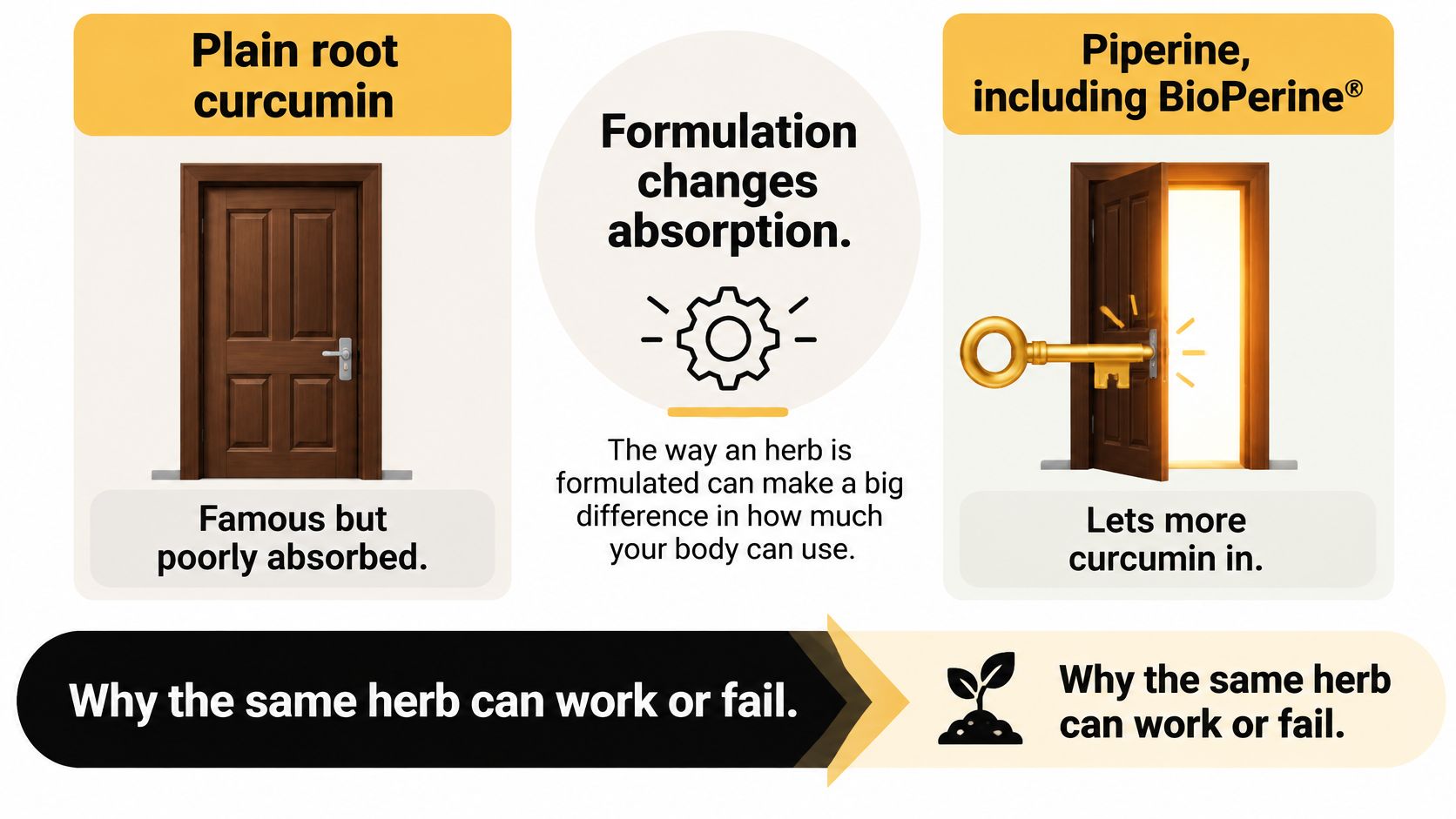
More absorption isn't automatically a better deal. A formulation that changes how much of an ingredient the body takes up can change the risk profile too. A high percentage printed on a label tells you nothing about whether the serving is clear, whether that formula suits your situation, or whether the maker tests the product batch after batch.
Ginger shows why blood markers and symptoms don't always move together. In a 12-week randomized study of 100 adults with mild knee osteoarthritis, steamed ginger extract improved pain and WOMAC outcomes and reduced TNF-alpha and IL-1 beta compared with placebo, while hs-CRP, erythrocyte sedimentation rate, MMP-9, and TIMP-1 did not change significantly. A review of ginger's anti-inflammatory effects reported changes in some markers alongside wide variation between trials, with heterogeneity approaching 90% or higher for several outcomes. A capsule can't promise a predictable drop in chronic inflammation just because the mechanism sounds plausible.
A powder and an extract aren't interchangeable unless the label explains the form and standardization. Before buying, check whether the label makes it possible to tell what you'll take.
Label item | What good looks like | Red flag |
|---|---|---|
Plant part and form | Names the plant part, such as root or rhizome, and states whether it's powder or extract | Generic herbal blend with no plant part |
Daily amount | Lists milligrams per serving | Proprietary blend hides the amounts |
Standardization | Names an extraction ratio or marker compounds, such as curcuminoids | Lists only the herb name |
Absorption aid | Identifies the piperine amount when present | Claims an absorption percentage without explaining its basis |
Quality verification | Identifies independent verification, such as USP or NSF, and batch testing for contaminants | Says nothing about independent testing |
Storage and shipping | Explains how stability is protected in heat and transit | Offers no information about shipping conditions |
The details behind curcumin bioavailability belong on the label and in your safety discussion. If a blend hides ingredient amounts or never names its extract form, you can't judge whether it fits your goal. The formula that earns a place is the one tied to a symptom you can score over eight to twelve weeks, after a safety screen, not the one making the boldest inflammation claim.
Daily Routines for Joints Stress and Recovery
A supplement makes the most sense when it fits a routine you can keep. Mara has creaky knees and wants stairs to feel more manageable. She keeps her prescribed care in place, takes one clearly labeled turmeric formula with a meal as directed, and records stiffness and stair comfort rather than adding multiple curcumin products at once.

Andre lifts weights and notices soreness after training. He already uses ginger in meals and protects his recovery with sleep and a sensible training schedule. If a blend includes bromelain, he treats it as a possible part of a recovery routine, not a reason to chase a CRP result.
Lena is wired at night and wakes feeling as if she never fully settled. Her practical target is sleep continuity and stress, so she tracks nights awake and how long it takes to feel calm at bedtime. If she considers ashwagandha root, she keeps the goal there rather than buying it for an inflammation claim.
The shared basics help make any trial easier to interpret: eat regular meals with protein and plant foods, take a daily walk if it's appropriate for you, keep alcohol modest, and aim for a consistent sleep schedule. Don't change several habits and supplements at once, or you won't know what made a difference. For another way to think about recovery supplements and muscle soreness, keep the target concrete: better recovery from activity, not a claim that one ingredient treats every ache.
River of Life Capsules are one combined option for people who want a vegan capsule with standardized turmeric extract and BioPerine, alongside ashwagandha root, ginger, and bromelain. The company offers a 60-capsule bottle as a one-time purchase or through subscription options, with a 30-day return window for unopened bottles. Treat it as an adjunct for comfort, stress resilience, sleep, or recovery, not as treatment for a disease.
Here's a short video to accompany a steady, everyday approach to movement and routine.
Set an Eight Week Trial and Judge the Result
Before your first capsule, decide what “working” would look like in your actual day. A supplement might be intended for joint function, post-exercise soreness, sleep continuity, or stress, but each goal needs its own measure. A lower blood marker doesn't count as a personal win if you still can't walk comfortably, sleep through the night, or finish your planned workouts.
The National Center for Complementary and Integrative Health describes early positive evidence for turmeric or curcumin in knee osteoarthritis pain, stiffness, mobility, and function, while noting that the evidence isn't definitive and that enhanced-bioavailability products need more study. A recent review of turmeric and curcumin outcomes highlights the distinction between changing a marker and improving symptoms or quality of life.
Five steps for a fair trial
Write one goal and a baseline. For knee discomfort, record a pain score, morning stiffness, or how far you can walk before stopping. For sleep, note nights woken and minutes awake. Use a goal you can check again, not a broad promise to “reduce inflammation.”
Screen for safety first. Ask a clinician or pharmacist before starting if you take anticoagulants, diabetes medicines, immune-suppressing drugs, or other prescriptions that may interact. Bring up liver history, pregnancy or breastfeeding, and planned surgery, too.
Choose one transparent formula. Check the plant form, daily amount, standardization, and absorption aids. Don't stack multiple turmeric or curcumin products, because overlap can make your trial harder to judge and your exposure less clear.
Keep the routine steady. Take the product as directed on its label, with a meal if that's what the instructions specify. Keep your usual walking, food, sleep, and training habits as consistent as you can, so a change in your score has some context.
Compare at week 8, then by week 12 at the latest. Continue only if the measure you chose has improved in a way that matters to you and you haven't developed concerning symptoms. If nothing meaningful changed, stop rather than extending the experiment indefinitely.
Goal | Measure | How often | Judge at week 8 |
|---|---|---|---|
Joint pain and function | 0–10 pain score, morning stiffness in minutes, walking distance before stopping, or days using rescue pain relief | Weekly | Compare with baseline |
Post-exercise soreness | Next-day soreness rating and whether planned sessions happened | After each session | Compare completed sessions with planned sessions |
Sleep | Nights woken and minutes awake | Nightly log | Look at the weekly trend against baseline |
Stress | Daily mood or tension rating | Daily | Compare the weekly average with baseline |
Lab marker, only if already ordered | The value your clinician ordered | As ordered | Review with the clinician, not as proof of personal benefit |
A lab test can be useful when your clinician has a reason to order it, but don't order or interpret one solely to prove a supplement is working. The practical question is whether the chosen symptom or function improved. Stop promptly and seek medical advice if fatigue, nausea, poor appetite, dark urine, or jaundice appears. Persistent swelling, fever, or unexplained pain calls for a medical assessment, not a larger dose.
If River of Life matches your goal, you can start with one 60-capsule bottle or a pausable 30-day subscription and judge it against the same scorecard before renewing. The capsule is intended to support comfort and recovery alongside appropriate care, not to treat chronic inflammatory disease. For more background on the brand's educational resources, visit The ROL Journal.
If you're looking for a single vegan capsule combining turmeric extract with BioPerine, ginger, bromelain, and ashwagandha root, River of Life offers one-time and subscription purchase options. Choose one symptom to track, complete your medication and safety review, then visit River of Life to see whether the formula fits your defined trial.