

Recovery Muscle Supplements: Boost Your Recovery in 2026

You finish a good workout, sit down an hour later, and the ache starts creeping in. The stairs feel steeper. Your knees feel louder than usual. You drink a protein shake because that's what people do, but by the next morning you still feel stiff, heavy, and less ready to train than you expected.
That gap is where most recovery advice falls short.
A lot of supplement talk treats recovery like one job: rebuild muscle. Real life doesn't work that neatly. Recovery is also about calming inflammation, supporting joints, getting decent sleep, and lowering the stress load that keeps your body from repairing well. If you only focus on muscle protein synthesis, you can miss the very things that decide how you feel the next day.
For everyday active people, that matters more than supplement theory. If soreness keeps you from walking comfortably, training consistently, or sleeping well, then your recovery plan isn't working, even if it looks good on paper.
Table of Contents
Introduction Beyond the Protein Shake
The discourse around recovery muscle supplements doesn't need more hype. It needs a clearer definition of recovery.
If your workout leaves you sore but functional, that's normal. If it leaves you dragging through the next day, sleeping poorly, moving stiffly, and avoiding your next session, your body is telling you recovery isn't just a protein problem. It's a whole-system problem.
Protein still matters. Muscle tissue needs raw material to rebuild. But soreness has its own biology, and joint irritation has its own biology too. Stress makes both harder to manage because a wired, under-recovered body doesn't repair efficiently.
Recovery should make you feel more capable in daily life, not just better about your macros.
That's why the best recovery muscle supplements aren't always the ones marketed hardest to lifters. For many people, the better fit is a product or stack that supports several lanes at once:
Muscle repair: rebuilding damaged tissue after training
Inflammation control: helping the body manage the post-exercise cleanup process
Joint comfort: making movement easier the next day
Sleep and stress resilience: giving the body the conditions it needs to repair
A young athlete chasing strength PRs can tolerate a narrower strategy. A busy adult with a job, a family, and aging joints usually can't. That person often needs recovery support that feels practical: less stiffness in the morning, less hesitation before the next workout, and less friction getting through the day.
How Your Body Recovers and Where Supplements Fit
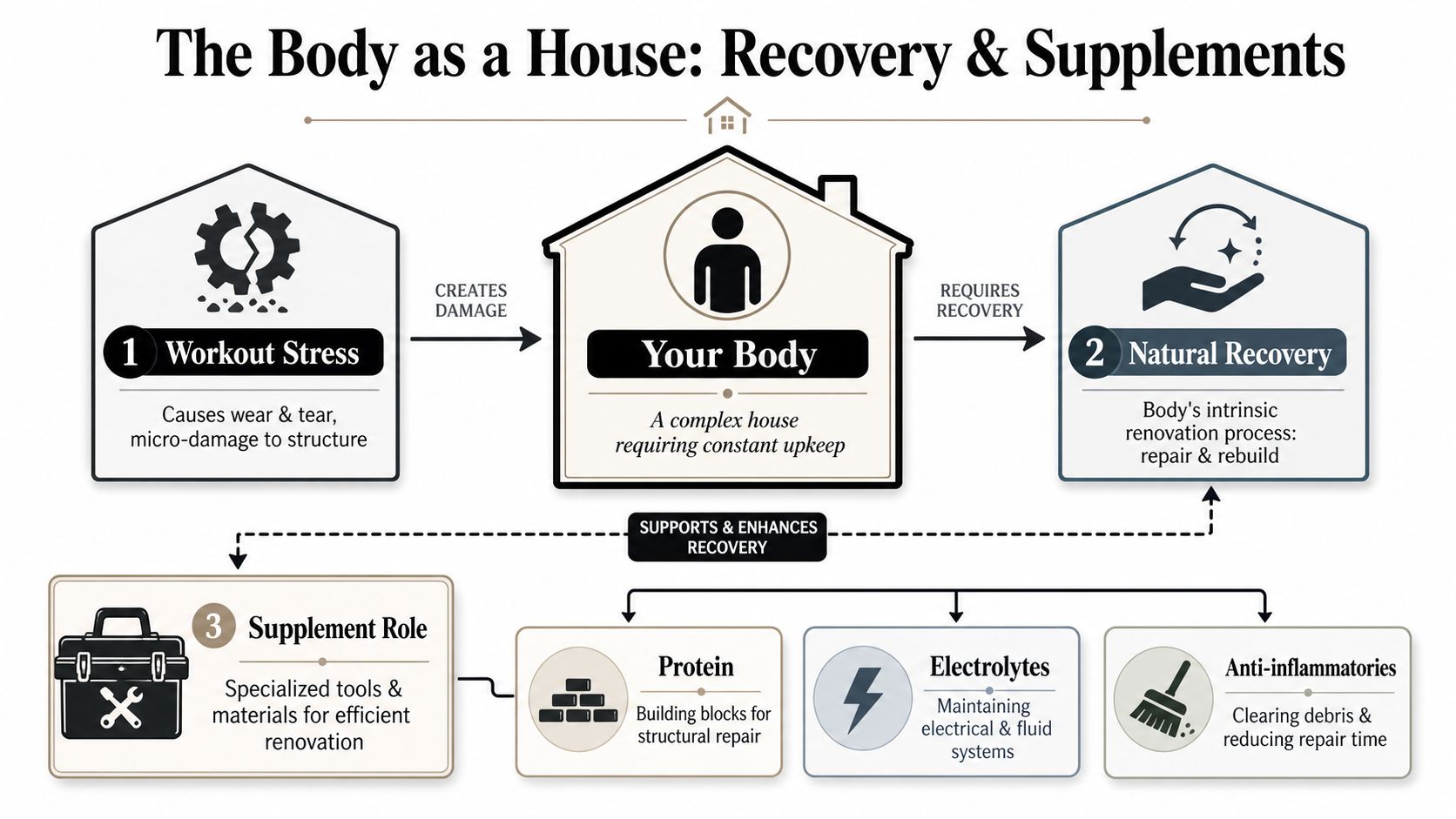
Think of your body like a house after a renovation project. Training creates a useful mess. Walls get opened up, old material gets torn out, and work crews need to come in and rebuild.
Repair and cleanup happen at the same time
Protein and amino acids are the building materials. They help repair the structure after exercise places stress on muscle tissue. If your training is demanding, you need enough material on site for repairs to happen.
But that's only half the story.
You also need a cleanup crew. Exercise creates inflammation, metabolic debris, and irritation in tissues that have been stressed. If nobody clears the site, the rebuild drags. That's why people can hit protein goals and still feel beat up. The materials are there, but the environment is still messy.
This is also where sleep enters the conversation. A body that stays keyed up doesn't run repair work smoothly. People who struggle to settle down at night often notice that soreness lingers longer, which is one reason broader recovery support can make sense. Better nightly recovery habits matter as much as the capsule or shake, and natural sleep support without melatonin is often part of that discussion for active adults.
Supplements support specific jobs
A smart supplement plan gives each job the right tool.
Protein powders and amino acids: support structural repair
Botanicals such as curcumin: help manage the inflammatory side of soreness
Electrolytes and hydration support: help the body maintain fluid and nerve-muscle function
Stress-support compounds: help people recover better when life outside the gym is part of the load
There's also a newer angle worth watching. Emerging science suggests that specific B-vitamins, nicotinamide and pyridoxine, may enhance muscle stem cell activity after eccentric contractions and support regeneration through a pathway distinct from protein or amino acids, as described in this preclinical research on NAM and PN after eccentric muscle damage.
A supplement isn't “good for recovery” in the abstract. It's good for a specific part of recovery.
That's the practical lens to use. Ask what the product is trying to do. Rebuild muscle. Reduce soreness. Support joints. Improve sleep quality. The best recovery muscle supplements are usually the ones matched to the bottleneck, not the biggest marketing claim.
The Four Pillars of Modern Recovery Supplements
A solid recovery plan stands on more than one ingredient class. If you want to feel better after training, you need to separate what repairs tissue from what changes soreness, hydration, or sleep quality.

Pillar one muscle repair and growth
This is the familiar category. Protein powders, essential amino acids, and similar products give the body building blocks for repair.
That matters, but there's an important reality check. Protein helps repair damage, yet it doesn't reliably reduce the feeling of soreness. A rigorous review found that protein supplementation attenuated some damage markers while having no statistically significant effect on subjective muscle soreness, and the same review noted that curcumin showed moderate-certainty evidence for reducing DOMS while creatine had no effect on soreness markers in this context, as discussed in this review of nutrition strategies for exercise-induced muscle damage and soreness.
So if someone says, “I'm drinking protein but still sore,” that isn't confusion. That's consistent with the evidence.
Pillar two inflammation and pain management
Many people find the relief they thought protein would provide.
Compounds in this bucket target the cleanup side of recovery. Curcumin stands out because it's tied more directly to reducing post-exercise soreness. HMB and L-carnitine are more closely associated with lowering markers of muscle membrane damage such as creatine kinase, with HMB also reducing lactate dehydrogenase leakages. BCAAs can also help preserve function and reduce strength loss in some recovery settings.
That means the category matters as much as the supplement name. Some ingredients improve how damaged tissue looks on paper. Others improve how you feel.
A quick visual helps show the difference between repair and relief.
Pillar three energy replenishment and electrolytes
This pillar is less glamorous but often more useful than people expect.
If you train hard, sweat heavily, or stack workouts close together, low fluid and electrolyte status can make you feel flat, cramp-prone, and slow to bounce back. This isn't the same thing as muscle damage, but it absolutely changes your recovery experience.
Short version: if your legs feel “dead” after training, don't assume that's only a protein issue. Sometimes the problem is simpler. You're under-hydrated, under-fueled, or both.
Pillar four sleep and stress reduction
People often overlook this because it doesn't look like a gym supplement category. It should.
Poor sleep and high stress make every other part of recovery worse. They can keep soreness feeling louder and make your next session feel harder before it starts. Adaptogens and calming support ingredients fit here, not because they build muscle directly, but because they help create the internal conditions where repair can happen normally.
The best recovery stack for a stressed, under-slept adult won't look the same as the best stack for a powerlifter in a low-stress training block.
That's why modern recovery muscle supplements should be judged by function, not by trend. A good product can be excellent for one goal and mediocre for another. Knowing which pillar you're trying to support changes everything.
Decoding the Label Dosing Timing and Bioavailability
A supplement label tells you a lot if you know what to look for. Most mistakes happen in three places: too little active ingredient, poor absorption, and an overbuilt timing routine that nobody can maintain.
What to look for on a label
Turmeric is a good case study because it's popular and often misunderstood.
For recovery support, curcumin dosages in clinical studies typically range from 400 mg to 2,000 mg daily, and curcumin's absorption can increase by up to 2,000% when combined with piperine, according to this practical review of curcumin dosing and black pepper absorption. Without that absorption support, you may be swallowing a good-looking ingredient that never delivers much practical effect.
When you read a label, check for these details:
Active form: Does it list curcumin or a standardized turmeric extract, rather than vague turmeric wording alone?
Absorption support: Is piperine or black pepper extract included to help bioavailability?
Daily serving reality: Can you realistically take the amount needed every day?
Purpose fit: Is the product built for soreness, joint comfort, sleep support, or muscle repair?
If turmeric is one of the reasons you're buying a product, it's worth learning more about curcumin with black pepper and why the pairing matters.
Practical rule: Don't judge a label by ingredient popularity. Judge it by active dose, absorbability, and whether it matches the problem you want solved.
Timing matters less than people think
A lot of people still stress over the immediate post-workout window. For most active adults, that stress is usually misplaced.
If you're using protein to help meet daily intake, consistency matters more than panic-drinking a shake the second you rack the weight. The same goes for anti-inflammatory and joint-support ingredients. These usually work better as part of a steady routine than as a one-time rescue move.
That's especially helpful for people who don't train on a perfect schedule. If your workout ends late, or you train before work, you don't need a fragile system that collapses if life gets busy. A supplement protocol should fit your life well enough that you'll consistently follow it.
Spotlight on Key Ingredients for Targeted Recovery
Some ingredients deserve attention because they solve problems people feel. Not just “support performance” in broad language, but support comfort, movement, and the ability to train again without dreading the after-effects.
Why certain blends make more sense than single ingredients
Turmeric sits near the top of that list. Curcumin, its best-known active compound, is useful when soreness has an inflammatory component. For active adults, that often shows up as the “everything feels irritated” kind of post-workout day, not just muscle fatigue.
Bromelain belongs in the same conversation because enzyme support can complement botanicals aimed at post-exercise irritation and tissue comfort. Ginger also makes sense in multi-ingredient recovery formulas for similar reasons. None of these ingredients replace training basics, but together they can support a more comfortable recovery experience than a protein-only approach.

Ashwagandha fits a different lane. It isn't there to rebuild a muscle fiber directly. It's there because recovery is worse when your stress system stays switched on. People who are tired but wired often don't need another “performance” ingredient. They need support that helps them settle, recover overnight, and stop carrying yesterday's training into tomorrow.
That same logic explains why some people also look at food-based recovery tools outside the usual gym stack. Tart cherry gummies and similar approaches often come up in broader recovery conversations because the actual goal isn't just muscle size. It's how the body feels after repeated stress.
Ingredient Action for Holistic Recovery
Ingredient | Primary Target | Benefit for Recovery |
|---|---|---|
Turmeric extract | Inflammation pathways | Helps support post-exercise soreness relief and daily comfort |
Black pepper extract | Bioavailability | Helps the body absorb curcumin more effectively |
Bromelain | Tissue comfort | Supports the body's response to exercise-related irritation |
Ginger | Joint and digestive comfort | Can fit well in formulas built for active adults who want smoother day-to-day recovery |
Ashwagandha | Stress response and sleep readiness | Helps support the recovery environment, especially when stress disrupts rest |
A single-ingredient product can work when your need is narrow. If your issue is broader, a thoughtful blend often makes more sense.
Better recovery often comes from stacking complementary actions. One ingredient helps calm the site, another improves absorption, another helps the nervous system stop acting like the workout is still happening.
That's usually the difference between a supplement that looks impressive on paper and one that fits day-to-day life.
Choosing the Right Supplement for Your Goals
A useful supplement choice starts with one question: What is limiting your recovery right now? Not your ideal goal. Your real bottleneck.

Match the supplement to the bottleneck
If you're mainly chasing strength and muscle gain, your center of gravity will still lean toward protein and creatine. That's a performance-focused setup.
If your main issue is feeling inflamed and sore after training, omega-3s deserve a hard look. In a network meta-analysis of 35 randomized controlled trials involving 1,211 trained athletes, omega-3 supplementation showed the greatest efficacy for post-exercise recovery outcomes with an SMD of 0.40 (95% CI: 0.18 to 0.62) and a SUCRA score of 88.7%, outperforming creatine and protein in that specific recovery domain, according to this network meta-analysis on omega-3, creatine, and protein for trained athletes.
If you're an active adult whose biggest complaint is joint irritation and daily stiffness, a formula centered on anti-inflammatory support may be more useful than a gym-style muscle stack. In practice, many individuals find greater success with a more comprehensive product.
If you're dealing with high stress and poor sleep, choose accordingly. A perfect training supplement won't help much if your nights are fragmented and your nervous system never downshifts.
Simple filters before you buy
Use these filters before spending money:
Primary complaint: Is it soreness, low energy, joint discomfort, poor sleep, or pure strength performance?
Training style: Heavy lifting, endurance work, general fitness, or active aging all create different needs.
Lifestyle friction: Can you stick to the routine without turning recovery into another full-time job?
Ingredient fit: Does the formula contain ingredients that match your actual problem, not just popular buzzwords?
The right product for a marathon runner won't always be the right one for a busy parent lifting three days a week. And the right one for a competitive lifter may be overkill, or misdirected, for someone who wants to stay mobile, recover comfortably, and keep exercising without flare-ups.
Conclusion A Holistic Approach to Feeling Your Best
The old recovery model was too narrow. It treated the body like a machine that only needed more building material.
That misses how people experience recovery. Most don't ask whether a supplement improved a marker in isolation. They ask whether they can walk downstairs normally, sleep well, train again on schedule, and move through the day without feeling beaten up.
That's why the best recovery muscle supplements should be viewed through a wider lens. Protein helps with repair. Anti-inflammatory ingredients help with soreness. Omega-3s stand out for post-exercise recovery support. Stress and sleep support matter because recovery doesn't happen well in a tense system. Different tools do different jobs.
Use supplements that match your real limitation. Keep the plan simple enough to follow. Pair it with smart training, hydration, food, and rest.
That's the version of recovery that holds up over time. Not just bigger numbers in the gym, but better comfort, steadier consistency, and a body that feels more ready for life.
If you want a simple way to support recovery beyond protein alone, River of Life offers a multi-ingredient capsule built around turmeric extract with BioPerine, plus ashwagandha, ginger, and bromelain. It's designed for people who care about joint comfort, stress resilience, sleep quality, and post-activity recovery in one daily routine.