

Liquid Pain Reliever: Types, Doses and Safe Use

You're standing in the kitchen with a medicine bottle in one hand and a kitchen spoon in the other. Your child hurts, you're tired, and the label seems to offer more numbers than answers. Before you pour, put the kitchen spoon down. The safest starting point isn't the flavor, the brand, or even the word children's. It's the active ingredient and its concentration.
Table of Contents
What a Liquid Pain Reliever Actually Is
Think of making a flour mixture. The flour is the active ingredient, the recipe ratio is the concentration, and the portion you serve is the volume. A spoonful from a thick mixture contains more flour than the same spoonful from a diluted mixture.
A liquid pain reliever works on that principle. It's an oral medicine, usually acetaminophen or ibuprofen, with an amount of active ingredient distributed through a measured volume. In a solution, the medicine is dissolved; in a suspension, particles are dispersed and may settle between uses.
The familiar kitchen setting is also where measuring mistakes can start.

Strength and volume aren't interchangeable
The acetaminophen labeling on DailyMed describes the common strength of 160 mg per 5 mL, equivalent to 32 mg/mL, so a 1 mL measuring error changes the dose by 32 mg. Milligrams describe how much medicine you're giving; milliliters describe how much liquid you're measuring.
Read these label details together:
Strength: How much active ingredient is in the liquid.
Dose volume: How much liquid the person should receive.
Dosing interval: How long to wait before another dose is allowed.
Liquids allow graduated, weight-linked doses for children and can help people who struggle with tablets. They aren't automatically weaker, gentler, or safer than pills. Acetaminophen and ibuprofen have different benefits and risks regardless of their form.
Practical rule: Read the strength before the volume. The concentration determines how much medicine that volume delivers.
Liquid Acetaminophen and Liquid Ibuprofen Compared
The same volume of two liquids can deliver different amounts of medicine. Compare the active ingredient, concentration, dosing directions, and safety risks before choosing a product. The measuring device matters too: use the device supplied with that medicine, not one from another bottle.
Criterion | Liquid acetaminophen | Liquid ibuprofen |
|---|---|---|
Drug class | Pain reliever and fever reducer; not an NSAID | Nonsteroidal anti-inflammatory drug (NSAID) |
Common liquid strength | 160 mg per 5 mL (32 mg/mL) in common pediatric liquids | Strength varies by product; check the bottle's mg-per-mL concentration |
Dosing interval | Follow the product's age- and weight-specific directions | Follow the product's age-specific directions |
Maximum doses in a day | Children: no more than 5 doses in 24 hours; adults and older children: follow the product's stated maximum | Adults and children older than 12 years: no more than 6 doses in 24 hours, according to MedlinePlus's ibuprofen guide |
Daily ceiling for adults and older children | The FDA adult ceiling is 4,000 mg in 24 hours; count acetaminophen in every medicine | Follow the product's milligram limit, not just its dose count |
Main safety concern | Liver injury from excess medicine, duplicate products, or alcohol-related risk | Stomach bleeding and kidney injury, especially with dehydration |
Best fit | Fever, headache, and general aches when swelling isn't prominent | Pain with inflammation, such as a swollen joint or sprain |
For ibuprofen, adults and children older than 12 years may generally take a nonprescription dose every 4–6 hours as needed, with no more than six doses in 24 hours, as MedlinePlus's ibuprofen guide explains. Children's instructions and individual product labels can differ, so this schedule is not pediatric dosing guidance. Acetaminophen directions also depend on the product and the person taking it.
What the difference means for pain
Acetaminophen can reduce pain and fever, but it has little anti-inflammatory effect. It may suit a headache, minor sore throat, toothache, or general aches when swelling is not the main concern.
Ibuprofen reduces production of prostaglandins, substances involved in pain, fever, and inflammation. That can make it a possible choice when pain comes with tenderness or swelling. Its effects on the stomach and kidney blood flow also mean that older adults and people with kidney disease, dehydration, a history of ulcers, or anticoagulant use need particular caution.
Choose by health history as well as symptoms
A symptom points toward a possible option, not an automatic choice. Acetaminophen may be reasonable when stomach concerns matter and inflammation is limited, if liver health and other medicines allow it. Ibuprofen may suit inflammatory pain when kidney, stomach, and medication considerations have been checked. For more context on the ingredient, see this guide to ibuprofen.
Liquid form does not remove either medicine's risks. Flavor does not change how the active ingredient works, and the bottle's concentration determines how much medicine each measured volume contains. Check other products in the cabinet for acetaminophen before giving a dose, since duplicate ingredients can add up toward the daily limit.
Don't start alternating acetaminophen and ibuprofen because pain returns before another dose is allowed. If a clinician recommends using both, ask a pharmacist for a written schedule. Keeping track of which medicine was given and when can help prevent a tired caregiver from mixing up doses.
How to Measure a Liquid Dose by Body Weight
The same volume can deliver different amounts of medicine from bottles with different strengths. Before measuring, check that the bottle contains pediatric acetaminophen at 160 mg per 5 mL. These typical U.S. label volumes apply only to that concentration.
Liquid acetaminophen volume by body weight
Body weight (lb) | Label volume (mL) |
|---|---|
24 to 35 | 5 |
36 to 47 | 7.5 |
48 to 59 | 10 |
60 to 71 | 12.5 |
72 to 95 | 15 |
For this concentration, typical U.S. pediatric label directions allow a dose every 4 hours when needed, with no more than 5 doses in 24 hours. Follow the bottle's directions if they differ from this general chart.
Use this visual as a measuring reminder, not as a substitute for reading the label.

Follow a repeatable measuring routine
Confirm the strength. Read the active ingredient and concentration on the bottle. A familiar-looking package is not enough; the mg per mL determines how much medicine each measured volume contains.
Check current body weight. Match the child's weight to the product's band. Don't estimate from clothing size or rely on an old weight.
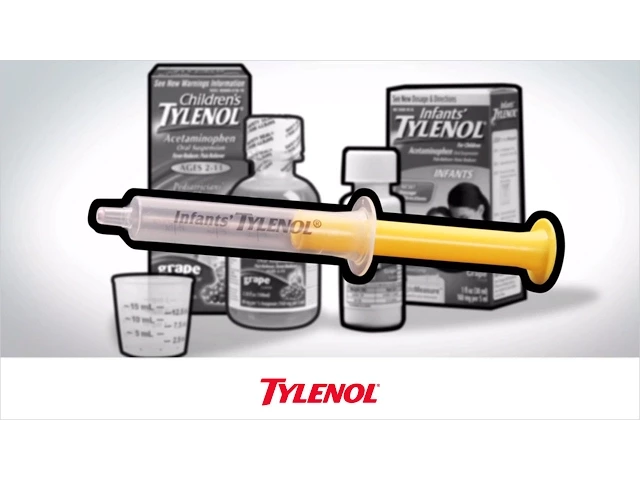
Choose the supplied device. Use the enclosed oral syringe or dosing cup. Kitchen spoons and measuring devices from another medicine can deliver the wrong amount.
Shake a suspension as directed. Medicine can settle, so check the label for whether and how to shake this product before measuring.
Measure at eye level. Set a cup on a flat surface and read the liquid level at eye height. With a syringe, remove large air bubbles and line up the correct edge of the plunger with the prescribed mark.
Record the dose immediately. Write down the medicine, volume, and time before another caregiver takes over. Keep the record with the bottle, out of children's reach.
Check other medicines before giving another dose. Cold-and-flu products may also contain acetaminophen, even if the package name sounds unrelated. Review active ingredients across the household's medicines to avoid accidentally giving the same ingredient twice.
Keep a child upright and give syringe-measured medicine slowly toward the inside of the cheek. Don't squirt it toward the back of the throat. If the child spits out the medicine or vomits, don't automatically repeat the full dose. You may not know how much stayed down.
When the chart doesn't answer your question
If the child's weight falls between the printed bands, is outside the chart, or conflicts with the bottle's instructions, ask a pharmacist rather than rounding up. This chart is not for ibuprofen or for acetaminophen in a different concentration.
The acetaminophen guide can help you identify the ingredient across product names. Compare the guide with the bottle in hand, and use the video below as a measuring demonstration.
Choosing Liquid, Pills or Gels by Pain Pattern
Reader situation | Main need | Best-fit form | Key watch-out |
|---|---|---|---|
Arthritis or chronic joint pain | Recurring pain and stiffness | Consider a suitable topical gel for a localized joint; oral treatment needs an individual plan | Kidney, stomach, and blood pressure history |
Post-workout soreness | Temporary relief while muscles recover | Local treatment for a sore area; oral acetaminophen when appropriate | Don't combine ibuprofen with other NSAIDs |
Poor sleep or stress-related pain | Address pain without using medicine as a sleep aid | A clearly scheduled oral dose when indicated | Don't take extra medicine to force sleep |
Young children | Precise weight-linked dosing | Liquid with the supplied syringe | Measuring and caregiver handoff errors |
Swallowing difficulty | Establish what can be swallowed safely | Pharmacist-advised formulation | A thin liquid may be unsafe |
Match the route to the problem
Oral liquids, tablets, and capsules deliver medicine through the digestive tract into the bloodstream. They can help when symptoms are widespread, such as fever with body aches. A liquid isn't a way to keep the drug away from the stomach, liver, or kidneys.
A topical pain-relief gel is applied over a painful area. Some topical NSAID gels can treat a localized joint while exposing the bloodstream to less medicine than an oral NSAID, but they still have warnings and interactions. Other gels contain different ingredients, so don't assume every tube works the same way.
Tablets and capsules are convenient when the required dose matches the available strength and swallowing is safe. They don't need a measuring device, but that convenience doesn't remove the need to check ingredients.
For liquids, weigh these practical trade-offs:
Adjustable amounts: A marked device allows doses that don't correspond to a whole tablet.
Swallowing convenience: Some people handle a liquid more comfortably than a pill.
Measuring work: Every dose requires attention, including during travel or overnight.
Taste and storage: Flavor can affect acceptance, and storage or discard instructions may differ between products.
Don't assume a liquid will always work faster than a tablet. The ingredient and formulation matter, and faster absorption wouldn't justify an early repeat dose.
The form-selection chart below is a conversation aid. The product's actual ingredient and warnings still decide whether it fits.

Recurring joints and sore muscles need different plans
For a painful knee or hand joint, a suitable topical gel may be worth discussing before routine oral NSAID use. Apply it only where the label permits, avoid damaged skin, and check before combining it with an oral anti-inflammatory. A gel isn't automatically harmless because you don't swallow it.
Joint pain that keeps returning needs more than a preferred dosage form. A clinician may recommend exercise, physical therapy, or treatment directed at the cause. Ongoing oral NSAID use deserves review, particularly when blood pressure, kidney function, or stomach problems are concerns.
After unfamiliar exercise, mild soreness may improve with gentle movement, rest, and a temporary reduction in training intensity. If medicine is appropriate, choose according to your health history rather than treating soreness as a reason to combine products. Severe pain, marked weakness, substantial swelling, or dark urine after exertion needs prompt assessment.
Night pain isn't a reason to shorten the interval
Say your shoulder hurts at bedtime, but you already took an evening dose. The next step is to check the written dosing record, not to take an extra amount because sleep feels urgent.
A permitted dose can be timed around bedtime, but it shouldn't be taken early or increased to make you sleepy. Repeated night-waking pain also deserves evaluation, even if medicine temporarily helps.
Stress can worsen muscle tension and make pain harder to tolerate. Addressing workload, sleep habits, and muscle tension may help, but labeling symptoms as stress shouldn't replace assessment of unexplained or worsening pain.
Difficulty swallowing needs a safety check
Struggling with a large tablet isn't the same as struggling to swallow drinks. Someone who coughs during drinking, has a wet-sounding voice afterward, or has a history of swallowing problems shouldn't automatically switch to thin liquid medicine.
The NHS Specialist Pharmacy Service guidance on medicines for adults with swallowing difficulties distinguishes suitable formulations according to swallowing needs. A pharmacist may need to coordinate with a swallowing specialist before recommending a liquid, thickened preparation, or alternative route.
Don't crush tablets, open capsules, or mix medicine with thickener without checking. Some formulations must remain intact, and altering a medicine can affect how it works or how reliably the dose is delivered.
Choose the form that matches the pain and the person's swallowing ability, not the flavor, color, or promise of convenience.
Natural Supplement Options and Where They Fit
A supplement considered for an ongoing joint-comfort or stress routine isn't interchangeable with an acute-pain medicine. The useful question isn't whether an ingredient is natural. It's whether the intended benefit, uncertainty, and interaction risks fit your situation.
Keep that distinction clear when reading about natural pain-relief options. A capsule marketed for everyday wellness doesn't replace a properly selected pain reliever or an evaluation of persistent symptoms.
Judge the ingredient against the goal
Turmeric and curcumin are commonly discussed for joint comfort, not immediate rescue relief. Formulations may include black pepper extract, also called piperine, to improve absorption. Better absorption doesn't establish that a product is suitable for everyone, especially someone taking blood thinners or managing gallbladder disease.
Ginger is sometimes used for exercise-related discomfort, but it shouldn't be presented as a reliable substitute for acute-pain treatment. It can cause stomach upset, and a concentrated supplement isn't equivalent to the amount used in food.
Bromelain, an enzyme derived from pineapple, is marketed for swelling and recovery. Anyone taking anticoagulants or antibiotics should ask a pharmacist about the specific combination before starting it.
Ashwagandha belongs more naturally in a discussion about stress and sleep than immediate pain relief. Avoid it during pregnancy, and seek clinical advice if you take thyroid medicine or have a thyroid condition.
Check the complete formulation
A multi-ingredient product can make an interaction review more complicated. Show the pharmacist the full label, including botanical extracts, added absorption enhancers, and the recommended serving.
Use these questions before adding anything:
Purpose: Am I trying to support an ongoing routine, or am I delaying care for active pain?
Interactions: Has someone checked this against my prescriptions and nonprescription medicines?
Tolerability: Do I know which symptoms mean I should stop and seek advice?
Expectations: Am I expecting a wellness product to do the job of an acute-pain treatment?
Don't discontinue prescribed treatment to test a supplement on your own. If you and your clinician decide to try one, agree on the goal and how you'll judge whether continuing makes sense.
Keep the categories separate: Supplement support is an optional long-term decision. Acute pain, injury, and unexplained symptoms need their own plan.
Check the Ingredients and Dose Before You Take One
Start with the medicines already in the cabinet. The FDA's acetaminophen safety guidance states that acetaminophen appears in more than 600 prescription and nonprescription medicines and that total intake for adults and children aged 12 years and older must not exceed 4,000 mg in 24 hours. That ceiling isn't a target; your product label or clinician may set a lower limit.
Read the active-ingredient panel on cold-and-flu medicines, combination pain relievers, and prescription products. Count medicine already taken, not just the dose you're about to measure.
Answer yes before proceeding
Correct match: Does the bottle's strength match the directions I'm using?
No duplicate acetaminophen: Have I confirmed that no other acetaminophen-containing product is being taken at the same time?
Total checked: Is the planned amount within both the product's directions and my personal daily limit?
No NSAID stacking: If this is ibuprofen, have I checked for naproxen, aspirin, and other NSAIDs? Don't stop prescribed aspirin without advice.
Alcohol reviewed: If alcohol use or liver disease is relevant, have I checked with a pharmacist rather than assuming the usual dose is safe?
Health history reviewed: If there's kidney disease, ulcer history, anticoagulant use, or dehydration, has a pharmacist confirmed whether ibuprofen is appropriate?
Record ready: Can every caregiver see what was given and when?
Keep this checklist with the medicine, not just on your phone.

Know when another dose isn't the answer
Persistent or worsening pain, spreading swelling, fever with concerning symptoms, or repeated night-waking pain needs medical assessment. Black stools, vomiting blood, fainting, or severe abdominal pain require urgent care.
If an overdose may have occurred, contact emergency services or poison control immediately, even if the person feels well. Don't wait for symptoms.
Today, write down the bottle's strength, the planned volume, and the dosing times. Bring the bottle and your medication list to a pharmacist for a safety check.
River of Life offers a capsule-based dietary supplement containing turmeric extract with BioPerine, ashwagandha root, ginger, and bromelain for ongoing wellness support, not liquid or immediate pain relief. Visit River of Life to review the ingredient information and discuss whether the formula fits your joint-comfort or stress-management routine with your pharmacist.