


Liquid Turmeric Supplements: A Practical Buyer's Guide

You're looking at a dropper bottle beside a familiar bottle of turmeric capsules. The liquid seems more modern, so it's tempting to assume it must be better absorbed. But does liquid automatically mean better delivery, or is the difference hiding in the formulation?
That question matters because curcumin, turmeric's best-known active compound, is difficult for the body to absorb in its natural form. A carefully engineered capsule can outperform a weak liquid, while a well-designed liquid can offer advantages that capsules can't. The practical buying decision isn't liquid versus capsule alone. It's what form of curcumin you're getting, how much is present, and what the manufacturer has done to improve delivery.
Table of Contents
What Liquid Turmeric Supplements Actually Are
A shopper named Maya sees two options on a supplement shelf. One is a small amber bottle with a dropper. The other contains rows of capsules. Maya dislikes swallowing pills, so the liquid looks appealing, but the label only says “turmeric extract.” She still doesn't know whether she's buying a concentrated curcumin product, a mild turmeric preparation, or a flavored liquid with very little active compound.
Liquid turmeric supplements are products that deliver turmeric extract or curcumin in a drinkable format. You might take them by dropper, spoon, or spray, or mix them into water, juice, yogurt, or a smoothie. The liquid can be a tincture, a suspension, or an emulsion, and those terms describe how the ingredients are held and dispersed.
The carrier matters
Some formulas suspend turmeric extract in an oil such as MCT, sunflower, or olive oil. Others use water, glycerin, or a blended emulsion designed to help oil-loving curcumin disperse through a watery digestive environment. The carrier may improve handling and mixing, but it doesn't automatically solve curcumin's absorption problem.
Turmeric extract and curcumin extract also aren't interchangeable. Turmeric powder typically contains only 2–5% curcuminoids, according to independent review material hosted by the peer-reviewed NIH source on curcumin delivery. A product that lists only “turmeric root” may therefore provide much less curcumin than a standardized extract.
Why people choose the liquid format
Liquids serve several practical needs:
Swallowing: They can suit people who struggle with capsules or tablets.
Adjustability: A dropper can make it easier to change the amount, provided the label explains the concentration clearly.
Mixing: The product can fit into a smoothie or meal routine.
Formulation: An oil or emulsion can give formulators another way to disperse curcumin.
The trade-off is that liquid labels can be harder to compare. A capsule usually states the amount per capsule. A liquid may list the amount per serving, dropper, teaspoon, or milliliter, and those measures can vary between products.
A liquid bottle is therefore a delivery format, not proof of superior absorption. The label still needs to tell you the active curcuminoid content and the technology used to make that content available.
Why Curcumin Is Hard for Your Body to Absorb
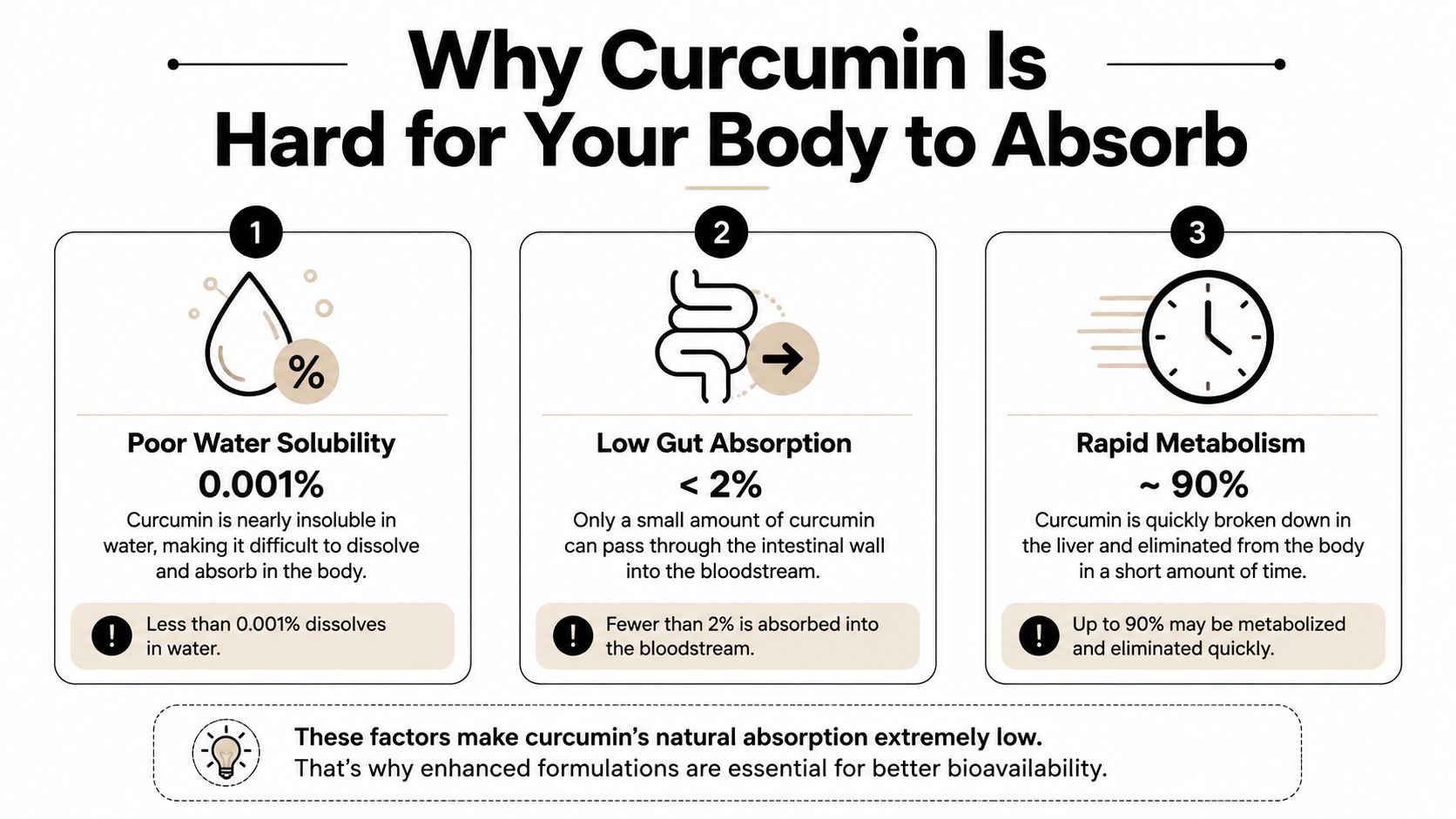
Curcumin faces three obstacles after you swallow it. It's poorly soluble in water, it crosses the gut wall inefficiently, and the portion that does enter the body is rapidly metabolized in the intestine and liver. A liquid can make ingestion easier, but it can't overcome those obstacles unless the formula has been designed to do so.
One human research review describes baseline curcumin bioavailability as only about 0.16% to 1%, while a separate peer-reviewed review explains that curcumin is poorly water-soluble, chemically unstable, and rapidly metabolized. These findings are discussed in the 2025 review of curcumin formulations and the review of advanced curcumin delivery systems.
What black pepper changes
Piperine, a compound from black pepper, is one established formulation strategy. In an NIH-hosted peer-reviewed study, co-ingestion with black pepper increased curcumin's half-life from 2.2 ± 0.79 hours to 4.5 ± 0.80 hours, and the authors concluded that black pepper increased oral absorption and overall bioavailability by more than fourfold. You can read the research background in this guide to curcumin with black pepper.
That result doesn't mean every product containing pepper will perform identically. The study involved a specific combination and set of conditions. It does show why a formulation enhancer can matter more than the bottle's physical state.
Practical rule: Treat “liquid” as a format description. Treat “enhanced,” “micellar,” “liposomal,” or “with piperine” as formulation information that requires closer label reading.
A modern liquid can use a water-dispersible system, an emulsion, or another delivery method that changes exposure. One review reported a water-soluble curcumin formulation with a 7.3-fold higher AUC and plasma levels sustained for up to 12 hours compared with a conventional tablet. That result belongs to the named formulation tested, not to every liquid turmeric product.
The buyer's central question is simple: What happens to the curcumin after it leaves the bottle? If the answer is unclear, the liquid may be convenient without being meaningfully more bioavailable.
Liquid vs Capsule Turmeric With Absorption Boosters
A liquid and a capsule can use similar absorption logic. Both might contain standardized curcumin, piperine, a lipid carrier, or phospholipids. The bottle shape tells you almost nothing about whether the formula addresses poor solubility and rapid metabolism.
Liquid products can be useful when swallowing is difficult or when flexible serving adjustments matter. Capsules tend to provide more predictable portions, cleaner transport, and less exposure to air each time the product is opened. Neither advantage guarantees better biological delivery.
Factor | Liquid Turmeric Supplements | Capsule with Absorption Boosters, such as River of Life Capsules |
|---|---|---|
Serving control | Flexible, but the concentration and measuring method must be clear | Consistent serving size when the capsule contents are uniform |
Absorption strategy | May use oil, emulsions, or water-dispersible systems | May combine standardized extract with piperine, fats, or phospholipids |
Convenience | Helpful for people who dislike swallowing pills and for mixing into food | Easy to carry, pre-measured, and less messy |
Stability | Depends on the bottle, carrier, preservatives, light exposure, and storage instructions | Often simpler to store, though the label and packaging still matter |
Taste | Earthy, bitter, or peppery notes may be noticeable | Usually avoids taste because the ingredients are enclosed |
Main uncertainty | A liquid may look advanced while providing little formulation detail | A capsule may list a strong dose but still need a credible enhancer |
The fair comparison
A thoughtfully made capsule can match or outperform a poorly engineered liquid. For example, a liquid that lists turmeric extract but doesn't identify curcuminoid content or a delivery system gives you little basis for expecting improved absorption. A capsule with a standardized extract and a documented enhancer may offer more useful information per serving.
The reverse is also true. A well-characterized liquid using a water-dispersible or emulsified curcumin system may produce greater exposure than a basic capsule filled with unenhanced powder. The evidence supports comparing formulation quality, not awarding an automatic win to either format.
The best choice is the product that makes its active ingredient, serving amount, absorption strategy, and storage requirements easiest to verify.
For a daily routine, dose consistency and adherence can outweigh theoretical advantages. A product you measure inaccurately or forget to take won't help you build a reliable habit. Choose the format you can use correctly, then judge the formulation on its own evidence.
Evidence for Joint Comfort, Inflammation, Stress and Sleep
Curcumin research is strongest around joint comfort, while evidence for inflammation markers is more mixed and support for stress and sleep remains less developed. That distinction helps prevent a common mistake, using a product studied for joint symptoms as if it had equally strong evidence for every wellness goal.
Joint comfort has the clearest practical signal
Research on standardized curcumin preparations has commonly examined adults with joint discomfort over sustained periods rather than after a single serving. The outcome is usually a change in pain, stiffness, or physical function, not an instant feeling of relief.
For a detailed explanation of turmeric and joint pain, see this guide to how turmeric and curcumin may help with arthritis joint pain. The useful takeaway is modest: curcumin may support comfort for some people, but it shouldn't replace medical evaluation for persistent, worsening, or disabling symptoms.
Other goals require more careful wording
Curcumin's effects on systemic inflammation markers have been studied, but a change in a laboratory marker doesn't automatically equal a noticeable improvement in daily wellbeing. Stress, mood, and sleep research is still thinner, and formulas that combine turmeric with other botanicals can't be judged by turmeric research alone.
BioPerine and other piperine ingredients illustrate why formulation matters. The frequently marketed claim of absorption increases of up to 2,000% belongs to specific product and study contexts, not to every turmeric supplement or to outcomes such as better sleep. The peer-reviewed evidence cited earlier supports a more cautious conclusion, piperine can change curcumin exposure, but exposure is not the same as a guaranteed symptom benefit.
Benefit area | Typical trial dose | Strength of evidence |
|---|---|---|
Joint comfort | Studies commonly use standardized curcumin preparations, with amounts varying by formulation | Strongest practical signal among the areas listed |
Inflammation markers | Varies substantially by extract and delivery system | Moderate and outcome-dependent |
Stress and mood | Formulas and study designs vary | Emerging, with thinner evidence |
Sleep quality | Often studied as part of broader combination formulas | Early and less conclusive |
These categories aren't promises. They're a way to align your expectations with the type of evidence available. Whether the product is liquid or encapsulated, look for a standardized active ingredient and an absorption strategy that resembles the product tested.
Safe Dosing, Timing and Who Should Be Cautious
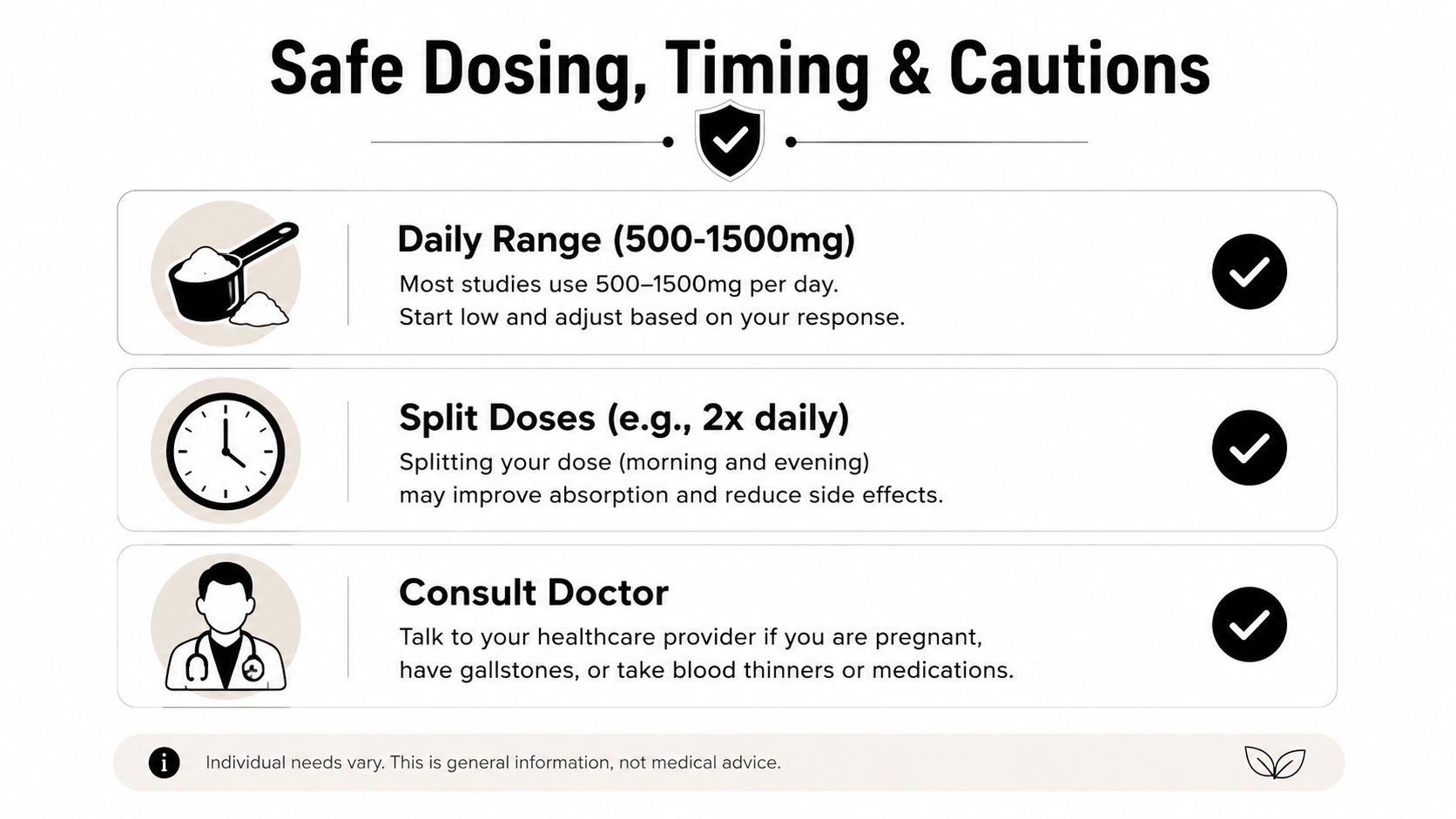
A supplement label should translate its curcumin amount into a serving you can measure without guesswork. Research and review material commonly discuss daily amounts in the 500–1,500 mg range for standardized curcumin, but the appropriate serving depends on the extract, delivery system, and your health situation.
How to use a liquid responsibly
First, find the actual curcuminoid amount per serving. “One dropper” isn't meaningful unless the label defines the dropper volume and the concentration. Don't assume a teaspoon of one product equals a teaspoon of another.
Taking curcumin with a meal that contains fat may support dispersion and digestion, especially for oil-soluble preparations. This applies to capsules as well as liquids. Splitting a serving can also be more comfortable for people who experience digestive upset, but follow the product label rather than increasing the amount on your own.
Medication and health cautions
Speak with a qualified healthcare professional before using concentrated turmeric or curcumin if you:
Take blood thinners: Curcumin and piperine may be unsuitable alongside some medicines that affect clotting.
Use antidiabetic drugs or PPIs: Ask about potential interactions and whether monitoring is needed.
Have gallstones or bile duct obstruction: Avoid self-starting a concentrated product without medical advice.
Are pregnant or nursing: Get individualized guidance before supplementation.
Have surgery planned: Discuss turmeric and curcumin ahead of the procedure, especially if surgery is within two weeks.
Mild digestive symptoms, including loose stools or stomach upset, can occur. More is not automatically better, particularly when an enhancer changes exposure. Start according to the label, monitor how you respond, and give a consistent routine time before deciding whether it suits you.
Quality Markers to Check Before You Buy
A trustworthy label should answer more than “How much turmeric is inside?” It should tell you how much curcuminoid is present, how the product supports absorption, and whether an independent organization has checked its quality.
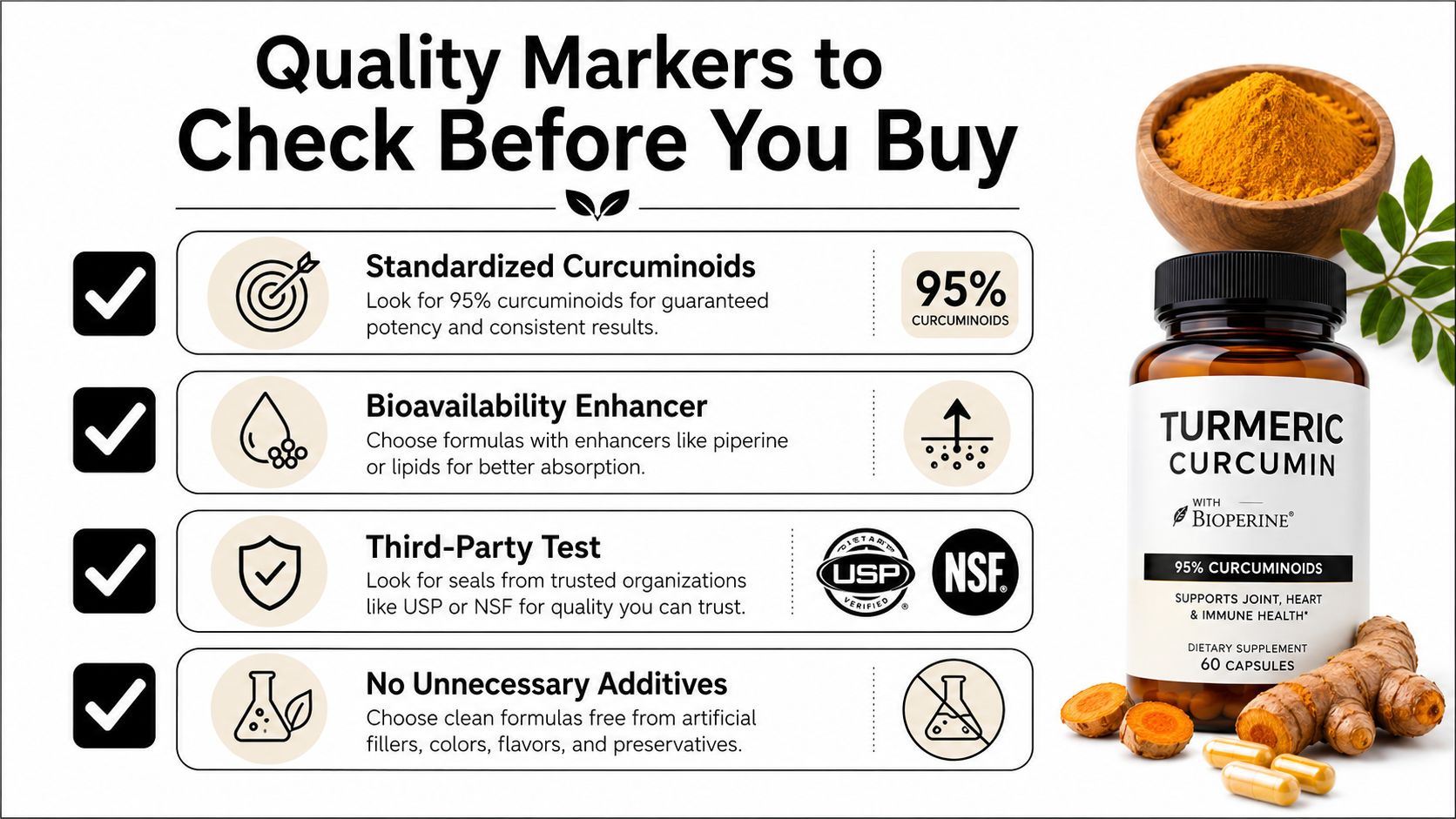
Use this label-reading checklist:
Standardized curcuminoids: Look for a declared standard, such as 95% curcuminoids, rather than turmeric powder weight alone.
Actual active amount: Confirm the milligrams of curcuminoids or curcumin per serving.
Named absorption support: Check for piperine, BioPerine, a lipid system, a phospholipid complex, micelles, or another clearly described technology.
Independent testing: Look for credible third-party verification, such as USP, NSF, or Informed Choice, when applicable.
Contaminant screening: Seek transparent testing for heavy metals and other contaminants.
Clear sourcing: A reputable company should explain where its turmeric comes from and how it's processed.
Protective packaging: Dark glass can help shield liquid products from light. The bottle should also show an expiration date and storage instructions.
No hidden blend: Avoid proprietary blends that conceal individual ingredient amounts.
Don't let presentation do the evaluating
A polished amber bottle can still provide inadequate information. A plain capsule can contain a well-specified extract with a credible enhancer. Compare both against the same standards in this turmeric and curcumin supplement guide, rather than assuming one format has a built-in advantage.
For liquid products, also check how long the product remains usable after opening. Exposure to air, heat, and light can affect stability, and a label that ignores storage gives you less confidence in the product's real-world consistency.
Matching the Format to Your Goals and Lifestyle
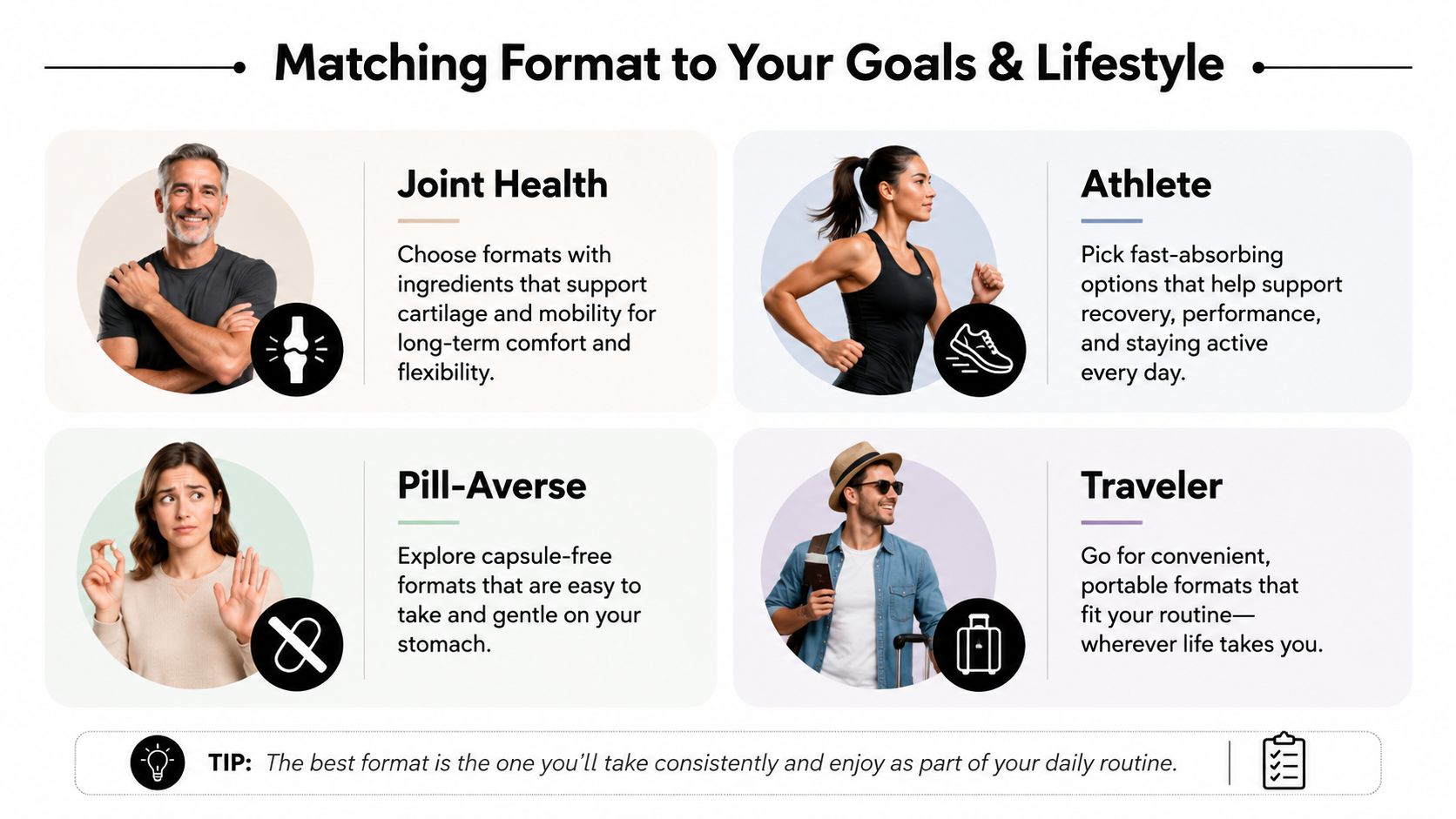
The right format depends less on trends than on the friction you face every day. Someone who can't swallow capsules has a real reason to choose a liquid. Someone who travels frequently may reasonably prefer a sealed, pre-measured capsule that won't leak into a bag.
Match the format to the obstacle
Joint-focused adults may value whichever product makes consistent use easiest. If a person already takes several supplements, adding a measured capsule may reduce decisions. If swallowing is uncomfortable, a clearly dosed liquid may be more practical.
Active people may prefer a liquid that mixes into a post-workout drink, but convenience doesn't replace label transparency. A capsule may suit someone who wants a fixed serving without carrying a bottle.
Pill-averse adults and older users often benefit from a liquid, provided the dropper markings are clear and the taste is manageable. The ability to adjust a serving can be useful, but it also creates room for accidental underdosing or overdosing.
Travelers usually have a stronger case for capsules because they're portable, pre-measured, and less likely to spill. Liquid products can work on the road, but they require attention to temperature, light, and container security.
A simple decision rule helps:
Choose liquid when swallowing, flexible measuring, or mixing into food is your main concern.
Choose capsules when portability, repeatable servings, taste avoidance, and storage simplicity matter most.
Choose either format only after confirming the standardized curcumin content and absorption technology.
Three principles should guide the final choice: formulation beats format, standardized curcumin is more useful than an unexplained turmeric weight, and independent verification adds confidence that the label reflects the product inside.
Practical Questions Buyers Ask Before Choosing
Liquid turmeric products create a few everyday problems that capsule users rarely face. Taste, stains, storage, and measuring all matter because a supplement only works as part of a routine you can maintain.
Question | Practical answer |
|---|---|
How should I store a liquid? | Keep it cool and dark, and follow the label. Some products may need refrigeration after opening. |
Can I mix it into a smoothie? | Usually, if the label allows it. A meal or smoothie containing fat may suit oil-soluble curcumin. |
Can I add it to coffee? | You can, but strong heat, taste, and separation may make coffee less practical than a smoothie or meal. Follow the product's instructions. |
What if the taste is too strong? | Use a smaller labeled serving first, mix it into food, or choose capsules to avoid taste altogether. |
Should I introduce it gradually? | That can help you monitor tolerance, especially if you're sensitive to concentrated botanicals. Don't exceed the label serving. |
Why does it stain clothing? | Turmeric's yellow pigments can transfer to fabric. Wipe spills promptly and use care around light-colored clothing. |
Are liquids suitable for children or pets? | Keep concentrated supplements away from children and pets unless a qualified professional has specifically advised use. |
When should I take it around medicines? | Ask a pharmacist or clinician, particularly if you use blood thinners, antidiabetic medication, PPIs, or other regular prescriptions. |
Capsules sidestep most taste and staining issues, but they aren't automatically superior. The final decision should rest on active curcumin content, formulation transparency, storage requirements, and third-party testing.
River of Life offers vegan capsules combining standardized turmeric extract and BioPerine with ashwagandha, ginger, and bromelain, giving shoppers a capsule-based alternative to liquid turmeric supplements. If consistent, pre-measured use fits your routine, visit River of Life to review the formula and purchase options.