


How to Take Turmeric for Joint Pain That Actually Works

Your knee hurts on the stairs, your hands feel stiff in the morning, or yesterday's workout is still complaining today. You bought turmeric because it sounded like a sensible, gentle option, but the jar has been sitting in the cupboard while your joints feel exactly the same.
The problem usually isn't that turmeric is useless. It's that people treat culinary turmeric, concentrated curcumin, and enhanced-absorption formulas as interchangeable. They aren't. The product form, labeled serving, meal timing, consistency, medication list, and safety signals all matter.
Here's the practical answer to how to take turmeric for joint pain: choose a clearly labeled product, use it consistently with food, don't escalate the dose when results are slow, and reassess after several weeks. Turmeric may support an established joint-care plan, but it isn't a replacement for diagnosis, prescribed treatment, movement, or medical advice.
Table of Contents
Why Most Turmeric Routines Miss the Mark
The knee still hurts after a week of turmeric because one casual sprinkle at dinner is not a clinical routine. Taking a capsule only on painful days creates the same problem. So does choosing a high-strength bottle without checking whether it lists curcuminoids. A disappointing result often reflects inconsistent use or a poorly defined product, not proof that turmeric has no value.
Clinical research has generally examined turmeric or curcumin as a daily oral supplement taken over weeks, rather than as an instant pain reliever. A review of Curcuma longa and curcumin trials found that studied products varied widely in both dose and treatment duration, with use extending from 4 to 36 weeks and daily amounts ranging from 120 mg to 1,500 mg. That range does not give you a personal target. It shows why copying a dose from one label or trial can mislead you.
The label creates another trap. One jar may list a large amount of turmeric root, while a research product may contain a concentrated extract with a stated curcuminoid amount. Those figures describe different ingredients. Compare products only after identifying what the serving actually contains.
Practical rule: Ignore the biggest milligram number on the front. Check the Supplement Facts panel for the amount and type of curcuminoids, then follow the labeled serving.
What a sensible routine needs
Before taking the first capsule, answer five questions:
What form are you taking? Powder, standardized extract, or enhanced formula?
What does the label measure? Total turmeric, curcuminoids, or a branded delivery system?
How will you take it? With a meal, at a consistent time, and within the labeled serving?
When will you reassess it? After several weeks of consistent use, not after one difficult day.
Is it appropriate for you? Medicines, pregnancy, gallbladder problems, surgery, and liver concerns can change the decision.
Evidence for knee osteoarthritis is encouraging, but it does not support miracle claims. Formulations differ, trial quality varies, and results for other joint conditions may not match. Use turmeric as one part of an established joint-care plan, alongside appropriate diagnosis, prescribed treatment, and movement.
Keep the trial controlled. Choose one clearly labeled product, record pain and function, and stop if it causes problems. Buying another bottle before identifying the first routine's weakness wastes money and hides the true issue. A transparent label and a realistic testing period beat a dramatic promise every time.
Turmeric Powder, Curcumin Extract, or Enhanced Formula
Start with the ingredient panel, not the marketing claim. Turmeric powder is the ground spice used in cooking. Curcumin extract concentrates the compounds commonly studied in joint-pain research. An enhanced-bioavailability formula adds a delivery method intended to increase uptake, such as piperine or a specialized formulation.
Those categories aren't automatically better or worse. They answer different needs.
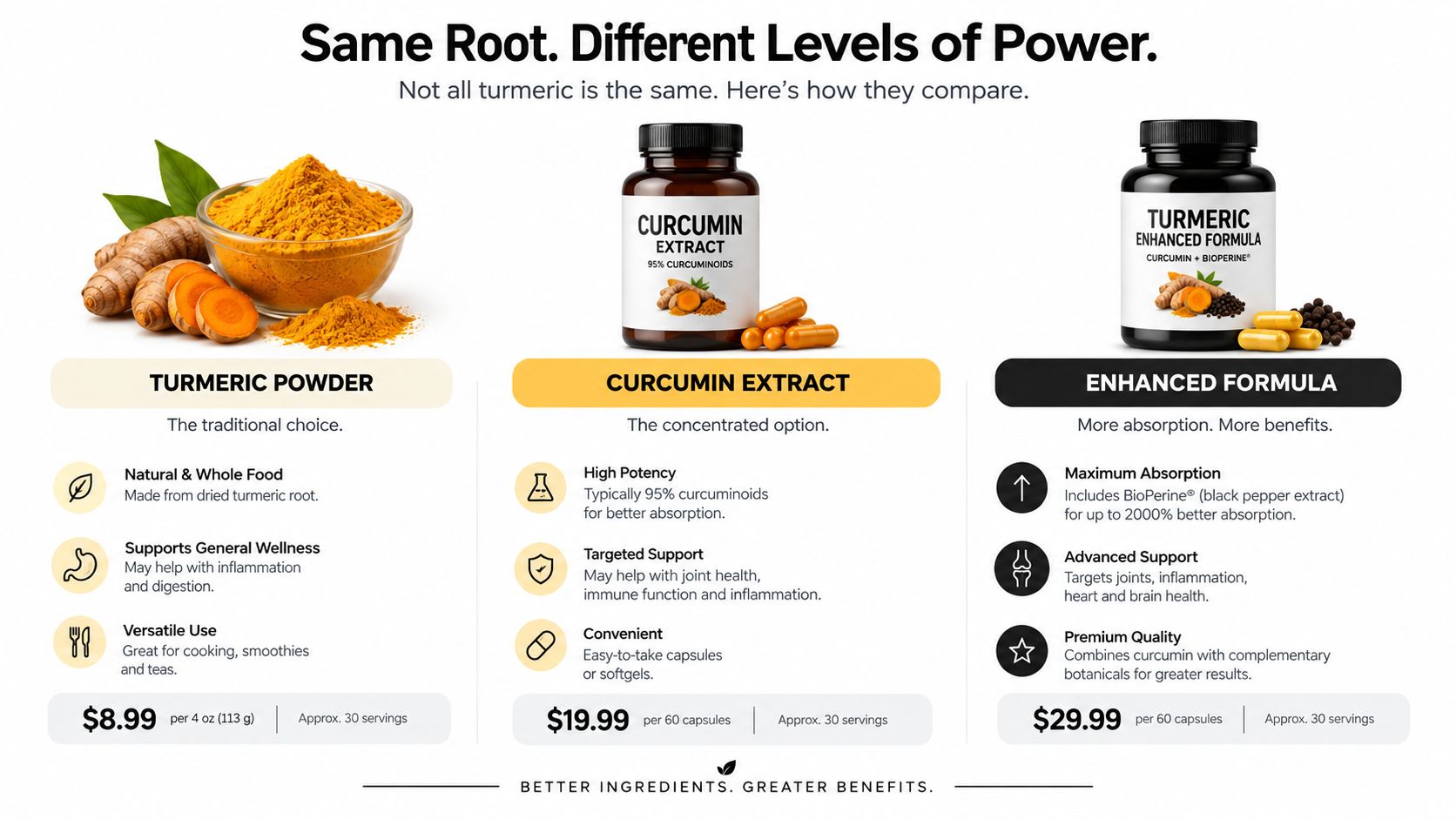
Read the label like a skeptic
Culinary turmeric works well as food, but a spoonful of kitchen spice isn't automatically equivalent to a clinical supplement. Extract products should identify the curcuminoid amount, ideally alongside the extract type or standardization. If a label only says “turmeric root” and gives no useful curcuminoid information, you can't confidently compare it with the products used in trials.
Enhanced formulas add another layer. Piperine, phytosomes, and other delivery systems may change absorption, but higher absorption doesn't prove better pain relief. It can also change the safety conversation, particularly for people taking medicines or using the product for a long time.
Form | Curcuminoid Content | Typical Use | Best For |
|---|---|---|---|
Turmeric powder | Variable and usually not clearly standardized | Cooking, tea, food-based use | General culinary use |
Standardized curcumin extract | Listed curcuminoid amount or standardization | Daily supplement routines | People seeking a more measurable extract |
Enhanced-bioavailability formula | Curcuminoids plus a delivery aid | Lower-volume supplement use with absorption in mind | People who need to discuss formulation and medication safety with a professional |
A 2021 systematic review and meta-analysis of 11 randomized controlled trials involving 1,258 adults with primary knee osteoarthritis found statistically significant improvements in VAS pain and the WOMAC pain component with oral curcuminoids. It found no statistically significant pain or adverse-event difference between lower-dose treatment, defined as less than 1,000 mg per day, and higher-dose treatment, defined as at least 1,000 mg per day or at least 42 g in total (2021 curcuminoid meta-analysis). More product on the label didn't automatically mean more relief.
For a deeper label-reading guide, see this explanation of turmeric and curcumin supplements. The useful question is simple: Can you identify the extract, the curcuminoid amount, the serving size, and any absorption-enhancing ingredients?
If you can't, choose a clearer product rather than guessing.
A Practical Daily Routine for Turmeric and Curcumin
Start with a routine you can repeat, not a capsule you reach for only when your knee hurts. Choose one product, follow its labeled serving, and track whether function improves over several weeks.
As noted earlier, studies have used different formulations and treatment periods. Use that variation to set realistic expectations, not to justify the largest number on a label. A practical example is a 500 mg extract standardized to 95% curcuminoids, taken once daily with dinner, provided that serving matches the product directions and fits your medication and health situation.
Build the routine around a meal
Take the supplement with food if the label permits and your stomach tolerates it. Dinner works well for someone who rarely skips it, especially when the meal contains some dietary fat. Food can also make capsules easier on the stomach than an empty stomach.
Morning or evening matters less than repetition. Consistency is. Pick the meal you reliably eat and use a pill organizer or calendar reminder if needed. If the label calls for more than one capsule or serving, follow those directions rather than creating your own schedule.
Do not take an extra capsule because your knee feels worse on a particular day. Pain changes with activity, sleep, weather, training load, and the underlying condition. Curcumin is not an immediate substitute for conventional pain medicine, and increasing the serving can raise the chance of unwanted effects without producing quick relief.

Use a short, honest tracking period
Record your baseline before starting. Note morning stiffness, pain while walking or using stairs, swelling when relevant, and whether ordinary activities feel easier. Keep the record simple enough to maintain.
Give the routine several weeks of consistent use before judging it. Clinical outcomes are assessed over weeks, not after one cup of tea or one capsule. At your first review, ask whether the improvement is meaningful enough to justify continued use.
A workable routine looks like this:
Choose one product: Confirm the extract, curcuminoid amount, serving size, and added absorption ingredients.
Take it with food: Use a regular meal, preferably one that is not completely fat-free.
Follow the label: Do not exceed the stated serving because a larger amount sounds stronger.
Track function: Record stairs, walking, exercise, sleep, and morning stiffness.
Reassess: Continue only when the benefit is noticeable and no concerning effects appear.
If you take medication, have a medical condition, or plan to use an enhanced formula, show the exact label to a pharmacist or clinician before starting.
Boosting Absorption and the Safety Trade-Off
Curcumin is poorly absorbed on its own, which is why supplement companies emphasize delivery systems. Piperine, a compound from black pepper, and certain specialized formulations are intended to increase uptake. Taking turmeric with food that contains dietary fat is another practical way to fit the compound into a meal-based routine.
That benefit comes with a catch. More absorbable doesn't mean clinically superior, and a compound that reaches the bloodstream more efficiently may also create more opportunity for interactions or adverse effects.
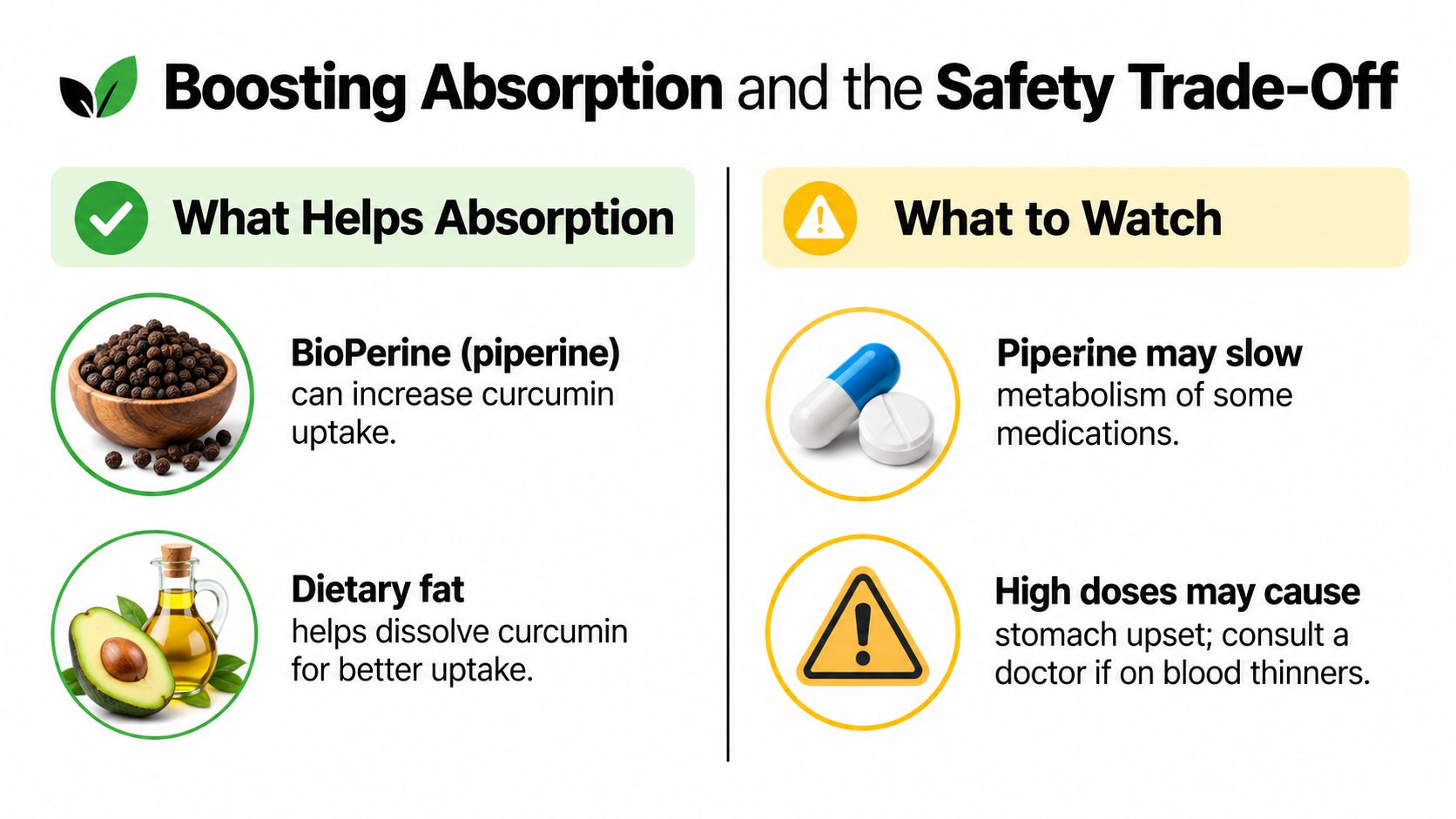
Piperine deserves more respect than a marketing badge
People often see “with black pepper” and assume it's automatically an upgrade. It may help uptake, but piperine can also affect how the body handles some medicines. That matters if you take several prescriptions, use blood-thinning treatment, or already have a sensitive stomach.
The NCCIH turmeric safety guidance says conventional oral turmeric or curcumin is likely safe in recommended amounts for up to 2 or 3 months, while enhanced-bioavailability products require particular caution. The agency also reports that liver injury has occurred with some enhanced-bioavailability formulations.
Safety rule: Treat an enhanced formula as a more active supplement, not as a harmless shortcut.
Stop the product and seek medical advice if you develop fatigue, nausea, poor appetite, dark urine, or jaundice. These symptoms can signal liver injury. Gastrointestinal effects such as reflux, nausea, diarrhea, constipation, or stomach upset also deserve attention, especially if they persist.
For a closer look at the absorption question, read this guide to curcumin bioavailability. The practical conclusion is restrained: take a clearly labeled formula with food, don't chase absorption for its own sake, and review the choice with a healthcare professional if you use medicines or have liver or gallbladder concerns.
Stacking Turmeric With Ginger, Bromelain, and Ashwagandha
A multi-ingredient formula can be sensible, but only if every ingredient has a job. Otherwise, you're creating a crowded capsule and making it harder to identify what helps, what irritates your stomach, and what interacts with your medication.
Ginger is the most obvious companion for a turmeric-focused routine. It brings a separate botanical profile and may suit someone who wants broader digestive or exercise-recovery support, but evidence for joint symptoms is less established than the evidence for curcumin in knee osteoarthritis. Don't use ginger as a reason to assume the combination will work better for everyone.
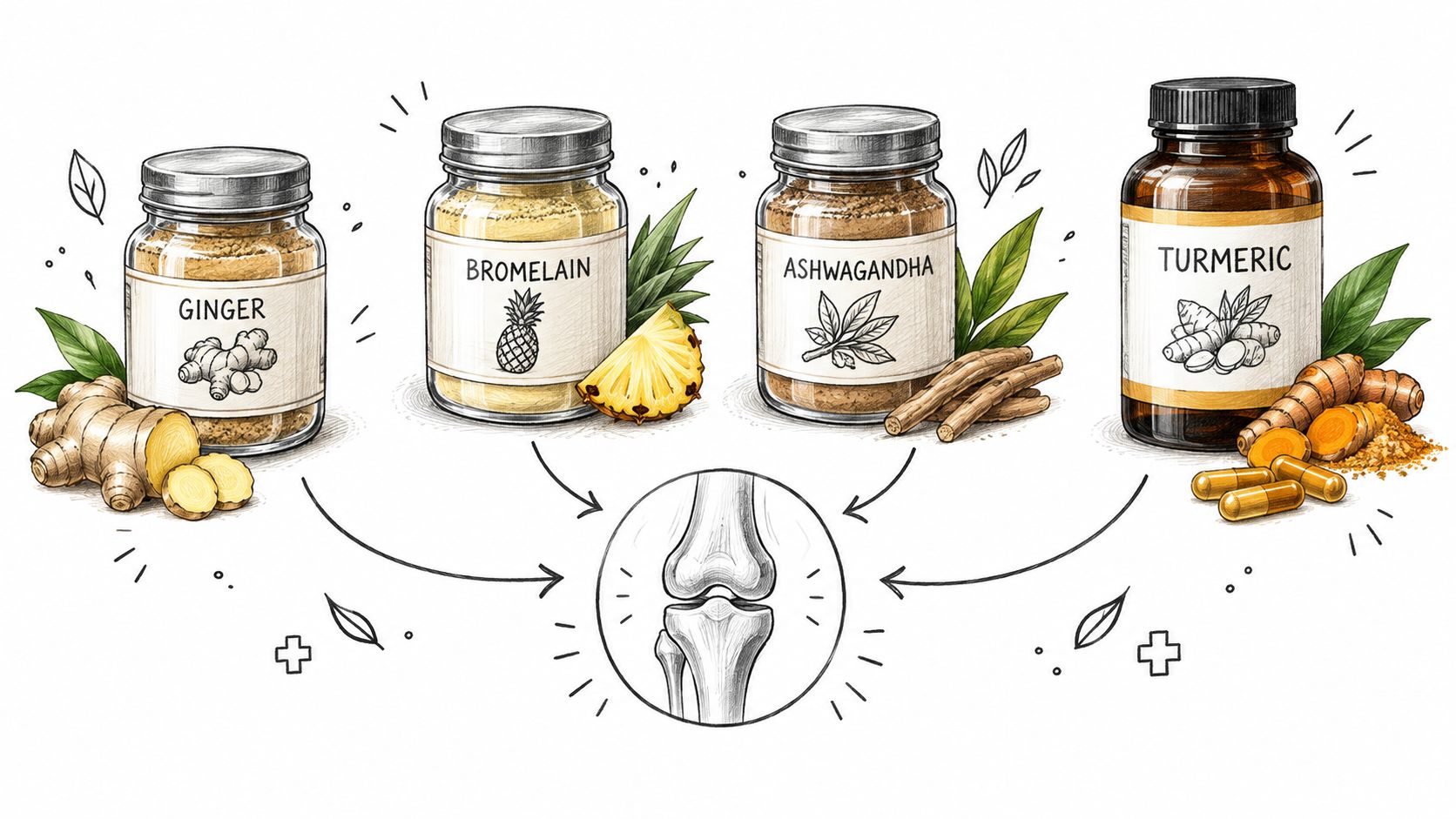
Bromelain is a pineapple-derived enzyme often included in formulas aimed at activity-related discomfort and recovery. It may be relevant for active people who notice soreness after training, but it isn't a substitute for checking whether the pain comes from an injury, overload, or an untreated joint condition.
Ashwagandha addresses a different part of the problem. Stress and poor sleep can make pain harder to manage, so an adaptogen may appeal to someone whose joint discomfort comes with restlessness or disrupted recovery. That doesn't make it a direct joint-pain ingredient, and it adds its own medication and condition checks.
Keep the stack accountable
Use this decision test:
Joint-focused goal: Start with a clearly labeled curcumin product rather than adding several unrelated ingredients.
Exercise-related soreness: Consider whether ginger or bromelain matches the activity pattern, while still addressing training load and recovery.
Stress or poor sleep: Ashwagandha may fit the broader goal, but review it separately for suitability.
Multiple medicines: Avoid experimenting with a large stack without a pharmacist or clinician reviewing the full ingredient list.
A combination product can reduce the number of bottles you manage, but it can also hide the amount of each ingredient. The label must show enough detail for you to understand what you're taking.
For a product-level example of a turmeric and ginger combination, see this overview of ginger turmeric capsules. River of Life offers a vegan capsule containing turmeric extract with BioPerine, ashwagandha root, ginger, and bromelain, so it's one option to compare against single-ingredient products.
The video below can help visual learners understand how these ingredients are commonly positioned in joint-support routines.
Don't mistake a longer ingredient list for stronger evidence. A focused routine is easier to assess and easier to stop.
Dosing Mistakes, Interactions, and Who Should Avoid It
The most common dosing mistake is impatience. Someone takes a supplement for a few days, feels no dramatic change, and starts adding capsules. That approach ignores the evidence, which spans widely different products and schedules. A 2025 systematic review of 21 randomized trials involving 1,705 people with knee osteoarthritis found study doses from 80 to 1,500 mg of curcumin daily, with treatment periods from one week to four months (2025 systematic review).
That range makes one universal dose impossible to recommend for every label. It also reinforces the basic rule: use the product's labeled serving and don't self-escalate.
Ask before you start
Get professional advice before using concentrated or enhanced turmeric if you:
Take blood thinners or antiplatelet medicines: Turmeric may affect bleeding risk.
Use diabetes medicines: A combined effect on blood sugar may matter.
Take acid-reducing treatment or several prescriptions: Herb-drug interactions can be difficult to predict from a label alone.
Have liver or gallbladder concerns: Enhanced formulas deserve particular caution.
Are pregnant: Avoid supplement experimentation without medical guidance.
Have active gallstones or related symptoms: Ask your clinician before using concentrated turmeric.
Have surgery planned: Tell the surgical team about every supplement you use and follow their instructions.
“Natural” doesn't mean interaction-free. Your pharmacist can check the exact product, including piperine and the other ingredients in a blend.
Memorize the stop signals
Stop taking the product and seek medical advice for dark urine, jaundice, unusual fatigue, poor appetite, or persistent nausea. Those symptoms matter more than whether the front label promises maximum absorption.
Reflux, stomach pain, diarrhea, or constipation may also mean the serving, formulation, or timing doesn't suit you. Don't keep pushing through worsening symptoms to finish a bottle.
Your First 30 Days With Turmeric for Joint Pain
Use the first month as a structured trial.
Week one: Choose one clearly labeled product and take the serving with a regular meal. Record your starting pain, stiffness, and function.
Weeks two and three: Keep the routine steady. Don't add ginger, bromelain, or another turmeric product just because progress feels slow.
Week four: Decide whether movement, stairs, walking, or morning stiffness has changed enough to matter. Continue only if the benefit is meaningful and you're tolerating the product.
Clinical evidence generally measures turmeric's effects over weeks, while long-term use remains less certain. Don't assume you need it indefinitely. Reassess the product, formulation, and goal instead of taking it automatically.
Quick answers:
How long before results? Expect a gradual assessment over several weeks, not immediate relief.
Can you take it forever? Long-term safety is less clear, so ongoing use deserves periodic professional review.
Is one form better? A standardized extract is easier to measure than culinary powder, while enhanced formulas require extra attention to interactions and liver safety.
Turmeric can be a reasonable addition to joint care, but the winning routine is the one you can measure, tolerate, and stop when it no longer earns its place.
River of Life offers a vegan capsule combining turmeric extract and BioPerine with ginger, bromelain, and ashwagandha, giving you one blend to compare with single-ingredient options. Review the ingredient label and serving instructions, then visit River of Life if that formulation fits your joint-support routine.