


Bromelain Inflammation Dosage Guide That Works

You've finished a workout, your knees feel stiff, and you're looking at a bromelain label that lists a large milligram number without explaining what it means. Or perhaps you're comparing a single-enzyme capsule with a joint formula that also contains turmeric and ginger. The practical question is simple: how much bromelain should you take for inflammation?
The evidence doesn't support one universal answer. Human trials have tested different amounts, formulations, treatment periods, and health conditions. A responsible bromelain inflammation dosage plan therefore starts with the product label, your goal, your medicines, and your health history, not with the biggest number on the bottle.
Table of Contents
What Bromelain Does for Inflammation and Recovery
After a demanding lower-body workout, soreness and tightness may appear later that day or the following morning. Bromelain is often considered in that situation because it is a group of proteolytic enzymes derived from pineapple. These enzymes break proteins into smaller components, and researchers have examined bromelain in relation to inflammatory processes, swelling, discomfort, and recovery after physical stress.
That research does not make bromelain a substitute for medical treatment. It explains why people discuss it for short-term exercise support, occasional joint stiffness, or use alongside other recovery habits. A capsule studied for knee symptoms, however, is not automatically equivalent to one used for exercise recovery. Trials have involved different populations, formulations, and outcomes.
What researchers think bromelain may influence
Inflammation involves multiple biological signals and pathways. Bromelain's enzyme activity has led researchers to examine inflammatory markers and symptoms including discomfort, stiffness, and swelling. In the systematic review of randomized clinical trials, most included trials reported reductions in at least some inflammatory parameters. Results still varied because the studies used different participants, markers, treatment periods, and formulations.
A change in one laboratory marker does not guarantee noticeable relief. An improvement observed in a particular joint population also does not establish an appropriate dose for an unrelated condition.
The label adds another layer. Two capsules may list the same bromelain weight while differing in enzyme activity, standardization, serving size, and additional ingredients. The milligram figure alone therefore cannot show whether two products deliver comparable enzyme activity. A practical explanation of bromelain and pineapple enzymes can help clarify what the ingredient represents before you compare products.
Practical rule: Treat bromelain as a researched supplement ingredient with effects that depend on the condition, formulation, and outcome being assessed. Read the activity information and serving details, not only the total milligrams. If swelling or pain is sudden, severe, persistent, or unexplained, seek appropriate medical assessment rather than relying on a supplement.
Bromelain may be reasonable to discuss for short-term support, but it cannot identify why symptoms are occurring. The useful comparison is between the product's label and the type of dose studied, not between the largest numbers on different bottles.
Why Bromelain Dosage Is Not One Universal Number
A shopper comparing two bromelain bottles can find the same milligram amount on both labels and still be comparing products with different enzyme activity. The useful question is not how much bromelain a capsule weighs. It is what the trial studied, how activity was measured, how long the product was used, and which outcome researchers assessed.
A review of randomized trials found that bromelain research used varied doses, formulations, treatment periods, and outcome measures (the review indexed by PubMed). That variation makes a single daily recommendation misleading. The detailed studied ranges belong in the evidence section. Here, the practical takeaway is to match the label to the purpose and trial design rather than choose the largest number available.
Start with the purpose
Joint stiffness, post-exercise soreness, and general wellness describe different decisions.
Joint symptoms may reflect recurring mechanical irritation, osteoarthritis, an injury, or another condition that needs assessment.
Workout recovery usually concerns temporary soreness and returning to normal activity.
General wellness does not identify a specific inflammatory condition or measurable treatment outcome.
A dose studied for one purpose should not be presented as established for all three. Combination products create another limitation because an observed result may reflect bromelain, another ingredient, or the formula as a whole.
Milligrams are only part of the label
Milligrams show ingredient weight. They do not necessarily show the amount of enzyme activity delivered. Depending on the product and testing method, activity may appear in units such as GDU or MCU.
Use this label check before comparing bottles:
Find the bromelain amount per capsule.
Confirm the serving size.
Calculate the amount in the full daily serving.
Look for the enzyme activity specification.
Check whether that activity applies to bromelain itself or to a wider proprietary blend.
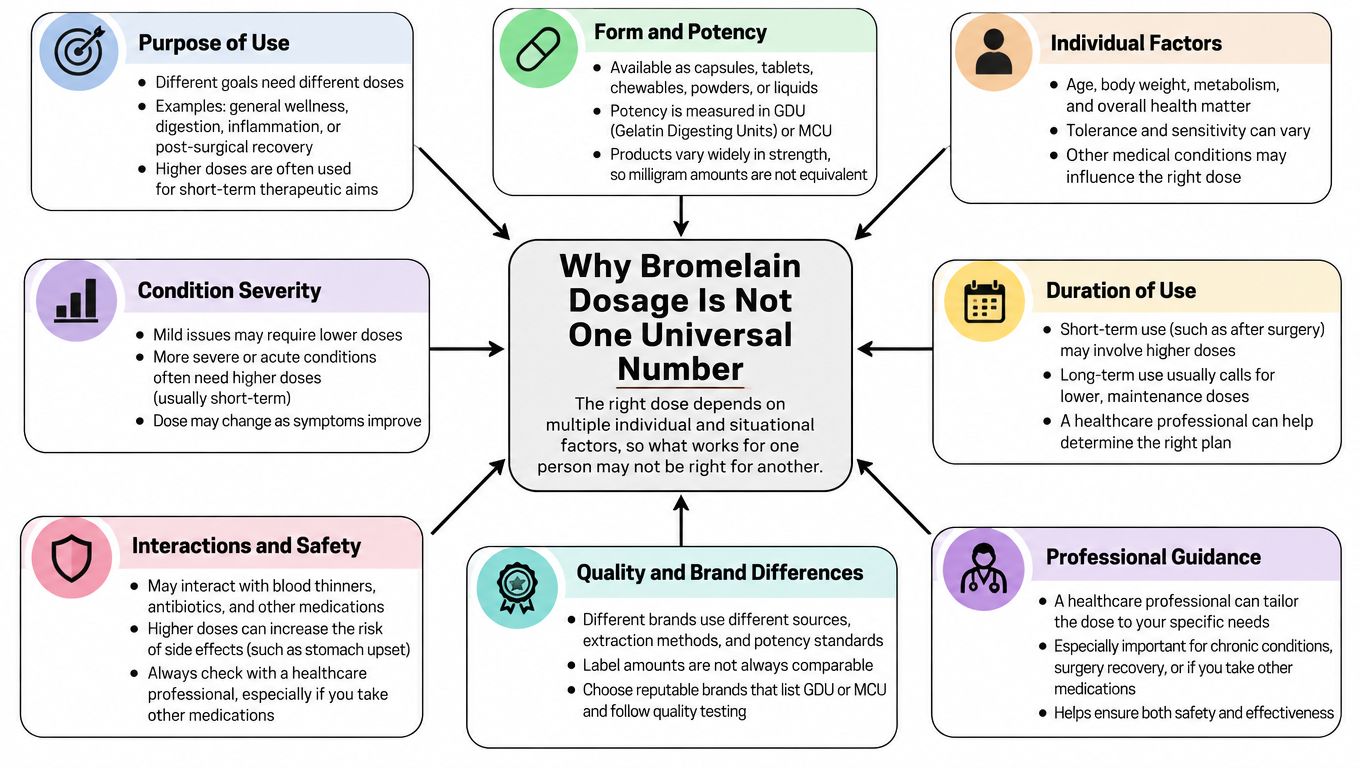
A product listing only a high milligram figure gives limited grounds for comparison. A label showing both quantity and activity lets you judge whether its format resembles a studied product, although it still cannot prove equivalent results.
Why duration changes the decision
A short research intervention does not establish indefinite daily use. If you are considering bromelain beyond a limited trial, define the reason for taking it, review the label's serving instructions, and reassess whether it is helping. Continuing solely because the bottle has become part of your routine is a weak basis for supplementation.
Clinical Evidence Behind Studied Dose Ranges
A bottle showing a larger milligram number is not automatically closer to an effective anti-inflammatory dose. Human trials have tested bromelain in several formulations, populations, and treatment periods, so the evidence provides boundaries rather than one universal prescription. A 2023 systematic review of randomized clinical trials in adults identified seven eligible trials. Most reported improvement in at least some inflammatory measures, although results differed across study designs, outcomes, and products (the systematic review in ScienceDirect).
For bromelain used alone, daily amounts ranged from 200 to 1,050 mg, with treatment periods lasting 1 to 16 weeks. Studies combining bromelain with other oral compounds used approximately 99.9 to 1,200 mg per day for 3 to 16 weeks. These figures describe investigated protocols. They do not establish what every person should take, particularly when a product label reports milligrams without enzyme activity.
The knee-pain dose comparison
A 2003 dose-ranging study examined adults with mild acute knee pain. Participants received 200 mg or 400 mg of bromelain daily for 1 month. Total WOMAC symptom scores declined by 41% in the 200-mg group and 59% in the 400-mg group, with both reductions statistically significant. In that study population, the higher-dose group also showed greater improvement in total symptoms, stiffness, and physical function (the NIH clinical summary).
The result suggests a dose-response signal in that specific trial. It does not show that doubling the amount will double the benefit for a different condition, product, or person. The study also used a defined intervention, so matching its milligram figure alone cannot confirm that a retail capsule is equivalent.
Earlier osteoarthritis trials discussed in the NIH summary used approximately 540 to 1,890 mg per day. Such variation reinforces the practical point: clinical research has not settled on one validated bromelain dose for inflammation.
A range is not a guarantee
A later placebo-controlled pilot tested 800 mg daily for 12 weeks and found no statistically significant benefit for its primary outcome, according to the evidence summarized by NIH. That finding limits any claim that a higher dose will always produce a better result.
Study context | Daily dose studied | Duration |
|---|---|---|
Bromelain used alone across randomized trials | 200 to 1,050 mg | 1 to 16 weeks |
Bromelain combined with other oral compounds | Approximately 99.9 to 1,200 mg | 3 to 16 weeks |
Mild acute knee pain dose comparison | 200 or 400 mg | 1 month |
Earlier osteoarthritis research | Approximately 540 to 1,890 mg | Varies by trial |
The NIH summary reports oral bromelain amounts ranging from 200 to 2,000 mg daily across sources and medical uses. It also lists abdominal discomfort and nausea among commonly reported adverse effects (the NIH clinical summary). This broader reported-use range is context, not a recommendation to select the upper end.
The practical conclusion is limited but useful: bromelain has been studied at substantially different amounts, and some trials found improvement in selected outcomes. No single dose has been universally validated for every inflammatory condition, and milligrams alone cannot establish that two products deliver the same enzyme activity.
How to Match Dosage to Your Goal
The best starting question isn't “What is the strongest dose?” It's “What am I trying to improve, and does the label provide enough information to compare this product with the relevant research?”
Joint stiffness support
Joint symptoms deserve the most careful interpretation. The knee-pain study found different WOMAC outcomes at 200 mg and 400 mg daily for 1 month, but that result applies to adults with mild acute knee pain in that particular trial. It doesn't automatically establish a dose for chronic osteoarthritis, rheumatoid arthritis, an injury, or unexplained swelling.
For a joint-focused product, check whether the formula states the bromelain amount per serving and whether it identifies enzyme activity. Also consider whether other ingredients may influence the intended use. If pain is persistent, worsening, associated with marked swelling, or limiting normal function, supplement selection shouldn't delay clinical evaluation.
Post-workout soreness recovery
Exercise recovery is a different job. A knee-symptom trial doesn't prove that bromelain will reduce delayed-onset muscle soreness, improve strength, or speed tissue repair after every training session. A practical approach is to keep the trial modest, avoid stacking several enzyme products, and track soreness, mobility, sleep, and training readiness rather than judging the product after one workout.
Take stomach tolerance seriously. If a product causes nausea, cramping, or loose stools, a lower amount or taking it with food may be more sensible than pushing toward a higher studied range.
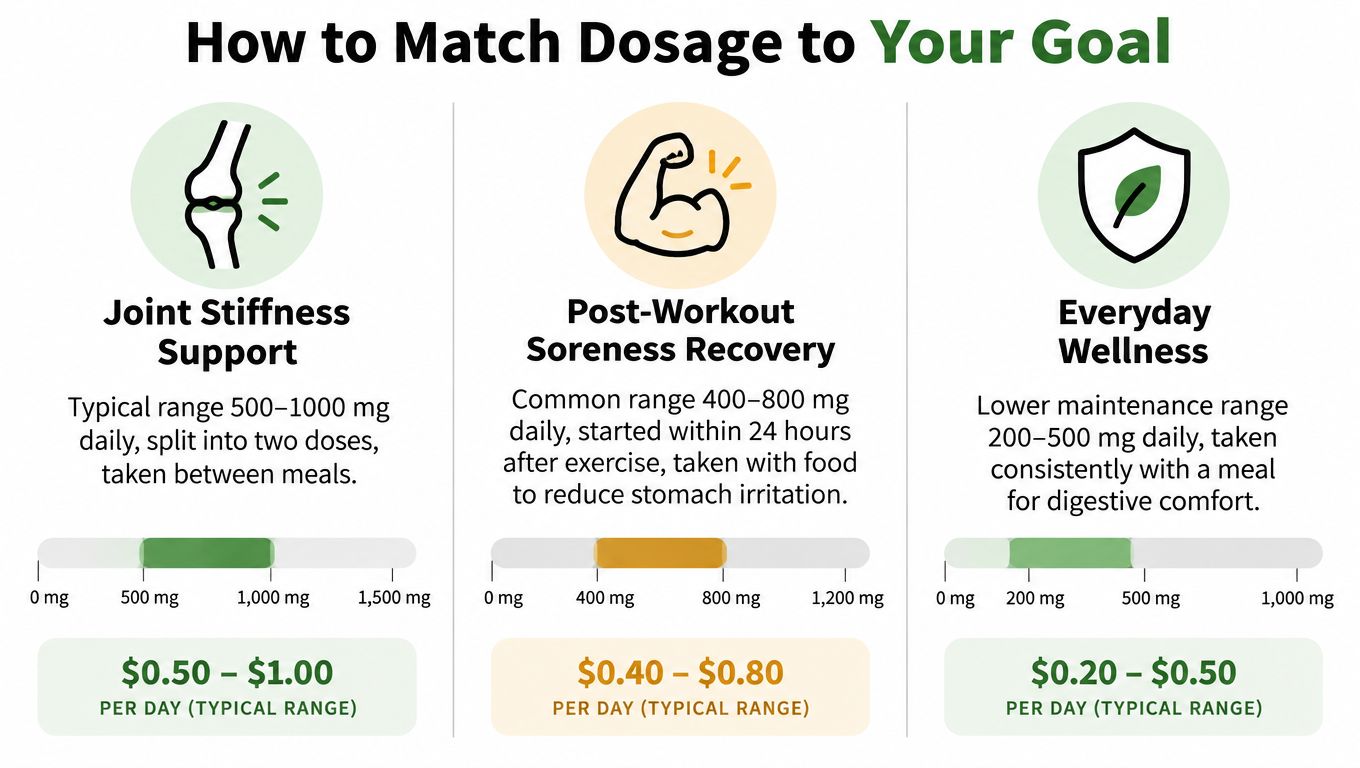
Everyday combination formulas
Combination formulas require extra label discipline. If a capsule contains bromelain alongside turmeric, ginger, or other botanicals, you can't compare its total blend weight directly with a trial that used bromelain alone. The combination may be convenient, but it also makes attribution harder.
Use this decision pattern:
If the goal is specific, choose a label that clearly identifies the active ingredients and serving math.
If the goal is broad, prioritize tolerability and transparency over a large headline number.
If the product combines ingredients, check every active component for medicine and surgery cautions.
If the response is unclear, change one variable at a time rather than adding several new supplements together.
A good trial has a defined purpose, a consistent routine, and a reason to stop or reassess. It doesn't promise that one dose will work for every form of inflammation.
When and How to Take Bromelain for Best Results
Timing matters less than consistency and tolerance. Bromelain products may be marketed for use between meals, but some people find that taking an enzyme supplement without food irritates the stomach. Follow the product label first, then adjust only within sensible limits and with professional guidance when your health history calls for it.

Build a routine you can actually follow
Choose a daily anchor, such as breakfast, lunch, or the meal after training. If your label directs use between meals, set a reminder at a consistent gap from food. If your stomach is sensitive, taking the product with food may improve comfort, although it may not match the intended use of every formulation.
Split servings only when the label allows it or a clinician recommends it. Dividing a daily amount may make the routine easier to tolerate, but it doesn't prove that split dosing creates better results.
Hydration, adequate sleep, and sensible training load still matter. Bromelain shouldn't be used to mask pain that is telling you to reduce activity or seek assessment. For broader recovery habits, see this guide to a supplement for muscle recovery.
Track the outcome instead of guessing
Keep a short symptom record for your chosen goal:
Joint symptoms: morning stiffness, comfort during movement, and any visible swelling.
Workout recovery: soreness, range of motion, and whether normal training feels manageable.
Tolerance: nausea, abdominal discomfort, loose stools, rash, or other new symptoms.
Context: training volume, sleep quality, and other supplements or medicines.
Review the pattern after a reasonable label-directed trial rather than reacting to one unusually good or bad day. If symptoms worsen or side effects appear, stop and ask a healthcare professional what to do.
This video can provide additional practical context for using supplements consistently:
Bromelain timing isn't a shortcut around product quality or medical screening. A transparent label and a safe routine are more useful than chasing a precise schedule that hasn't been established for your specific goal.
Safety Limits and Who Should Avoid Self Dosing
A dose used in a trial may still be unsuitable beside your medicines, bleeding risk, allergies, digestive health, and upcoming procedures. The practical question is whether your personal risk profile matches the product and amount you are considering.
Bromelain may influence coagulation and platelet activity. Clinical literature advises caution for people with coagulation disorders or those taking anticoagulants. One surgical study found no increased postoperative bleeding with 500 mg daily for 10 days, while still recommending caution and coagulation assessment for people at higher risk (the surgical bromelain safety study).
That finding does not establish safety with every blood-thinning medicine. A small perioperative study cannot settle questions about warfarin, direct oral anticoagulants, antiplatelet medicines, or regular NSAID use.
Sort yourself into the right risk group
Lower concern does not mean no concern. An adult who takes no interacting medicines, has no bleeding disorder, is not preparing for surgery, and tolerates pineapple-derived products may have fewer reasons to seek clearance. The label and the product's side-effect profile still deserve attention.
Talk with a clinician or pharmacist before self-dosing if you:
Take anticoagulants or antiplatelet medicines: Combining products may increase uncertainty around bleeding risk.
Use NSAIDs regularly: Ask whether the combined effect suits your situation.
Have a bleeding or coagulation disorder: Do not infer safety from a short supplement trial.
Have surgery or dental work planned: Tell the surgeon or dentist about bromelain before the procedure.
Take several medicines: An interaction review can account for multiple conditions and treatments.
Have digestive sensitivity or an ulcer history: Gastrointestinal discomfort may be more difficult to tolerate.
Have a pineapple allergy: A capsule should not be assumed suitable just because it is not a food serving.
The systematic review cited earlier reported side effects in 11 participants, with 2 participants discontinuing treatment. Adverse effects were mainly gastrointestinal and generally described as mild or tolerable. Mild effects in a study can still matter in daily use, particularly when symptoms continue.
Stop the product and seek appropriate advice if you develop a rash, signs of an allergic reaction, unusual bruising, bleeding, severe abdominal symptoms, or another unexpected reaction. Do not raise the amount to compensate for a lack of benefit, and do not combine enzyme formulas without checking every ingredient and medicine.
A dose studied for a limited period does not establish long-term suitability. Pregnancy, breastfeeding, planned procedures, bleeding conditions, and regular medication use all justify professional guidance before self-dosing.
How to Read Labels and Choose a Quality Product
Label reading turns bromelain inflammation dosage from a vague search into a comparison exercise. Start with the Supplement Facts panel, not the front-of-bottle claim.
Look for the amount of bromelain per capsule and per serving. A serving may contain more than one capsule, so multiply carefully before comparing it with a trial dose. Then check whether the manufacturer reports enzyme activity in addition to weight.
What to record from each label
Create a simple comparison:
Label detail | Why it matters |
|---|---|
Bromelain amount per capsule | Shows the ingredient weight in one capsule |
Serving size | Prevents mistakes when a serving includes multiple capsules |
Daily serving recommendation | Helps calculate the total daily amount |
Activity units | Adds information about enzyme potency beyond weight |
Other active ingredients | Identifies combination formulas and additional cautions |
Batch, expiration, and storage details | Helps you assess product handling and freshness |
Activity units such as GDU or MCU can make products easier to compare, but only when the testing method and ingredient identity are clear. You shouldn't convert one enzyme's activity units into another enzyme's units, and you shouldn't assume that a high activity number guarantees a clinical effect.
Compare formulas without pretending they're equivalent
A single-ingredient bromelain product offers simpler attribution. If your symptoms change, you have fewer variables to consider. A multi-ingredient joint formula may combine bromelain with turmeric, ginger, black pepper extract, or ashwagandha, but its total blend can't be treated as if it were the same intervention used in a bromelain-only study.
For a practical guide to serving size math and active ingredients, use this resource on reading Supplement Facts labels.
River of Life offers a vegan capsule formula containing turmeric extract, BioPerine black pepper, ashwagandha root, ginger, and bromelain, positioned for joint comfort and recovery support. If you consider a combination product like this, compare its stated bromelain amount and activity specification with the research, then review every other ingredient for suitability with your medicines and health history.
The quality question is transparency, not marketing intensity. A clear label won't guarantee a result, but an unclear label makes a meaningful comparison much harder.
Quick Reference for Doses Timing and Safety Checks
A useful quick check starts before purchase: write down your goal, the serving size, the bromelain amount per serving, the activity units, and every additional active ingredient. This record makes product comparisons more meaningful than milligrams alone. The studied ranges discussed in the clinical evidence section are reference points, not universal prescriptions, because formulation, enzyme activity, and intended use can differ.
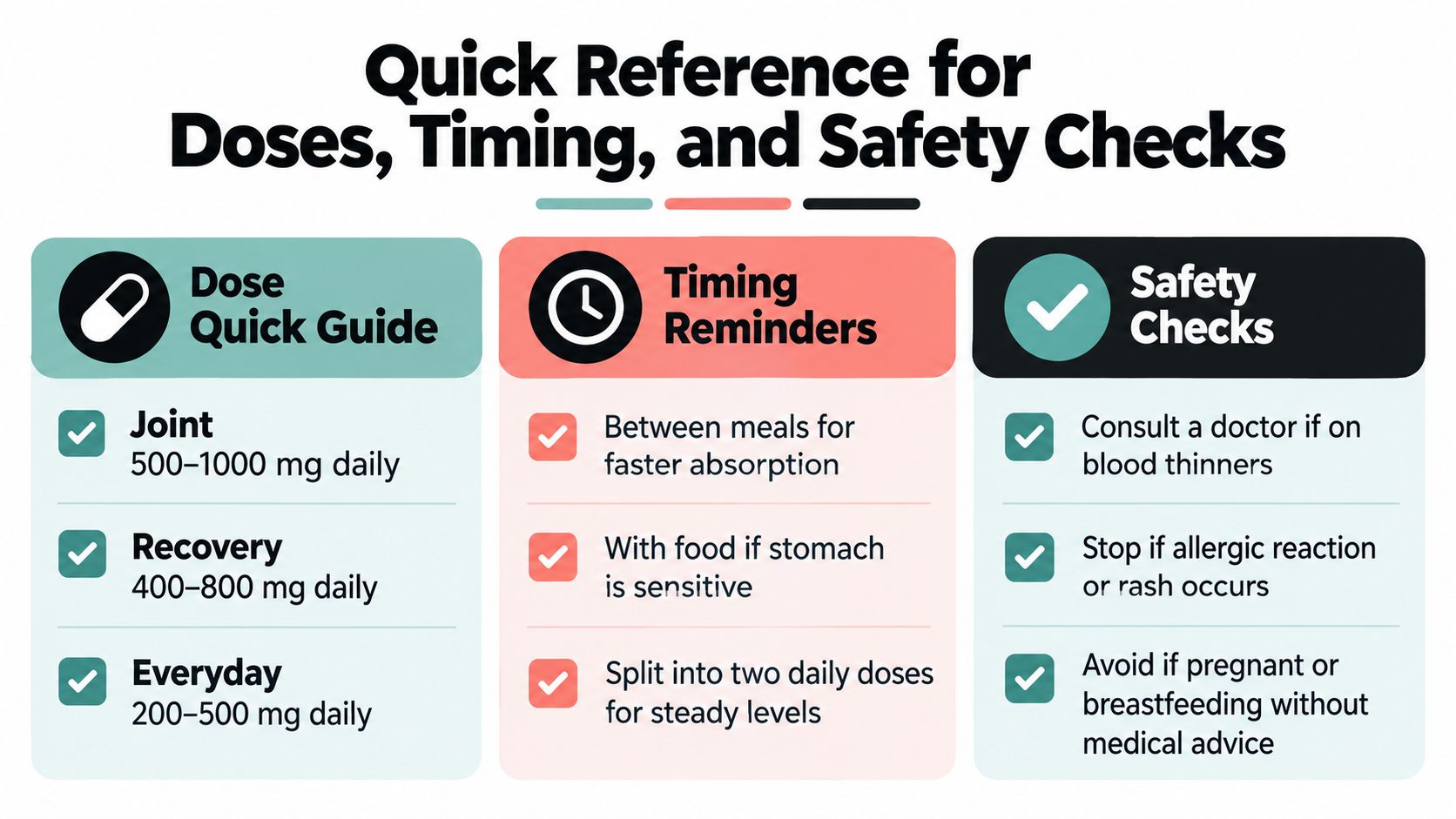
Dose checklist
Goal: Record whether you are evaluating joint comfort, exercise recovery, or another purpose.
Label math: Note the amount per serving, capsules required, and activity specification. A larger milligram figure does not automatically represent a stronger or more comparable product.
Formula: Mark whether bromelain is the only active ingredient. Combination formulas should not be compared directly with bromelain-only trials.
Trial context: Use the dose ranges in the clinical evidence section as context, then check whether the product's serving and formulation resemble the studied intervention.
Buying record: Save a photo of the Supplement Facts panel and write down the date you began. This gives you a clear baseline if you later compare products.
Timing and routine reminders
Follow the product directions, since formulations and serving instructions vary. If digestive discomfort occurs, ask a pharmacist or clinician whether taking the product with food is appropriate. Track one goal at a time, including symptoms, activity, sleep, and side effects. If there is no benefit, reassess rather than increasing the amount indefinitely.
Safety checks before the first dose
Ask a healthcare professional about bromelain if you take anticoagulant or antiplatelet medicines, have a bleeding condition, or use multiple medicines. Tell your surgeon or dentist about it before a planned procedure. Stop and seek advice for severe or persistent digestive symptoms. Stop immediately and seek urgent help for serious allergy symptoms.
River of Life offers a multi-ingredient, vegan capsule containing bromelain alongside turmeric extract, BioPerine, ginger, and ashwagandha. Visit River of Life to review the formula and compare its label with your inflammation or recovery goals before deciding whether it fits your routine.