
Anti Stress Supplement Guide: Expert Choices 2026

Your tabs are still open. Slack is pinging. You meant to finish work an hour ago, but your body hasn't gotten the memo. Your shoulders are up, your jaw is tight, and even when you finally sit down, your mind keeps running old conversations and tomorrow's to-do list.
That's the moment when a lot of people start looking for an anti stress supplement. Not because they think a capsule will erase modern life, but because they want something that might help turn the volume down enough to sleep better, think more clearly, and stop feeling like they're running hot all day.
Some supplements can help. Many don't do much. The gap usually comes down to one thing people rarely get taught: mechanism. If you understand how a supplement is supposed to work, and how to verify that on the label, you stop shopping by buzzword and start shopping like a clinician.
Table of Contents
The Modern Stress Epidemic and The Search for Relief
Stress used to sound like an occasional event. Now it often feels like a setting. People wake up already bracing for email, commute friction, financial pressure, family logistics, news alerts, and the low-grade stimulation that comes from never being fully offline.
That constant activation changes how people function day to day. They're not always having a dramatic breakdown. More often, they're tired but wired, impatient, foggy, less resilient, and weirdly unable to recover from small things that normally wouldn't hit so hard. If that sounds familiar, it helps to know this isn't a character flaw. It's what a system under repeated load often looks like.
A lot of readers start with simple questions. Do I need better sleep habits? More magnesium-rich food? Fewer late-night screens? Usually yes. And sometimes they also want to know whether an anti stress supplement belongs in the mix. That's a reasonable question, especially when the market keeps growing and product labels promise calm, focus, mood support, and “balance” all at once.
One reason this category keeps getting attention is that there is real research behind parts of it. A meta-analysis of 21 randomized controlled trials found that 71% of nutritional and herbal supplements showed a positive effect in treating anxiety without serious side effects, and the same analysis noted a $656 million global market in 2022 for supplements aimed at stress relief and mood improvement. That doesn't mean every product earns your trust. It does mean the category shouldn't be dismissed outright.
Stress support works best when you treat supplements as one tool in a larger recovery plan, not as a substitute for sleep, food, movement, and boundaries.
If you're already trying to reduce stress naturally with daily habits that actually hold up, supplements make more sense. They're most useful when the foundation is in place and you want targeted support, not a rescue mission in a bottle.
Decoding Anti Stress Supplements What They Really Do
Some people shop for stress supplements like they're buying a flavor. Ashwagandha. Magnesium. Lemon balm. Turmeric. B-complex. The list gets long fast. A better approach is to ask what job the ingredient is trying to do inside the body.

Stress support is not one thing
“Stress” is an umbrella term. One person means racing thoughts. Another means poor sleep. Another means feeling physically tense and inflamed after long stretches of pressure. Good formulas usually target one or more of these pathways:
Adaptogens help the body respond more evenly to stress load. They're often used for resilience rather than instant sedation.
Nervines are chosen for calming the nervous system more directly. These can be helpful when the main complaint is agitation, restlessness, or difficulty winding down.
Anti-inflammatory compounds matter because chronic stress often shows up in the body, not just the mind. Achy muscles, poor recovery, and that worn-down feeling can overlap with inflammatory signaling.
Nutrient support fills gaps that can make stress feel worse, especially when diet quality slips during demanding periods.
A common mistake is assuming every calming ingredient should feel immediately noticeable. That's not how many evidence-based products work. Some support the body gradually, more like changing the operating conditions than flipping a switch.
The stress thermostat analogy
The clearest way to think about an anti stress supplement is as support for your body's stress thermostat. When the thermostat is off, you may feel stuck on high alert, slow to recover, or oddly flattened after being “on” for too long.
A useful supplement doesn't erase life's stressors. It may help the body regulate its response more effectively so the same workload produces less internal wear and tear. That's why mechanism matters. If an ingredient is meant to influence cortisol rhythm, support inflammatory balance, or calm an overfired nervous system, the label should give you clues that it can do that.
Practical rule: Don't ask only “What ingredient is in this?” Ask “What pathway is this supposed to affect, and does the label show a form and dose that make that claim believable?”
That simple shift changes how you read products. You stop falling for decorative formulas packed with trendy botanicals in tiny amounts, and you start looking for targeted ingredients with a reason to be there.
The A-List Ingredients Backed by Science
When people ask me what separates a serious anti stress supplement from a decorative one, I look for two things. First, does the ingredient have a plausible biological role? Second, is there human evidence showing that the form and dose changed a stress-related outcome?
Ashwagandha and cortisol regulation
Ashwagandha is the most important herb to understand in this category because its mechanism is practical, not mystical. It's generally discussed as an adaptogen, meaning it helps the body respond to stress more steadily over time. In real terms, the key interest is its relationship to cortisol, one of the body's major stress hormones.
In a randomized, double-blind, placebo-controlled trial, adults taking ashwagandha extract for 60 days had a 41% reduction in anxiety scores, compared with 24% in the placebo group. The study also found greater reductions in morning cortisol in the ashwagandha group, which matters because it ties the symptom change to a measurable biological effect rather than vague self-report alone.
That's the kind of evidence I want to see. Not “used for centuries,” but a defined extract, a controlled trial, and a result that lines up with the proposed mechanism.
Another detail matters just as much as the ingredient itself: dose and extract quality. If you want a useful overview of how adaptogens fit into anxiety support, this guide on adaptogens for anxiety and how they're typically used is a good companion read.
Turmeric and the inflammation connection
Turmeric is often discussed as a joint or recovery ingredient, but it also belongs in some stress formulas because prolonged stress isn't purely psychological. It has a physical footprint. People under chronic load often feel inflamed, tense, sore, and mentally dull at the same time.
That's where anti-inflammatory support can make sense. Turmeric's active compounds, especially curcuminoids, are used for inflammatory balance. It won't replace a dedicated calming herb if your main issue is acute anxiety or insomnia, but in the right formula it can support the body side of stress, especially when pressure is showing up as stiffness, poor recovery, or an “always rundown” feeling.
A common pattern in practice is that people don't need only “calm.” They need better regulation plus less physical drag. That's why some multi-ingredient products pair an adaptogen such as ashwagandha with anti-inflammatory support from turmeric.
Key Anti-Stress Ingredients at a Glance
Ingredient | Primary Role | Mechanism of Action |
|---|---|---|
Ashwagandha | Stress resilience | Supports a healthier stress response, with evidence linked to cortisol modulation |
Turmeric | Physical stress support | Helps address inflammatory pathways that can overlap with chronic stress symptoms |
B vitamins | Nutrient support | Help cover nutritional gaps that can affect perceived stress and energy regulation |
Mimosa ottonis extract in phospholipid form | Mood and stress support | Uses a carrier system intended to improve delivery and speed of effect |
Not every good formula needs all four. A focused product can work well if it has the right mechanism, form, and dose. A crowded product can still underperform if every ingredient is underdosed or poorly absorbed.
If a label lists impressive ingredients but tells you nothing about the extract type, standardization, or delivery system, treat it like a promise without proof.
How to Choose a High-Quality Anti Stress Supplement
Smart buyers differentiate themselves from impulse buyers. Most disappointing supplements don't fail because the ingredient category was wrong. They fail because the label hid the details that determine whether the ingredient has any realistic chance of working.
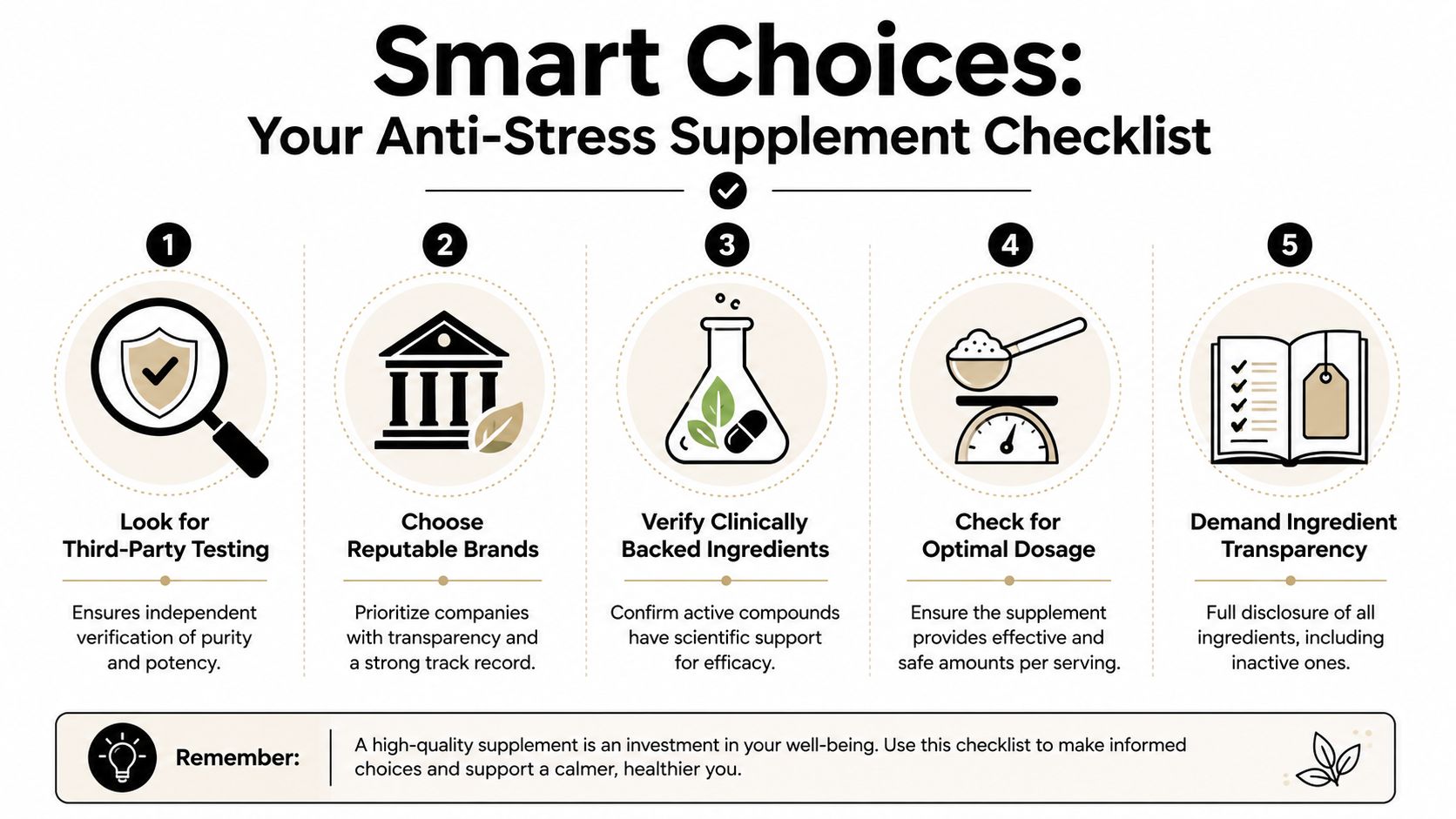
A quick visual checklist helps before you buy.
What standardization tells you
Standardization means the manufacturer is telling you how much of a relevant active compound is present in the extract. That matters because “ashwagandha root powder” and “ashwagandha extract standardized to a defined withanolide content” are not the same thing.
For ashwagandha, the NIH Office of Dietary Supplements fact sheet notes that root extract standardized to 5% withanolides has shown a dose-dependent effect on stress reduction, with 600 mg daily for at least 8 weeks producing more prominent reductions in stress scores than 300 mg or placebo. That tells you two useful things. First, standardization helps you compare products meaningfully. Second, a token amount may not behave like the studied amount.
When I read a label, I want to know:
Which part of the plant is used. Root, leaf, or a mix.
Whether it's an extract or plain powder.
Whether active constituents are standardized.
How much you get per day, not just per capsule if the serving size is multiple capsules.
Why bioavailability changes outcomes
A strong ingredient still has to reach the body in a usable way. That's bioavailability. It's one of the most overlooked reasons a product with good ingredients can still feel flat.
A useful example comes from a study of a phospholipid-based carrier for aqueous Mimosa ottonis extract. In that research, the formulation achieved significant improvements in depressive mood, anxiety, and stress scores within 3 weeks at 400 mg per day, using the carrier system to enhance delivery. The lesson isn't that everyone needs Mimosa ottonis. The lesson is that formulation technology changes performance.
That same principle is why some products pair turmeric with black pepper extract to improve absorption. River of Life Capsules are one example of a formula built around that idea, combining turmeric extract with BioPerine alongside ashwagandha and other ingredients. The important point is not the brand name. It's whether the label clearly explains why ingredients were combined and what problem the pairing is trying to solve.
Here's a simple buyer filter:
If the formula uses a hard-to-absorb botanical, look for a stated absorption strategy.
If the product mentions a trademarked delivery system, make sure the label still shows the actual ingredient amount.
If the brand makes “fast acting” claims, check whether the form of the ingredient gives that claim any credibility.
A short explainer can also help clarify the difference between ingredient hype and formulation quality.
Label red flags worth catching
Some labels make it easy to trust them. Others work hard to stay vague.
Watch for these problems:
Proprietary blends that list a long group of herbs but hide the amount of each one.
Buzzwords without specifics, such as “advanced,” “premium,” or “balanced” with no extract details behind them.
Missing testing language. Third-party verification doesn't guarantee effectiveness, but it does improve confidence in purity and label accuracy.
Kitchen-sink formulas with too many goals. If a product claims deep calm, energy, sleep, focus, weight control, and hormone balance all at once, skepticism is healthy.
The best labels usually feel a little boring. That's a compliment. They tell you exactly what's inside, how much is there, and why the form was chosen.
Using Supplements Safely and Building a Resilient Lifestyle
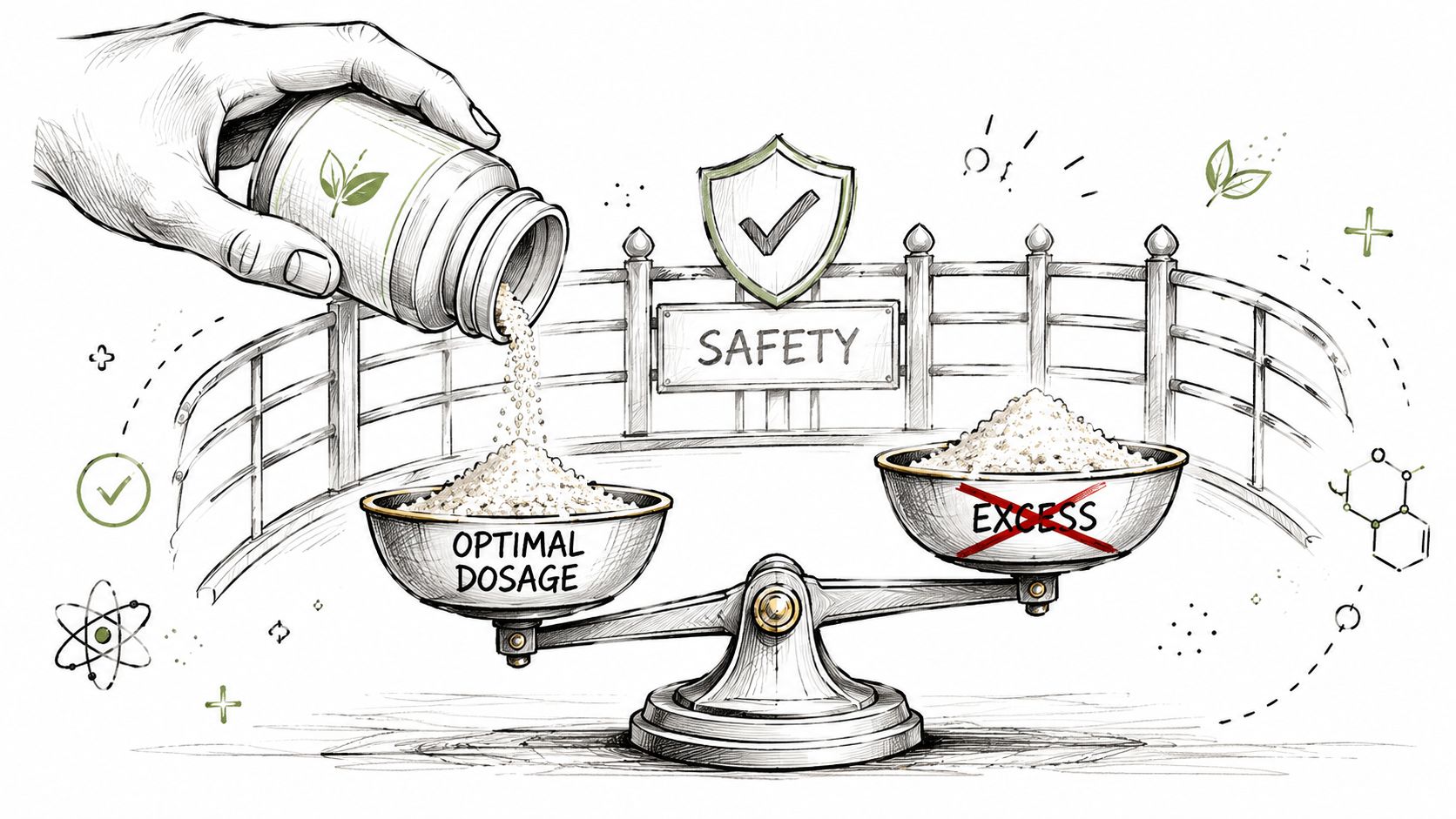
The most common mistake people make with stress supplements is thinking that if a little support is good, more must be better. That's rarely how this works. With botanicals especially, the target isn't maximum intensity. It's the right dose, for the right person, for the right reason.
Dose matters more than hype
If a formula uses ashwagandha, don't assume every label offers the same value. The NIH Office of Dietary Supplements summary on ashwagandha reports a dose-dependent effect, with 600 mg daily for 8 weeks producing the most significant reductions in stress scores. It also notes provisional recommendations from WFSBP and CANMAT in the 300 to 600 mg per day range for generalized anxiety disorder.
That doesn't mean everyone should automatically take the top end. It means clinically relevant dosing matters, and products with very small amounts may not reflect the evidence people think they're buying.
If you want a practical breakdown of how ashwagandha daily dosage is commonly framed in supplements, use it to compare labels, not to self-prescribe care you should be discussing with a clinician.
Start with the label, not the marketing. Serving size, total daily amount, extract type, and how long it was studied tell you more than front-of-bottle claims.
When professional guidance is not optional
An anti stress supplement may be sold over the counter, but that doesn't make it consequence-free. Herbs and nutrients can interact with medications and medical conditions.
Talk to a clinician before starting a product if you:
Take psychiatric medication, including SSRIs or other mood-related prescriptions
Use blood thinners or immunosuppressants
Have an autoimmune condition, thyroid condition, or are pregnant or breastfeeding
Are already stacking multiple supplements and aren't sure where ingredients overlap
This is especially important if the formula contains several active ingredients. Multi-ingredient products can be useful, but they increase the chance that one component won't fit your situation.
What a resilient routine actually looks like
Supplements work best when they're helping a system that already has some support. If sleep is chaotic, caffeine intake is excessive, meals are irregular, and the nervous system gets no off-ramp during the day, a capsule has to fight uphill.
A more realistic resilience plan usually includes:
Consistent sleep timing so the body has a real recovery window
Regular meals with enough protein and whole foods so stress isn't amplified by unstable energy
Movement that downshifts the system, not only intense exercise
Short moments of nervous-system relief such as breath work, walking without headphones, prayer, journaling, or quiet time outdoors
Plainly put, supplements are supplemental. They can support the process. They don't replace the process.
The people who do best with stress supplements usually aren't the ones chasing a miracle. They're the ones building routines that give the supplement something to work with.
Conclusion Building Your Personal Stress Resilience Toolkit
A good anti stress supplement isn't defined by how many calming words fit on the label. It's defined by whether the product makes biological sense. You want ingredients with a credible mechanism, forms that have been studied, doses that resemble the evidence, and a label that tells the truth clearly enough for you to verify it.
That's a key shift. Stop buying supplements as if they're personality brands. Start reading them like functional tools.
A strong personal stress resilience toolkit usually includes five pieces. Know what problem you're trying to solve. Look for ingredients that match that problem. Check standardization and delivery, not just ingredient names. Use supplements alongside sleep, food, movement, and recovery habits. Get medical guidance when medications, health conditions, or symptom severity raise the stakes.
That approach is calmer than chasing trends, and it's usually more effective. You don't need a giant shelf of products. You need a short list of options that you understand well enough to use safely and consistently.
If you want a simple formula that reflects the label-reading principles in this guide, River of Life offers a capsule-based blend with turmeric extract, BioPerine, ashwagandha root, ginger, and bromelain, along with educational resources that can help you compare ingredients more carefully before you buy anything.