

Turmeric vs Ibuprofen: Which Works Better for Pain?

Your knee feels stiff when you get out of bed, and the stairs look less inviting than they did yesterday. In the cabinet, there's ibuprofen beside the turmeric capsules you bought last month. You want relief, but you'd also like to avoid taking something you don't need.
Table of Contents
Where You Stand With That Ache Right Now
The useful question in turmeric vs ibuprofen isn't which one wins. It's whether you're treating a familiar, persistent ache or a new problem that needs a different response. A stiff knee with an established osteoarthritis diagnosis calls for a different decision than a swollen knee after a fall.
Before choosing either product, describe what's happening. Is the discomfort familiar? Can you walk normally? Has anything changed besides the pain level? Those details matter more than whether the label says pharmaceutical or botanical.
Start with the problem, not the bottle
Ibuprofen is a dose-defined medicine. With turmeric, the ingredient name alone doesn't tell you which extract you're getting, its curcuminoid content, or how the manufacturer has addressed absorption. Comparing a tablet with an unspecified golden capsule isn't a clean comparison.
That distinction also changes how to read research. A study of a particular extract doesn't automatically validate turmeric tea, kitchen turmeric, or a capsule containing several ingredients. Nor does improvement on an arthritis questionnaire establish that a supplement treats every kind of pain.
Practical rule: Choose according to the diagnosis, urgency, and your medication history, not according to which bottle sounds gentler.
For a familiar knee ache, the decision may involve a monitored trial, clear expectations, and a plan for reassessment. For unfamiliar pain, the first task may be finding its cause rather than suppressing it.
Bring your actual product label into the conversation. A clinician or pharmacist can make a more useful recommendation from the extract amount, directions, and full ingredient list than from the word turmeric alone. Your goal should be concrete: easier walking, less difficulty rising from a chair, or less interference with ordinary activities, not merely taking something described as anti-inflammatory.
How Each Option Actually Works in the Body
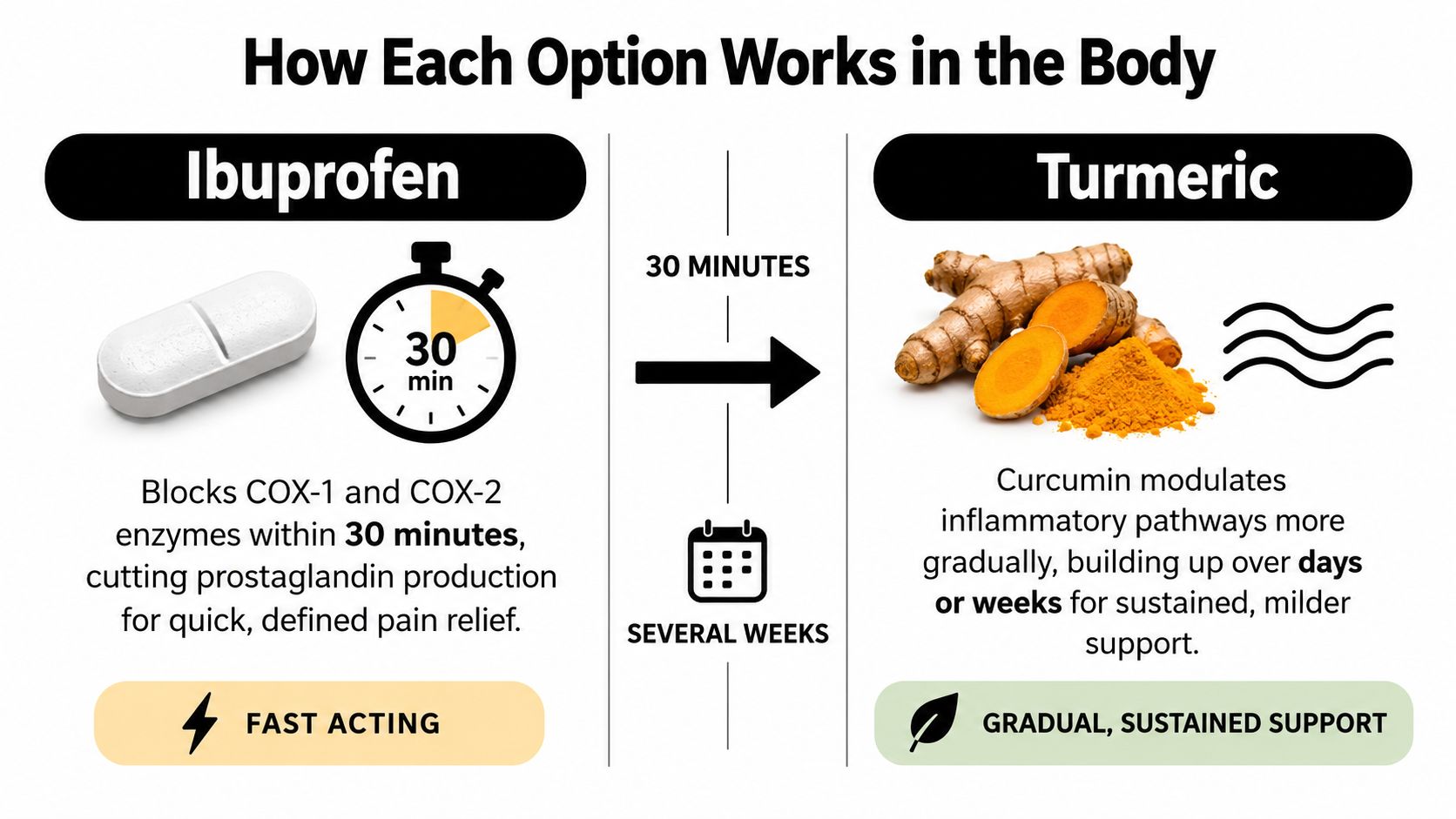
Ibuprofen and curcumin aren't different versions of the same treatment. Ibuprofen is a nonsteroidal anti-inflammatory drug, or NSAID. Its action involves inhibiting cyclooxygenase enzymes, which participate in producing prostaglandins involved in pain and inflammation.
Curcumin is a component of turmeric studied for effects on inflammatory signaling. That broader biological description can sound impressive, but it doesn't tell you how much relief a person will feel. Laboratory activity and meaningful clinical improvement are different questions.
Mechanism isn't a stopwatch
The practical contrast is between a medicine used for short-term symptom relief and a supplement evaluated through repeated use. It's misleading to promise an exact onset for a turmeric capsule based on its ingredient list. It's equally misleading to assume that influencing several pathways makes curcumin more effective than a medicine with a more defined target.
The visual below illustrates the broad contrast, but its precise timing shouldn't be treated as a guarantee for either individual response or supplement performance.
Absorption is a separate question
Curcumin's limited absorption is one reason manufacturers use standardized extracts and absorption-focused formulations. BioPerine, a black pepper extract containing piperine, is one approach; other products use different delivery systems. Better absorption, however, doesn't by itself establish better pain relief or prove that different products are interchangeable.
Ingredient identity: Turmeric root powder and a concentrated extract aren't equivalent descriptions.
Delivery method: An absorption aid changes the formulation, not the diagnosis it can treat.
Clinical relevance: The important outcome is whether the finished product improves symptoms and function, not how many biological pathways appear in its marketing.
Treat mechanism as an explanation of plausibility. Use clinical outcomes to judge usefulness.
Side-by-Side Differences That Actually Matter
Turmeric vs Ibuprofen at a Glance
Criterion | Ibuprofen | Turmeric (Curcumin Extract) |
|---|---|---|
Speed | More appropriate when short-term analgesia is the priority, if medically suitable | Not established as a rescue treatment for sudden pain |
Magnitude of benefit | A defined comparator in knee-osteoarthritis trials | Some favorable comparisons, but not consistently equal across outcomes |
Duration | Follow labeled or prescribed use | Studies assess repeated treatment, not guaranteed all-day relief |
Evidence quality | Findings depend on the condition and regimen | Extracts, doses, and study quality vary |
Tolerability | Gastrointestinal complaints can limit use | May offer a gastrointestinal advantage, but isn't free of adverse effects |
The clearest tolerability comparison is modest rather than miraculous. One clinical comparison reported abdominal pain or distension in 10.8% of turmeric-treated participants versus 18.1% taking ibuprofen, as summarized in a review of curcuminoids for osteoarthritis. That finding concerns particular symptoms in a particular comparison, not overall proof that turmeric is safer for everyone.
Compare outcomes you can actually notice
Pain intensity matters, but so does function. A product that slightly changes an ache without helping you walk, sleep comfortably, or complete normal activities may not be delivering enough practical benefit. Conversely, meaningful improvement doesn't require pain to disappear.
For a supplement trial, decide beforehand what would count as success:
Movement: Getting up from a chair or walking your usual route becomes easier.
Interference: Discomfort interrupts fewer ordinary activities.
Medication use: Any change in prescribed treatment happens with the prescriber's agreement.
Tolerability: New digestive symptoms or other concerns don't outweigh the benefit.
A treatment earns its place by helping you function with acceptable risk, not by belonging to the natural or pharmaceutical category.
Avoid reading “clinically studied” as a complete quality statement. Ask whether the studied preparation resembles the product in your hand and whether the research measured an outcome that matters to you.
Also resist claims about guaranteed duration. A daily capsule schedule doesn't prove continuous symptom control, and improvement during a study doesn't establish how long benefits persist after stopping. Pick by situation and observed response, not by category loyalty.
Best Scenarios for Each Option
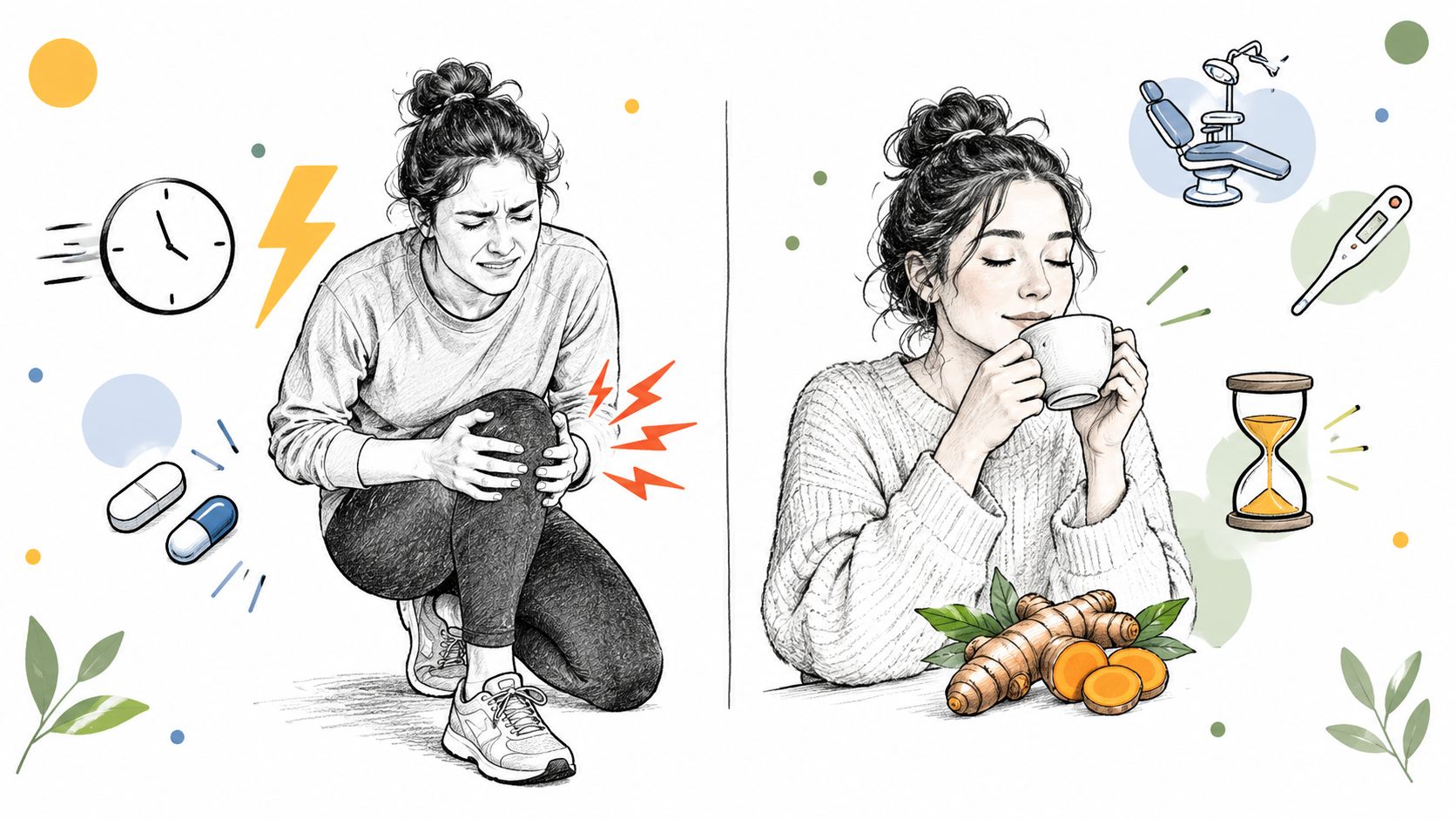
The person managing familiar knee stiffness and the person dealing with a new injury may both describe their problem as inflammation. They shouldn't automatically make the same treatment choice.
This image shows the common consumer choice, although tea and a studied turmeric extract shouldn't be treated as equivalent.
When prompt symptom control matters
For an ordinary short-lived headache, fever-related discomfort, or an acute pain flare, choose an established treatment appropriate to your health history rather than experimenting with a supplement. Ibuprofen may fit that role when it's suitable, but a contraindication doesn't disappear because you need relief quickly.
After dental work or surgery, follow the treating clinician's plan. With sudden injury pain, first consider whether the injury needs assessment. Neither an ibuprofen tablet nor a botanical product should become a reason to keep exercising through a possible significant injury.
When a monitored supplement trial may fit
Persistent discomfort from diagnosed knee osteoarthritis is the clearest setting for considering curcumin. A reasonable discussion includes what you're already doing, what improvement you want, and when you'll decide whether the trial has helped.
Frequent NSAID use: Ask for a medication review rather than independently substituting capsules.
Post-exercise soreness: Don't assume knee-arthritis findings prove a recovery benefit.
Other arthritis diagnoses: Don't replace disease-directed treatment with an osteoarthritis supplement strategy.
The guide to natural pain-relief approaches can support that discussion, but the diagnosis should determine which options deserve consideration.
The accompanying video provides additional context for comparing these approaches.
Suspected fracture, an acutely hot and swollen joint, possible gout, or back pain accompanied by neurological symptoms calls for assessment rather than a supplement experiment. Sudden severe pain isn't just a stronger version of your usual ache.
What the Head-to-Head Studies Actually Show
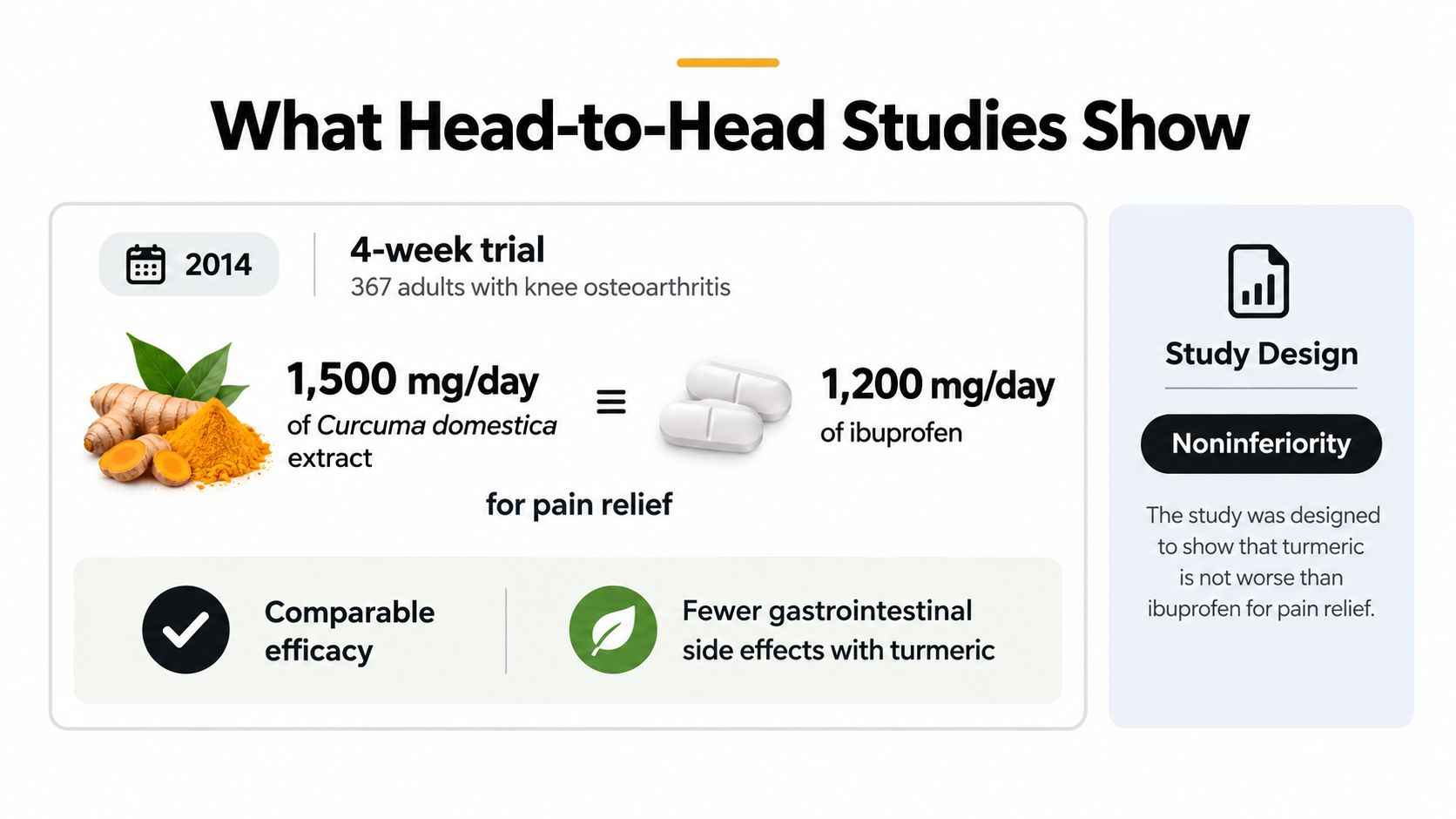
The most useful direct comparison was a 2014 randomized, double-blind noninferiority trial involving 367 adults with symptomatic knee osteoarthritis, testing 1,500 mg/day of Curcuma domestica extract against 1,200 mg/day of ibuprofen for four weeks (published trial). These were study regimens, not universal dosing recommendations.
Researchers assessed WOMAC scores, which incorporate pain, stiffness, and physical function. The extract met the trial's noninferiority criteria for the total score, pain, and physical function. Stiffness favored turmeric directionally but didn't meet the prespecified significance threshold.
What noninferiority actually means
A noninferiority trial asks whether a treatment performs no worse than its comparator by more than a predefined margin under the study's conditions. It doesn't establish that the treatments are identical, that the supplement is better, or that patients can substitute any turmeric product.
Similar performance within a defined trial is a narrower finding than interchangeable treatment in everyday practice.
The study-summary graphic captures the comparison, but the qualification about outcomes and study design matters.
The broader evidence is promising, not uniform
A 2022 meta-analysis reviewed 29 randomized trials involving 2,396 participants across five arthritis categories, with preparations ranging from 120 to 1,500 mg daily over 4–36 weeks; studies generally reported symptom improvements without severe adverse events (arthritis meta-analysis). That absence of reported severe events doesn't establish indefinite safety, particularly across different formulations and patient groups.
A 2017 systematic review evaluated seven randomized studies involving 797 participants, primarily people with knee osteoarthritis, and found significant benefits over placebo but generally weaker results than ibuprofen for pain, stiffness, and function in direct comparisons (systematic review of curcuminoids). These findings aren't a reason to dismiss turmeric, but they prevent a confident claim that it consistently matches ibuprofen.
The defensible conclusion is specific: a defined turmeric extract may help short-term knee-osteoarthritis symptoms. These comparisons don't establish equivalent treatment for acute pain, higher ibuprofen regimens, or long-term disease management. They also don't show that symptom improvement means underlying joint disease has been reversed.
Why a BioPerine-Enhanced Turmeric Capsule Fits the Toolkit
A BioPerine-enhanced capsule deserves consideration because formulation matters, not because black pepper turns turmeric into a substitute for medicine. For someone considering a supplement for persistent joint discomfort, an explicitly described extract and delivery approach are more informative than a front-label claim about inflammation.
The next question is whether the complete formula is appropriate. A multi-ingredient capsule adds considerations beyond curcumin, including whether each ingredient fits your medication list and health history. More ingredients don't automatically mean greater benefit.
Evaluate the finished formula
River of Life Capsules are one option combining turmeric extract and BioPerine with ashwagandha root, ginger, and bromelain, with climate-resistant packaging intended to protect the product during delivery. That describes the formulation and fulfillment approach; it doesn't establish that the finished blend reproduces the outcomes of a turmeric-extract trial.

The practical buying questions are straightforward:
Extract information: Does the label clearly describe what the product supplies?
Full ingredient review: Can your pharmacist evaluate the entire blend, not just turmeric?
Evidence match: Is the claim about the ingredient, the absorption method, or the finished capsule?
Accountability: Can you obtain clear directions and answers to product-specific questions?
The explanation of curcumin bioavailability offers context for comparing delivery approaches. Don't translate an absorption claim into an assumed increase in pain relief.
A sensible trial has boundaries: an appropriate diagnosis, a functional goal, a review point, and permission to stop if it doesn't help. A supplement shouldn't become a permanent expense just because its proposed mechanism sounds plausible.
Safety, Interactions, and When to See a Clinician
Natural doesn't mean interaction-free, and over-the-counter doesn't mean suitable for everyone. Before starting either option, consider your existing medicines, relevant diagnoses, and whether you're already treating the same symptoms with another product.
For ibuprofen, the safety discussion should address stomach irritation or ulcer history, kidney health, blood pressure, other NSAIDs, and alcohol use. Don't combine pain products without checking their ingredients. The ibuprofen guide provides background, but individualized advice should come from a clinician or pharmacist.
Bring the actual labels to the review
Concentrated curcumin can cause digestive symptoms, and people taking anticoagulants, living with gallbladder disease, or using other medicines should obtain clinician guidance before starting it. If you're receiving chemotherapy or preparing for surgery, have the treating team review the complete supplement formula rather than assuming it's irrelevant to care.
Ask direct questions: Is this appropriate with my prescriptions? Should I avoid it before a procedure? What symptoms should make me stop? Don't use a research dose as personal instructions, and don't increase a supplement dose because the initial effect is disappointing.
Know when self-treatment should stop
Seek medical evaluation for changes that don't fit your usual pattern:
Swelling after injury: Especially when movement or weight-bearing becomes difficult.
Fever with joint pain: Don't assume this is an ordinary arthritis flare.
Sudden severe headache: Seek urgent assessment rather than testing another remedy.
Numbness or new weakness: Particularly with back pain or worsening mobility.
Rapidly declining function: A marked change deserves evaluation even if pain medication helps temporarily.
Safety checkpoint: Relief doesn't confirm a diagnosis. A concerning symptom still needs attention even when a tablet reduces it.
Using ibuprofen for occasional symptom spikes while taking a turmeric product isn't automatically a safe combination. If both are being considered, agree on the plan with a clinician, including when each is appropriate and when to reassess. The aim is useful relief with the least unnecessary treatment, not collecting overlapping products.
River of Life offers a turmeric-and-BioPerine capsule blend for adults considering botanical support for everyday joint comfort. Visit River of Life to review the full formula and directions, then bring the label to your clinician or pharmacist to decide whether it fits your pain-management plan.