


Turmeric Powder Tablets: Dosing, Safety and How to Choose

If a bottle of turmeric powder tablets advertises a heavier dose, does that mean you'll absorb more of the compounds studied for joint pain? Not necessarily. The weight on the front can describe root powder, concentrated extract, or a delivery system, and those aren't interchangeable.
A useful comparison starts with curcuminoid content, then asks how the product changes absorption. That second question belongs in a safety conversation, not just a marketing comparison.
Table of Contents
What Turmeric Powder Tablets Actually Contain
A turmeric label is like a juice carton that says “orange.” It identifies the source, but it doesn't tell you how concentrated the contents are. You still need to read the ingredient details.
With turmeric supplements, the important distinction is between whole-root powder, extract, and standardized curcuminoids. The curcuminoids include curcumin, demethoxycurcumin, and bisdemethoxycurcumin. A tablet's total weight doesn't tell you how much of that group it contains.
Think of root powder and standardized extract as different ingredients, not different strengths of the same finished product. A heavier powder tablet may contain fewer curcuminoids than a smaller standardized extract. Without a declared assay, you can't calculate the difference reliably.
What each turmeric tablet label measures
Label wording | What the number measures | Typical curcuminoid content | What it means for you |
|---|---|---|---|
Turmeric root powder | Whole dried root, ground | Requires a product-specific assay | Don't treat the whole powder weight as curcuminoids |
Concentrated turmeric extract | Extracted material | Depends on standardization, not extract ratio alone | Check whether curcuminoids are listed |
Standardized curcuminoids | Material standardized to named compounds | The percentage declared on the label | Calculate curcuminoid milligrams from the stated amount and percentage |
Curcumin with piperine | Curcuminoids plus black pepper extract | Label-dependent | Evaluate both the curcuminoid amount and the absorption ingredient |
Branded absorption system | A proprietary delivery formulation | Product-specific | Compare it with research on that exact formulation |
An extract ratio isn't a curcuminoid percentage. It describes a relationship between starting material and extract, not necessarily the concentration of the compounds you're trying to compare.
Also check whether an amount applies to an individual tablet or the entire serving. A prominent front-label figure can be much less useful than the smaller print beside the serving size.
Label-reading rule: Ask what the milligrams measure before deciding whether the number is large or small.
Before comparing products, locate these details:
Plant material: Does the label identify the botanical ingredient and plant part?
Curcuminoid declaration: Does it provide a percentage, an actual milligram amount, or neither?
Ingredient form: Is the stated weight root powder, extract, or standardized curcuminoids?
If the manufacturer can't clarify those points, you don't have enough information to make a meaningful dose comparison.
Why Absorption Decides How Much Reaches You
How much curcumin reaches your circulation can differ from the amount printed on a tablet label. Plain curcumin is like water poured into a sieve: some passes through before it can circulate. The analogy is imperfect, but it helps explain systemic exposure, the amount of a substance that reaches the bloodstream.
Piperine, a component of black pepper, is often added to affect curcumin exposure. It can slow some of the body's processing of curcumin and may affect uptake in the intestine. That can change absorption, but an absorption enhancer is not just a marketing feature. It may also affect how the body handles other substances.
What the absorption headline leaves out
An early pharmacokinetic study of curcumin and piperine examined piperine's effect on curcumin absorption under specific experimental conditions. The study's reported figures are difficult to interpret consistently, so a headline percentage shouldn't be treated as a reliable prediction for a tablet or for an individual. The practical point is qualitative: piperine can affect curcumin's measured exposure, but the result depends on the formulation and the conditions tested.
A result from a controlled experiment does not automatically apply to every tablet containing black pepper extract. The curcuminoid amount, piperine amount, and delivery system all matter. Compare tablets by their declared curcuminoid milligrams and the evidence for their delivery system, not just by the total weight printed on the front.
This illustration is a visual analogy for filtering, not evidence that turmeric removes toxins from the liver.

Turn the claim into questions
Ask the manufacturer for the study behind an absorption claim. Did researchers test the product being sold, or only one ingredient? What dose, food conditions, and measurement method did they use? Did they measure blood concentrations, symptom changes, or both? What adverse effects did they monitor, and for how long?
The explanation of curcumin bioavailability can help clarify formulation terms, but a product page cannot replace the underlying study.
More absorption does not automatically mean more benefit or greater safety. A higher exposure could also change how the body handles other substances. Ask a pharmacist to assess the whole formulation before choosing an absorption enhancer.
What Clinical Trials Show About Joints, Mood and Sleep
Could turmeric powder tablets ease joint pain, improve mood, or help with sleep? A systematic review and meta-analysis published in 2024 examined 103 randomized trials involving 7,216 participants and 42 health outcomes. It reported statistically significant findings for 23 outcomes, but that overall count does not show which results apply to a particular symptom or tablet.
For joints, the review includes evidence on pain and function, including findings related to osteoarthritis. That is more relevant to someone with arthritis-related discomfort than an overall health claim, but it does not establish that every turmeric tablet relieves joint pain. The studies tested different turmeric or curcumin formulations, so the result for a studied extract cannot automatically be carried over to a whole-root powder tablet.
A discussion of turmeric, curcumin, and arthritis-related joint pain can clarify the terms. For a product decision, compare the trial's formulation with the label, including curcuminoid amount and delivery system. The weight of turmeric powder alone does not tell you whether it matches what researchers tested.
The review's mood and sleep findings should also be read separately from its joint results. Its overall total of significant outcomes does not establish a reliable benefit for mood or sleep from turmeric powder tablets. If a study reports a change in one outcome, that is not proof of improvement in another.
Claim | What to check |
|---|---|
Joint comfort | Was the condition studied similar to yours, and was the formulation comparable? |
Improved function | Did researchers measure daily activities, such as walking or using stairs? |
Inflammation support | Which symptom or marker changed, and does it match your goal? |
Mood or sleep support | Is there direct human evidence for that specific outcome? |
Broad health benefits | Is each advertised benefit supported by its own evidence? |
A change in an inflammation marker does not by itself show that someone feels better, sleeps more soundly, or functions better. Those outcomes are like separate boxes on a label: evidence for one does not fill in the others.
Choose a specific goal before considering a supplement. For example, describe difficulty using stairs rather than aiming vaguely to “reduce inflammation.” Persistent pain, disrupted sleep, or ongoing mood symptoms warrant clinical attention; supplement use should not replace diagnosis or prescribed care.
How Much Turmeric Tablet to Take and For How Long
Research doses are reference points, not personalized instructions. A tablet's front label may emphasize the total extract weight, but the amount of curcuminoids and the delivery system tell you more about how it compares with a study. Match those details before comparing doses.
Research dose benchmarks for turmeric and curcumin
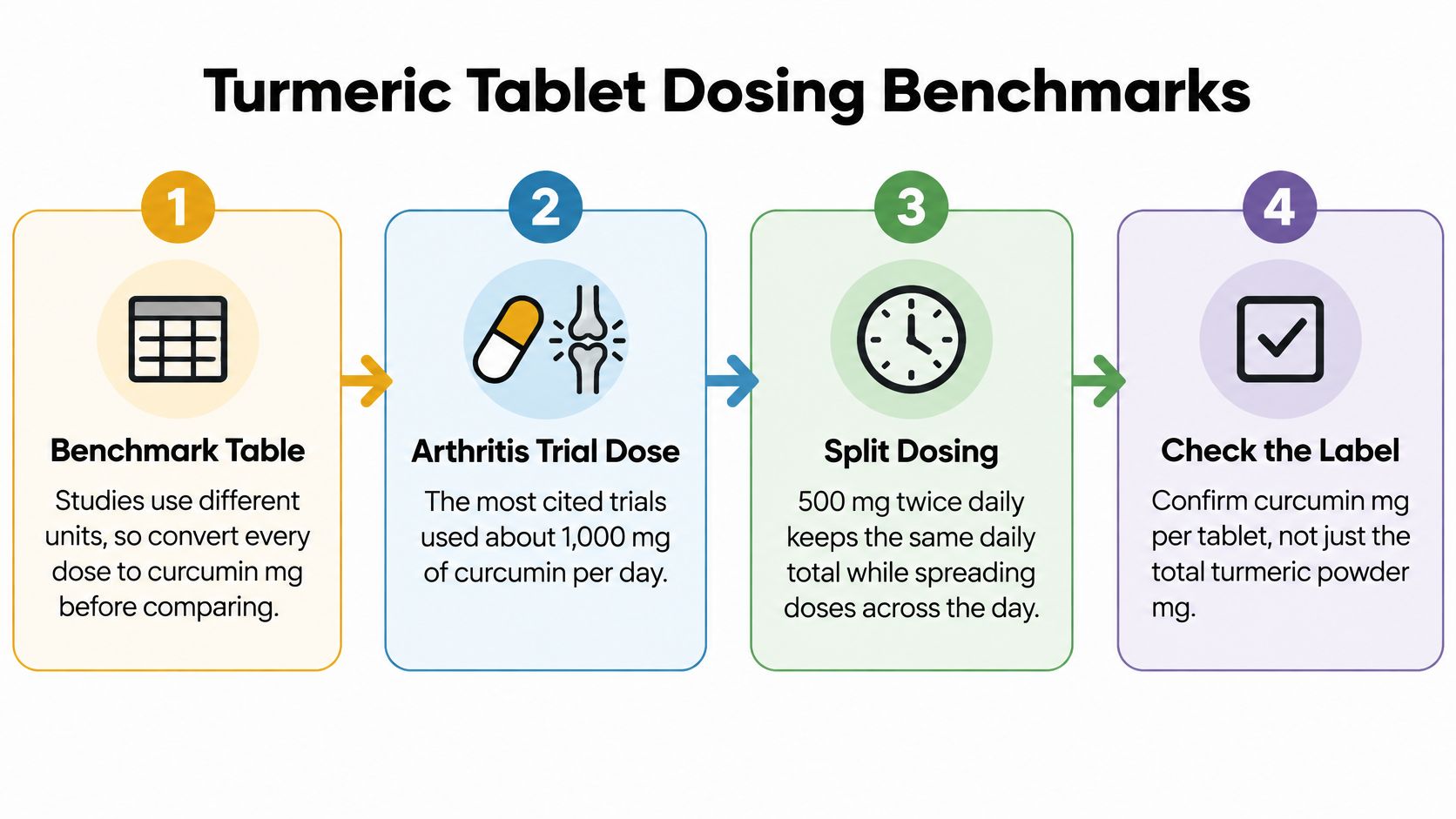
The review discussing turmeric formulations and clinical dosing describes studies using 80 to 2,000 mg of turmeric, trials using 500 mg of curcumin twice daily, and a knee osteoarthritis trial using 250 mg of water-dispersible extract daily for 90 days. These figures refer to different compounds and formulations, so they are not interchangeable targets for a tablet.
Study or guidance | Amount and compound | Schedule or duration | How to interpret it |
|---|---|---|---|
Turmeric studies summarized in the linked review | 80 to 2,000 mg of turmeric | Varied by study | A broad study range, not one standard dose |
Curcumin trials summarized in the linked review | 500 mg curcumin per dose | Twice daily | A trial schedule, not a general recommendation |
Knee osteoarthritis trial summarized in the linked review | 250 mg water-dispersible turmeric extract | Daily for 90 days | The delivery system differs from conventional powder |
NCCIH guidance | Recommended amounts of conventional oral turmeric or curcumin | Up to 2 or 3 months | Applies to conventional formulations, not every product |
Crossover research discussed in the linked review | 2,400 mg curcumin, with or without piperine | Study-specific | An experimental amount, not a daily-use instruction |
The review also describes a crossover study in which adding piperine to 2,400 mg of curcumin did not increase plasma uptake compared with curcumin alone. That finding concerns absorption under study conditions. It does not establish a useful or safe dose for an individual.
Use this visual to check which ingredient a label is measuring before comparing amounts.
Calculate content without prescribing a dose
Find the standardization. Look for the declared curcuminoid percentage, not just an extract ratio.
Identify the weight. Check whether the figure applies to one tablet or the full serving.
Work out curcuminoid content. Multiply the extract weight by its stated curcuminoid fraction.
Check the daily serving. Compare the result with research on the same compound and a similar delivery system.
For example, a tablet's extract weight is like the weight of a whole recipe, while its curcuminoid amount tells you how much of the ingredient being studied is inside. If the label gives no curcuminoid assay, you cannot calculate that amount reliably. Don't fill the gap with an assumed average.
For duration, NCCIH's turmeric guidance says conventionally formulated oral turmeric or curcumin is likely safe at recommended amounts for up to 2 or 3 months. Use that as a limit for a review, not a guarantee or permission to continue indefinitely. Agree with your clinician on when to reassess, and don't raise the serving just because you haven't noticed a benefit.
Side Effects, Liver Risk and Medication Interactions
What changes when you take a turmeric tablet, and what else might it affect? Start with the formulation: a tablet's total powder weight does not reveal its curcuminoid amount or how much may be absorbed. Enhanced-bioavailability ingredients can change exposure, so absorption is a safety consideration as well as a label claim.
Take liver symptoms seriously
NCCIH's formulation-specific safety warning reports cases of liver injury associated with some turmeric or curcumin products, particularly those designed to increase absorption. Symptoms to watch for include fatigue, nausea, poor appetite, dark urine, and jaundice.
If these symptoms appear, stop taking the supplement and seek medical advice promptly. The symptoms are not evidence that a product is “detoxifying” the body.
This warning does not mean every enhanced-bioavailability product causes liver injury. It does mean that a stronger absorption claim deserves careful consideration, especially for someone with current or past liver problems. The product's curcuminoid content and delivery system matter more than the weight printed on the front.
Who should check with a clinician before using turmeric tablets
Situation | Why it matters | What to do |
|---|---|---|
Liver disease or past liver injury | Some enhanced-bioavailability products have been linked to liver injury | Don't start without clinical advice |
Blood thinners, including anticoagulants or antiplatelets | Turmeric may raise a concern about bleeding when combined with medicines that affect clotting | Ask the prescriber or pharmacist to review the exact product |
Gallbladder problems | The condition may affect whether turmeric is suitable | Seek advice before use |
Diabetes medication | Turmeric could affect blood sugar, which may matter alongside glucose-lowering medicine | Ask whether blood sugar monitoring or other precautions are appropriate |
Planned surgery | The surgical team needs to know about supplements that could affect care | Disclose the product and follow their stopping instructions |
Dark urine, jaundice, or persistent fatigue | These can be warning signs of liver problems | Stop the tablets and seek medical care |
Bring the label, not just the word “turmeric,” to a medication review. Include prescription and nonprescription medicines, plus other supplements. A pharmacist can check the actual ingredients and help identify concerns.
Safety checkpoint: Higher absorption may change both exposure and the questions to ask about suitability, monitoring, and duration.
Pregnancy, breastfeeding, and use in children call for separate advice. Adult supplement research does not establish that the same product is suitable in those situations.
If joint pain or other symptoms persist, seek an assessment rather than repeatedly switching supplements. Finding the cause matters more than choosing a product with a stronger absorption claim.
How to Choose a Quality Turmeric Tablet
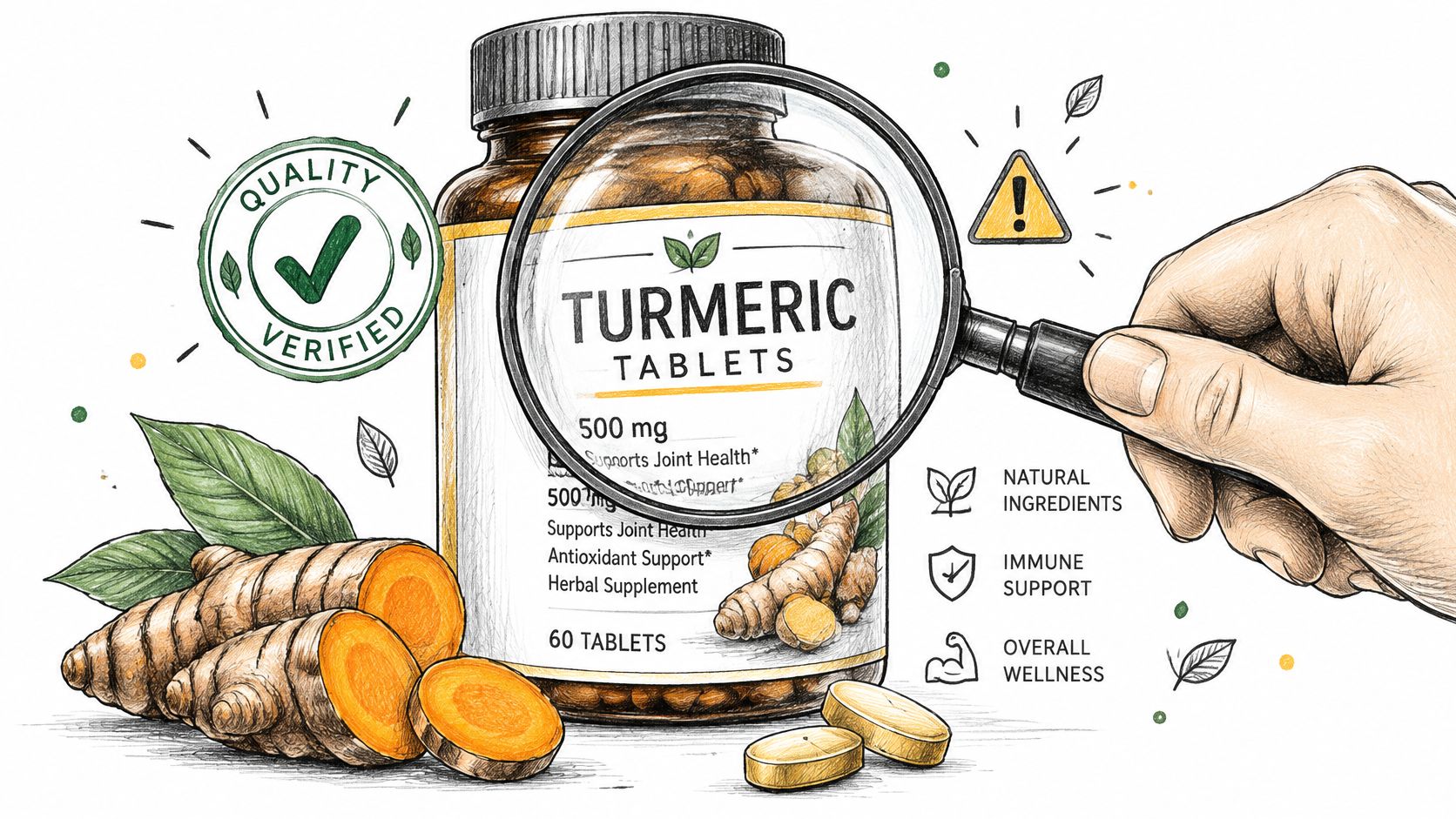
A precise label is useful, but it isn't the same as proof of contents. The formulation review cited earlier also discusses adulteration and contamination concerns, making batch-specific testing a practical purchasing criterion.
Read the label as a set of claims the manufacturer should be able to document. Botanical identity, curcuminoid content, and contaminant testing answer different questions.
Use the visual below as a reminder to inspect the details rather than the front-label promise.
Quality criteria for turmeric tablets
Criterion | Good sign | Red flag |
|---|---|---|
Botanical identity | Curcuma longa and the plant part are named | An unidentified herbal blend |
Curcuminoid standardization | Percentage and milligram content are clearly stated | Only total turmeric weight appears |
Certificate of analysis | A report matches the bottle's batch | A general testing claim without documentation |
Heavy metals | Batch results and acceptance limits are available | No contaminant information |
Synthetic curcumin | Testing supports the claimed plant-derived identity | Undisclosed substitution |
Capsule shell | Shell material and dietary suitability are declared | Unclear ingredients |
Absorption claim | Named system, relevant dose, and study design | An impressive percentage without methods |
A vegan label may matter for your dietary preferences, but it doesn't establish curcuminoid potency or purity. Likewise, a named delivery technology doesn't replace contaminant testing.
For help distinguishing serving size from individual ingredient amounts, use this guide to reading supplement facts.
What to request from the manufacturer
A certificate of analysis is a testing report, not a marketing brochure. Ask for one that matches the lot number printed on your bottle.
Useful entries include:
Identity and potency: Total curcuminoids and the marker-compound breakdown.
Contaminants: Heavy-metal results and microbial testing against stated limits.
Dosage-form performance: Disintegration results, where applicable.
Batch consistency: Evidence that the declared assay is maintained across production.
Ask what was tested, by whom, and whether the results apply to the finished product. A document for a raw ingredient doesn't necessarily answer every question about the capsule you'll swallow.
The embedded video is supplementary viewing, not a substitute for a product-specific laboratory report.
Choose using verified composition, relevant formulation evidence, and testing transparency. If a seller won't provide enough information to make that judgment, compare another option rather than filling in the gaps yourself.
Choose Your Supply and Confirm Before You Buy
Whole-root tablets, standardized extracts, and multi-ingredient capsules require different comparisons. For the publisher's capsules, assess the turmeric component separately from the ashwagandha root, ginger, and bromelain, and include BioPerine in the formulation review.
The purchasing page is a starting point for checking the current label and terms.

Match the commitment to the information
A one-time bottle lets you avoid an ongoing order while you assess suitability. A subscription can make replenishment convenient, but it shouldn't substitute for checking the label or setting a clinical review point.
Compare price per capsule only after confirming what each capsule contains. Otherwise, you're comparing containers rather than equivalent amounts of the ingredient you want.
The product information discussed here doesn't establish curcuminoid milligrams per capsule. Request that figure rather than inferring it from the extract description or absorption claim.
Confirm curcuminoid content per capsule. Check the current supplement facts panel and ask for clarification if needed.
Arrange a medication review. Have a pharmacist assess every ingredient, not just turmeric.
Request the batch certificate of analysis. Match it to the product you'll receive.
Choose the purchasing arrangement last. Verify current subscription, cancellation, shipping, and unopened-return terms before paying.
Start with the label and the batch report. If those don't answer the basic questions, hold off on the purchase.
River of Life offers a multi-ingredient capsule containing standardized turmeric extract with BioPerine, alongside ashwagandha root, ginger, and bromelain. Visit River of Life to review the current supplement facts and purchase options, then request curcuminoid details and batch testing before choosing your supply.