


Supplements for Mental Clarity and Focus Guide

About 15 million Americans used dietary supplements specifically for cognitive health in a national analysis of 2007 data, according to the National Center for Complementary and Integrative Health. That level of use shows interest, not proof that a supplement improves focus. People have reported using natural products for memory or concentration, and multivitamins were a common choice among those taking supplements for cognitive health.
Evidence varies by ingredient and by the task researchers measure. A review of studies in healthy young adults found some positive results for several ingredients, including caffeine, tyrosine, flavonoids, ginseng, and prebiotics. Those mixed findings are a reason to match an ingredient to the job, rather than treating every supplement as a general brain pill.
For acute attention, L-theanine has some evidence. Bacopa is studied for memory over a longer period. Neither should be judged by the same clock: attention may shift within a sitting, while memory benefits, if they occur, take consistent use over weeks. Supplements that ease stress may support calmer focus, but calm alertness is different from stimulation.
Table of Contents
What Clarity Supplements Can Realistically Do
Say it's 2 p.m. The spreadsheet is open, the paragraph is half written, and your mind keeps sliding off the line. You want to stay on the task with less fog. You don't want a higher IQ, and you aren't treating dementia or ADHD. That is the only result I score in this guide.
People buy for two different motives, and the bottle doesn't know which one you have. Some shoppers already feel slower and hope a capsule will patch the day. Others feel fine and want insurance. Those are different jobs, and a multivitamin leading the shopping cart shows demand, not a sharper mind.
I keep three clocks apart, in ordinary time, before any product name matters.
The hour. Acute attention can shift in the same sitting. You take something, wait, and then do the hard block. If nothing changes in that window, it isn't an attention tool.
The weeks. Memory botanicals need many weeks of the same dose. A capsule before a meeting is the wrong test.
The stress load. Some botanicals help by lowering the noise that breaks concentration. Rumination, a short fuse, and chopped-up sleep steal the task. Calmer is not the same as stimulated.
A review in young healthy adults can look encouraging for caffeine, tyrosine, flavonoids, ginseng, and prebiotics, and then fall apart when you change the ingredient or the test. I use that as a filter. If a label promises focus, memory, mood, and drive in one line, it is selling the aisle, not a result.
Practical rule: Pick the clock first. If you can't say whether you need the next hour, the next twelve weeks, or a lighter stress load, you don't have a supplement decision yet.
The match table below is the decision tool. Read your job in the left idea, then stop. Don't stack a second clock because the bottle has room.
Focus Ingredients and Doses That Match the Job
Choose by timing: an hour for attention, weeks for recall, or a sustained stress load for calmer focus. The dose and the limit matter as much as the ingredient.
Ingredient | Main job | Amount | When it can show | Limit |
|---|---|---|---|---|
L-theanine | Choice reaction time and visual attention | 200 mg once; 100–400 mg range | 30–60 minutes | Small acute effect, not a memory treatment |
L-theanine with caffeine | Alert focus with less jitter | 200 mg theanine plus modest caffeine | Same sitting | Extra caffeine can erase the calm |
Bacopa monnieri | Delayed or free recall | 300 mg daily of standardized extract | About 12 weeks | Weak evidence for instant concentration |
Ashwagandha root | Calm under stress while staying sharp | Root extract at the printed label amount | Several weeks | May add to sedation; check with a doctor about thyroid medication |
Ginseng | Mixed attention or fatigue signals | No reliable dose to specify | Varies with the extract and test | Inconsistent across studies |
Tyrosine | Focus when stress or sleep loss drains you | A pre-task serving, not a standing daily dose | Before the hard task | Situational, not an everyday brain boost |
The rows a tired workday actually uses
L-theanine is the hour-scale option. Research on single 200 mg doses suggests a small short-term attention benefit, but the evidence is mixed. A usable range is 100–400 mg, and the potential benefit is attention rather than memory. For a defined work block, take it 30 to 60 minutes beforehand.
Theanine with modest caffeine fits a same-sitting task. One usual cup of coffee or tea keeps the caffeine modest. Theanine may soften caffeine's rough edges while alertness remains; more caffeine can tip the balance toward jitters.
Bacopa belongs on the weeks-long clock. A common amount is 300 mg daily of standardized extract, taken with food. Judge it by recall after about 12 weeks, not by concentration before a meeting.
Ashwagandha fits a longer stress-focused trial. River of Life combines ashwagandha root with turmeric in one daily capsule. The product uses full-spectrum, root-only ashwagandha, described as supporting calm while helping the body maintain balance. Check with a doctor before use with thyroid medication; ashwagandha may also add to sedation.
Ginseng and tyrosine have less predictable jobs. Ginseng findings vary with the extract and the test, so there is no single dose to recommend here. Tyrosine is sometimes used before a demanding task when stress or sleep loss is already affecting focus; it is not a routine daily brain boost.
One job, then four moves
Pick one primary goal. A blend is only useful if it provides a clear amount of the ingredient meant to do that job.
Name the job. Is it same-day attention, delayed recall, or stress interfering with concentration?
Match the amount. Theanine is commonly taken as a 200 mg single dose; bacopa is often taken as 300 mg of standardized extract daily. If the label does not state the amount, you cannot match the dose.
Follow the relevant clock. Take theanine 30 to 60 minutes before a work block. Take bacopa daily with food and assess recall after about 12 weeks. Treat ashwagandha as a weeks-long stress-focused trial, not a rescue capsule.
Track the result. Note sleep, jitters, and whether you finish the work block. Stop if you experience palpitations, heavy sedation, or stomach upset. These supplements do not treat Alzheimer's disease, ADHD, or anxiety disorders.
Choose the simplest option that matches the job, then give it a fair trial before adding another ingredient.
Why Calm Alertness Beats Extra Stimulation
Think of a dashboard. Stimulation is the rpm gauge. Clarity is whether you can hold a lane. High rpm feels like work. It is not the same as staying between the lines when the task gets dull or hard.
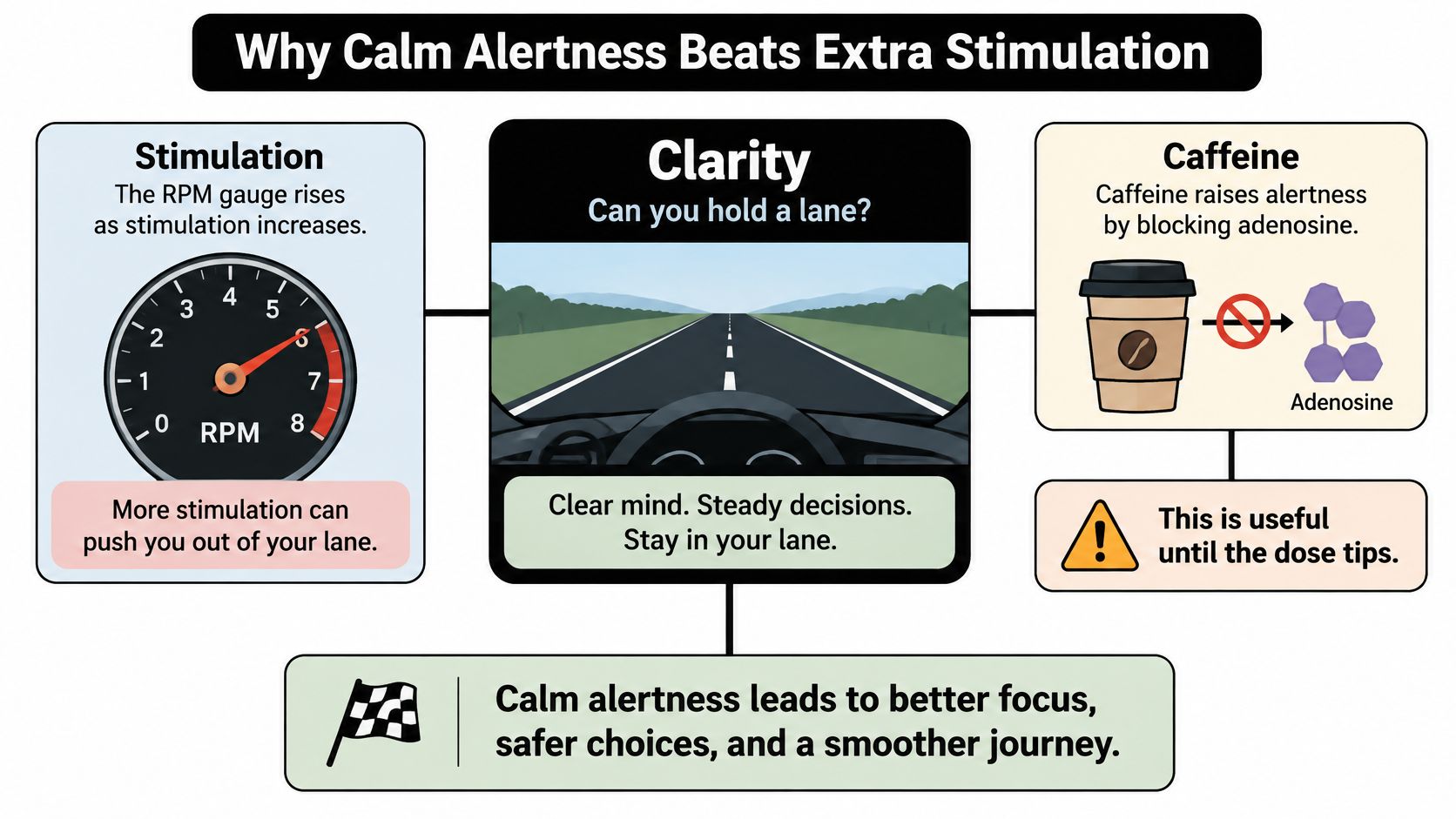
Caffeine raises alertness by blocking adenosine. That is useful until the dose tips into a racing mind and a crash. Another espresso at 3 p.m. often buys speed you can't steer.
L-theanine is not a second stimulant. The practical story is that it moderates caffeine's rough edges while alertness stays. That is why the pair fits clear focus better than either alone for many people. Keep the claim narrow. The strongest theanine signal is short-term attention and reaction time, not mood, memory, or executive function across the board.
Bacopa is a slow memory botanical, not a deadline pill. A systematic review of randomized controlled human trials found improvement in 9 of 17 free-recall tests, while other cognitive domains were limited and inconsistent, according to the PubMed summary of that review. A separate summary of a longer trial in older adults describes a small edge on delayed recall and reaction time versus placebo, without reported serious adverse events. Preparations, tests, and study length differ, so the reproducible signal stays free recall and delayed memory. I want a standardized extract and weeks of use. I don't want a capsule swallowed on the way into a presentation.
Ashwagandha belongs on the stress circuit. As an adaptogen, the root is used to support a steadier stress response and a sense of calm. Focus gets easier when rumination and broken sleep stop taking the attention you needed for the lane. That is a different pathway from rpm. If stress is the thing breaking your afternoons, the longer note on stress and resilience is the right next read, not another stimulant.
Clarity is the right amount of alertness for the job, not the maximum.
A formula that mixes the hour, the memory weeks, and the stress load still has to earn each claim on its own. One pathway doesn't vouch for the other two.
The short version of that split, stimulation versus a lane you can hold, is easier to see than to read.
Interactions and People Who Should Pause
Some people should not self-experiment with a focus botanical. If you take antidepressants, anti-anxiety medication, sedatives, thyroid medication, or blood thinners, or you are pregnant or breastfeeding, check with your doctor before you add one. We treat that pause as the starting rule, not a footnote.
The scan below is the practical list. The concern is an added effect, a changed drug effect, or a group the adult trials never covered.
Situation | Concern | What to do |
|---|---|---|
Antidepressants, anti-anxiety drugs, or sedatives | Added sedation or a changed drug effect | Ask the prescriber before starting |
Melatonin or sleep medication plus ashwagandha | Ashwagandha may increase sedation | Do not combine without medical advice |
Thyroid medication | Ashwagandha can affect thyroid status | Get approval and lab follow-up |
Blood thinners | Turmeric, ginger, or ginseng may affect bleeding | Clear the formula with the prescriber |
Pregnancy or breastfeeding | Safety data for these blends are thin | Skip unless the obstetric clinician agrees |
Heavy caffeine already | Extra stimulants cause jitters, not clarity | Count coffee, tea, and pre-workout first |
Children or teens | Cited trials are in adults | Do not use adult focus stacks |
Why those rows exist
Sedatives stack. Ashwagandha may add to the effect of sedatives, so ask a doctor before you pair it with melatonin or sleep medication. Guessing "it's herbal, so it's mild" is how people wake up foggy and call it clarity.
Thyroid drugs need the same pause. Ashwagandha is not a neutral herb for that axis. Approval plus lab follow-up is the move, not a quiet add-on.
Bleeding risk hides in comfort ingredients. Turmeric, ginger, and high-dose ginseng show up in formulas sold for ease or energy. On a blood thinner, that is a prescriber question. Our notes on ashwagandha interactions walk the same caution without turning the herb into a drug.
Pregnancy and breastfeeding are a skip unless the obstetric clinician agrees. The trials behind these bottles are not safety trials for that group.
Caffeine is already in the day. Coffee, tea, soda, and pre-workout supply it. Another stimulant capsule produces jitters, not a cleaner lane. Children and teens sit outside the adult evidence used here, so adult focus stacks don't belong in that age group.
A standard multivitamin is not an automatic conflict with a typical botanical capsule. There are no known issues taking a straightforward multi beside that kind of daily capsule. Hidden caffeine and a second copy of the same herb still count. Read both labels.
Stop and call the prescriber for a new rash, unusual bleeding, crushing fatigue, chest flutter, or a mood crash. Supplements are not a substitute for evaluating a sudden change in thinking.
How to Choose a Formula Worth Taking Daily
Read the label. Don't rank brands by the adjective on the front.
Since the Dietary Supplement Health and Education Act, signed on October 31, 1994, supplements have been regulated as a category of food, not like prescription drugs. Manufacturers generally carry the duty to ensure safety and truthful labeling before marketing, while the FDA can enforce rules after marketing, as laid out in this DSHEA regulatory review. A brain claim on a bottle can be common and still unproven until the ingredient and the dose match a trial. Widespread use doesn't settle effectiveness. Memory, concentration, and stress language has to stay separate from disease-treatment claims, and you judge evidence one ingredient and one formula at a time.

Five checks, in order
Name the ingredient and the extract. Root-only ashwagandha, or a bacopa extract with a stated standardization, beats a fairy-dust blend that lists twelve plants and hides the milligrams.
Put the milligrams next to the job. They should sit close to the studied amount, visible per serving. If you chose the hour, you are looking for theanine in the hundreds of milligrams, not a sprinkle.
Match the serving to real life. If the formula says with food, that is the trial, not a suggestion you skip on busy mornings.
Check helpers and fillers. An absorption helper should be specific, such as black pepper extract beside turmeric. Fillers should be absent or clearly minor.
Keep the claim in structure-function language. Focus or calm is the lane. A promise to treat Alzheimer's, ADHD, or an anxiety disorder is the wrong lane, and skepticism here is rational because the category isn't drug-approved.
A few extras you can verify help more than a slogan. Third-party testing, when the brand offers it, is a check on what is in the capsule. A vegan capsule matters if that is your line. A return window means an unopened bottle isn't a sunk cost while you read the facts panel. If you want the panel decoded line by line, use this walkthrough on how to read a supplement facts label.
If the label will not show the dose, you can't match it to evidence. Leave it on the shelf.
Build a Steady Clarity Routine This Month
Pick one job from the match table and ignore the other clocks for now. Same-day attention means L-theanine. A memory trial means bacopa for about twelve weeks. Calmer stress means ashwagandha. Two jobs at once make a muddy month, and you won't know what moved.
The habits are what make that job visible. A botanical can't outrun the day you built under it.
Sleep first. No capsule outruns a short night. Protect the hours before you protect the milligrams.
Feed the morning and walk before the hard block. A protein-containing breakfast and a short walk do more for afternoon fog than a second stimulant. Do that on the day you care about, not as a personality project.
Set a caffeine cutoff. Late espresso fights the calm you wanted from theanine. Count the cup, then stop.
Keep one ingredient on a fixed schedule. Theanine only on days with a defined focus block, 30 to 60 minutes before it. Bacopa or ashwagandha goes in daily with food. Don't "catch up" with a double serving after you skip.
Run a four-week note. Each week, mark stress, whether sleep stayed continuous, and whether work blocks finished. Four weeks is long enough to see a stress pattern. It is not long enough to grade bacopa's recall job, so don't quit a memory trial at day 20 and call it a failure.
Ashwagandha's amount is not set in this plan. It has to come from the label, with a clinician check where the medication rules apply. If calm under stress is the job you picked, we put ashwagandha root with turmeric in one daily capsule, and the use we stand behind is 2 capsules daily with food for at least 4 to 8 weeks. It is a melatonin-free capsule and it contains no sedative, so it is not a sleep drug wearing a focus label.
Routines support focus. They don't treat disease. If thinking changes suddenly, that is a medical visit, not a new bottle.
River of Life is our daily capsule for adults seeking calmer stress and mental clarity, combining ashwagandha root with turmeric, black pepper, ginger, and bromelain instead of another stimulant. It suits the weeks-long stress timeline in this guide, taken with food, not as a same-hour attention trick. If that is the job you picked, visit River of Life and read the label against the dose you can keep.