
Ashwagandha Root Powder: 2026 Guide to Benefits & Dosing

You're probably here because ashwagandha keeps showing up everywhere. A friend says it helped them feel calmer. A sleep supplement includes it. A wellness shop sells both “root powder” and “high-potency extract,” and the labels make them sound interchangeable.
They aren't interchangeable.
As a practitioner, I see the most confusion on this topic. People buy Ashwagandha root powder, expect the same results they've read about in clinical studies, then assume the herb “doesn't work” when the issue is often the form, the dose, or the fit for their health history. The other side of the problem is just as important. Some people take it casually because it's “natural” and never hear the cautions around thyroid health, medications, pregnancy, or liver concerns.
Ashwagandha can be useful. It can also be misunderstood. The goal is to help you sort out what it is, what it's good for, when Ashwagandha root powder makes sense, and when a standardized extract is the better tool.
Table of Contents
What Is Ashwagandha and Why Is It So Popular
A lot of people aren't looking for a miracle. They're looking for something that helps take the edge off. They feel wired at night, flat in the morning, and stretched thin all day. That combination drives interest in herbs that promise calmer stress responses without making you feel dulled out.
Ashwagandha has become popular because it sits right at that intersection of stress, sleep, and resilience. It has a long traditional history, but it also fits a modern problem. People want support that feels gentler than jumping straight to a stronger intervention, especially when the issue is chronic pressure rather than one dramatic event.
I also think people are drawn to it because it doesn't live in only one health category. Someone might first hear about it for anxious tension, then notice it mentioned for sleep, workout recovery, or general stamina. That broad reputation makes it attractive, but it also creates confusion. A single herb can do different things depending on its form, the dose, and the person taking it.
The mistake isn't being interested in ashwagandha. The mistake is assuming every product on the shelf is built to do the same job.
That's where online advice often falls short. It lumps powder, extracts, gummies, blends, and “proprietary” formulas into one bucket. If you've read a general overview of adaptogens and want a broader look at why they're drawing so much attention, this discussion of the rise of adaptogens in 2025 and ashwagandha's role in stress management gives useful context.
Why people try it in the first place
Some of the most common reasons are practical:
Stress overload: They want help feeling less reactive and less tense.
Poor sleep quality: They're tired but can't settle well at night.
Mental fatigue: Their focus feels scattered when stress stays high.
General wellness curiosity: They want a traditional herb that has more behind it than hype.
Ashwagandha isn't popular because it's trendy. It's popular because modern life gives people plenty of reasons to look for support in exactly these areas.
From Ancient Ayurveda to Modern Science
A patient will often bring in two bottles. One says “ashwagandha root powder.” The other says “high-potency extract.” They assume the herb is the same in both, just packaged differently. In practice, that assumption causes a lot of confusion.
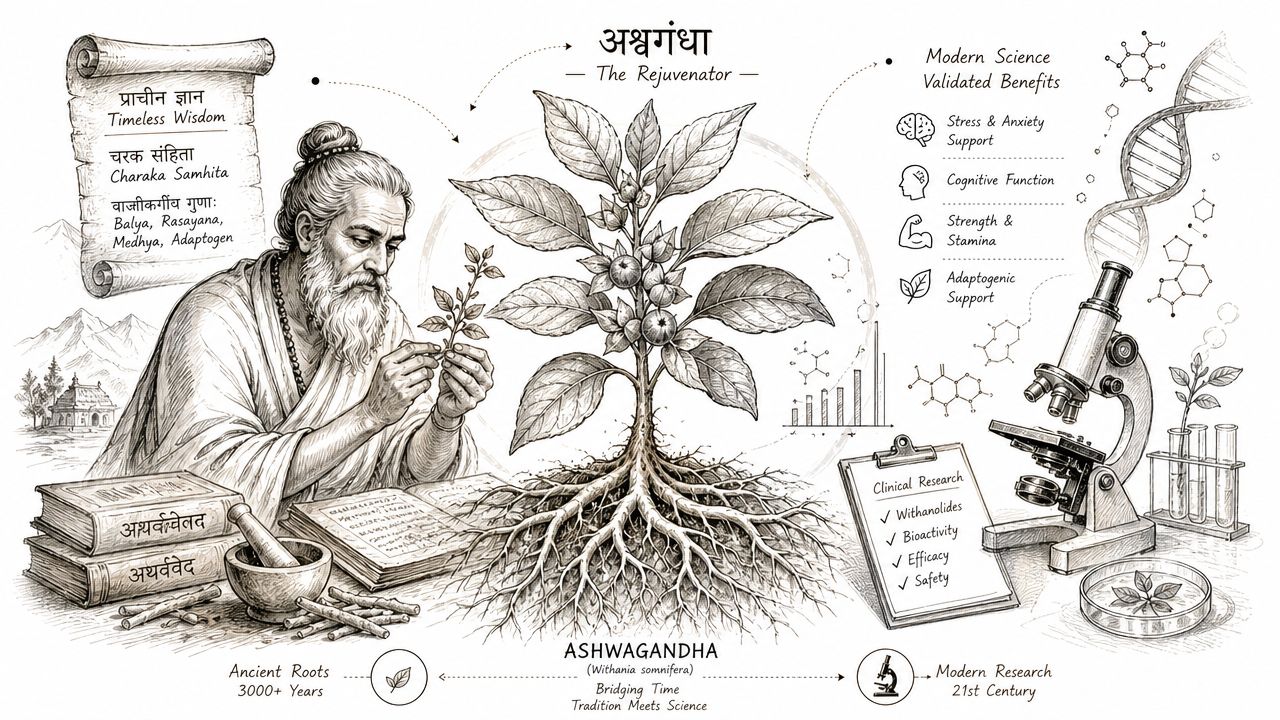
Ashwagandha comes from the root of Withania somnifera, a plant used in Ayurveda for centuries as a restorative herb. Traditional use gave it a reputation for supporting resilience, recovery, and steadier energy over time. Modern research has not repeated those older claims word for word. Instead, it has tested specific preparations, at specific doses, for specific outcomes. That distinction matters.
Why people still turn to it
In traditional practice, ashwagandha was usually used more like a rebuilding tonic than a fast-acting symptom reliever. That is still the right frame for many people. Someone dealing with chronic stress, poor recovery, or worn-down energy may be looking for better reserve, not a stimulant effect.
I often explain it this way. Ashwagandha is usually a “steadier over time” herb, not a “feel it in an hour” herb.
That helps explain why people describe it in different ways. Some notice calmer stress reactivity. Others notice better sleep quality or less mental fatigue. Those effects can overlap because stress physiology touches all of them. If you want a closer look at how ashwagandha may help with stress and anxiety based on current evidence, that is where the modern research is strongest.
What modern science adds
Modern science gave us a more precise language for an old herbal idea. Ashwagandha is commonly grouped with adaptogens, meaning herbs studied for their potential to support the body's response to stress. The key point is not that it “balances everything.” The key point is that researchers are trying to measure which preparations affect stress markers, sleep, mood, and related symptoms.
That is where many articles oversimplify the story. They talk about “ashwagandha” as if root powder, concentrated extract, and blended products all perform the same way. They do not.
The compounds discussed most often are withanolides. Standardized extracts usually list them on the label because they help define potency and consistency from batch to batch. Root powder may still be useful, especially for broader traditional use, but it is less precise. That makes a real difference if the goal is to match a clinical study rather than include the herb in a daily wellness routine.
A practical way to frame the history-to-science shift is this:
Traditional whole-root use points to long-standing, broad restorative use.
Standardized extracts allow more consistent dosing and are the forms used in much of the clinical research.
Product form changes expectations. Root powder and extract should not be treated as interchangeable.
Clinical reality: Ashwagandha has a long traditional history, but modern decisions still come down to preparation, dose, and safety. The biggest mistake is assuming every product labeled “ashwagandha” is built for the same goal.
The Clinically Studied Benefits of Ashwagandha
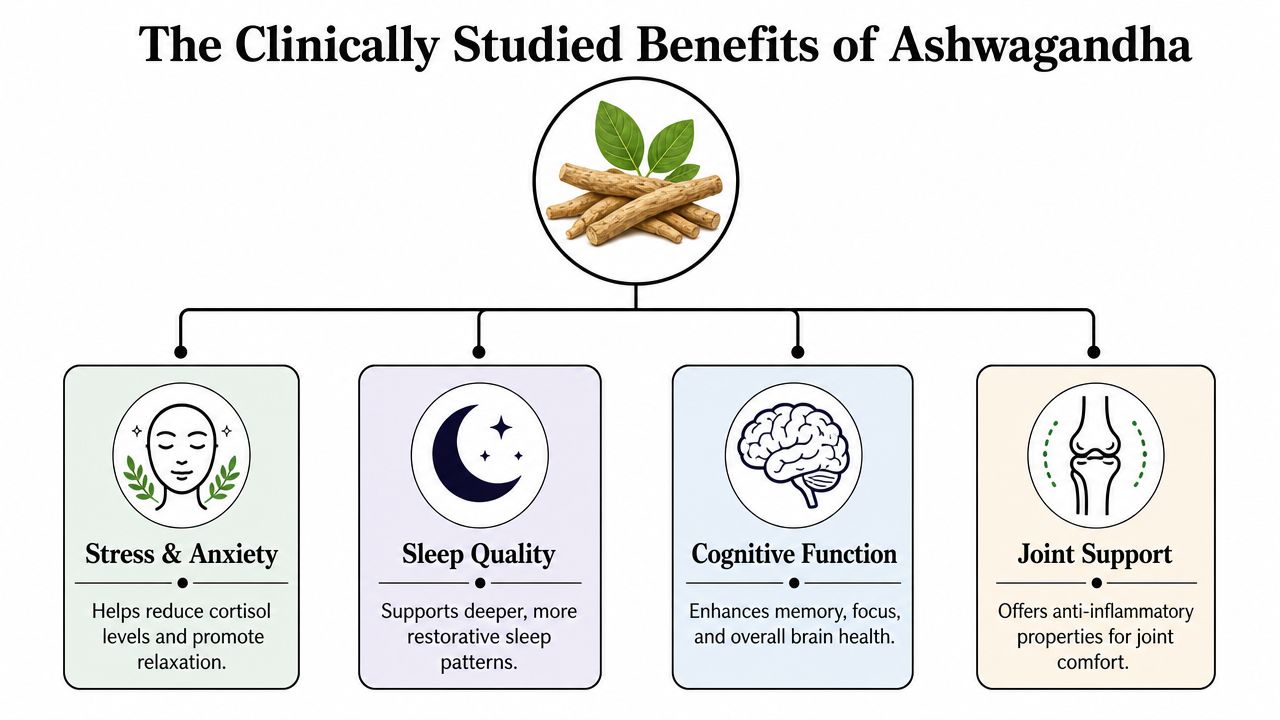
Clinical interest in ashwagandha is strongest in one area: stress-related symptoms. That's the center of gravity. Other benefits may matter, but if someone is choosing it for evidence-backed reasons, stress and sleep are usually the clearest place to start.
Stress and anxiety support
A thorough review involving 372 adults found that participants taking ashwagandha, typically 500–600 mg/day standardized to 5% withanolides for 6 to 12 weeks, had statistically significant reductions in stress, anxiety, and serum cortisol compared with placebo. The same review notes that anxiety scores were reduced by up to 70% or more in patients with stress-related conditions, and a WFSBP and CANMAT taskforce provisionally recommends 300 to 600 mg daily of ashwagandha root extract for generalized anxiety disorder, with greater benefits at 500–600 mg/day than at lower doses, as summarized in this clinical review of ashwagandha use and efficacy.
That's why standardized extract gets so much attention in practice. The more specific the goal, the more important consistent dosing becomes.
If stress is your main concern, this guide on ashwagandha for stress and anxiety is worth reading alongside the clinical discussion.
Sleep quality
The same review found that sleep improvements were significant, with the most prominent effects seen at 600 mg/day for at least 8 weeks, especially among people with insomnia. That doesn't mean it acts like a sleeping pill. It usually doesn't knock people out.
Instead, it appears to help some people sleep better by reducing the stress burden that keeps the body too activated to settle well. That distinction matters. If your sleep problem is driven by pain, sleep apnea, alcohol use, late caffeine, or a highly irregular schedule, ashwagandha may not be the main fix.
Cognitive function
People often ask whether ashwagandha improves memory or focus. In real-world use, the most believable path is indirect. When stress is lower and sleep improves, concentration usually improves too. A calmer nervous system tends to think more clearly than an overloaded one.
I advise patients not to expect a dramatic “brain boost.” Expect less friction. Better follow-through. More mental steadiness.
Better focus from ashwagandha often looks less like stimulation and more like reduced internal noise.
Joint comfort
Ashwagandha also gets mentioned for joint support, especially in broader wellness formulas. Traditional use included rheumatoid arthritis, and the plant's bioactive compounds are associated with anti-inflammatory and stress-modulating actions. In practice, that means it may fit best as part of a bigger joint-support strategy, not as a stand-alone answer for persistent joint pain.
For people with joint discomfort, I'm careful here. If swelling, stiffness, or loss of function is ongoing, they need a proper medical evaluation. A supplement may support comfort, but it shouldn't delay diagnosis.
Ashwagandha Root Powder vs Standardized Extracts
This is the part most articles blur, and it's the reason so many buyers end up disappointed.
Ashwagandha root powder is the whole dried root ground into a fine powder. A standardized extract is a concentrated preparation made to deliver a more predictable amount of active compounds, especially withanolides. They come from the same plant, but they are not equivalent tools.
Why this distinction matters
Consider this comparison: Root powder is closer to eating the whole orange. Extract is closer to taking a measured vitamin C serving. Both come from the same source, but one is diffuse and one is concentrated.
According to this comparison of ashwagandha root powder and extract potency, a 600 mg serving of raw root powder at about 1% withanolides delivers roughly 6 mg of withanolides, while a 600 mg serving of a 5% extract provides about 30 mg, a five-fold increase in bioactive concentration. That's the practical reason raw powder usually needs higher total intake to approach the effect of a lower-dose extract.
This is also why many clinical benefits for stress and sleep are linked more closely to standardized root extracts than to casual use of raw powder. Root powder can still make sense, but usually for people who want a whole-herb option and understand that it may be less precise.
Side by side comparison
Feature | Raw Root Powder | Standardized Extract |
|---|---|---|
What it is | Dried mature root ground into powder | Concentrated preparation of the root |
Withanolide concentration | Lower and less consistent unless specified | Standardized to a declared percentage |
Typical use case | General wellness, traditional whole-herb use | Targeted stress and sleep support |
Dose practicality | Often requires more bulk | Usually easier to dose in smaller amounts |
Best for | People who prefer minimally processed whole-root products | People who want to follow clinically studied dosing more closely |
Main trade-off | Less precision | More processing, but more consistency |
A second quality point matters here. The USP-NF standard defines quality ashwagandha root powder as the dried mature root of Withania somnifera reduced to a fine powder containing not less than 0.3% withanolides, as described in the USP-NF specification for ashwagandha root powder. If a root powder product doesn't make potency easy to understand, you're guessing more than is commonly understood.
How to Use Ashwagandha Correctly
A patient buys a jar of ashwagandha root powder for stress, then follows a study that used a concentrated extract. A few weeks later, they tell me it “didn't work.” In many cases, the problem is not the herb. It is a mismatch between the form, the dose, and the goal.

Start with the outcome you want. For broad wellness, a whole-root powder can be a reasonable choice if you are comfortable with a less precise product and a larger serving size. For measurable stress support, sleep support, or trying to follow clinical research more closely, a standardized root extract usually makes more sense.
That distinction matters more than many labels suggest.
Clinical use commonly falls in the low hundreds of milligrams per day for extracts, often taken once daily or split into two doses, as noted earlier. Research has also used higher amounts in some athletic and male reproductive contexts. Root powder is different. Because it is less concentrated, the amount needed is often bulkier and harder to compare directly with extract studies. If a label says only “ashwagandha” and does not make the form and potency clear, dosing becomes guesswork.
Choose the form that matches the goal
Use this quick rule in practice:
Root powder: Better suited for whole-herb use, food-based routines, and general wellness goals.
Standardized extract: Better suited for stress, sleep, and other goals where you want dosing to resemble the clinical literature.
Blends or gummies: Harder to judge if the ashwagandha dose is low or mixed with several other active ingredients.
I usually tell patients to pick one product and one purpose. If you are testing three variables at once, form, dose, and timing, you will not know what helped or what caused a side effect.
Timing and practical ways to take it
Timing should follow the symptom pattern.
Morning: A practical option for daytime stress, tension, or irritability.
Evening: Often a better fit if the main goal is sleep quality or evening wind-down.
Split dosing: Useful when a product is labeled for twice-daily use or when a single dose feels too strong on the stomach.
If you use ashwagandha root powder, the simplest options are the ones people will keep doing:
Smoothies: Easier if you mask the earthy taste with cocoa, cinnamon, dates, or nut butter.
Warm milk or a milk alternative: Common for evening use because it turns the dose into a routine.
Oatmeal or yogurt: Good for people who dislike capsules and want a quick breakfast option.
Take it consistently for long enough to judge it fairly. A few scattered doses will not tell you much.
One more practical point. Review ashwagandha interactions and safety concerns before starting, especially if you have thyroid concerns, take sedatives, or use medication for blood sugar or blood pressure.
A quick video can help if you want a more visual overview of how people use it in a routine:
Practical rule: Keep the preparation, dose, and timing consistent before deciding whether ashwagandha is helping. Switching between powder, extract, and mixed products every few days makes the trial hard to interpret.
Understanding Ashwagandha Safety and Interactions
This is the part many wellness articles soften too much.
Ashwagandha may be well tolerated for many people in the short term, but “natural” does not mean risk-free. The people who need the clearest guidance are often the least likely to get it.
Who should avoid it or use extra caution
Ashwagandha should not be used during pregnancy or breastfeeding because of potential miscarriage risks at higher doses. It is also contraindicated in hyperthyroidism because it can increase thyroxine levels, based on the clinical safety information already noted in the earlier MSK section.
Additional caution matters for people who take medications that affect blood pressure, blood sugar, or the central nervous system, especially sedatives. If you have an autoimmune condition, a thyroid disorder, active liver concerns, or cancer history, this is a supplement to review with your clinician before starting.
What I want patients to take seriously
Emerging safety concerns include ashwagandha-induced liver injury and thyrotoxicosis, and long-term safety data remains inconclusive. Caution is especially warranted for anyone using blood pressure, diabetes, or sedative medications, as discussed in this review of ashwagandha interactions and safety issues.
I don't say that to make people fearful. I say it because a good supplement plan includes screening for who should not use the supplement.
Watch for clear mismatch signals after starting a product:
Thyroid-type symptoms: Feeling overstimulated, shaky, or unusually revved up.
Sedation issues: Feeling too calm, flat, or sleepy, especially if you also take CNS-active medication.
Liver warning signs: Any concerning change in how you feel that warrants prompt medical review.
If a supplement is affecting your sleep, mood, energy, or digestion in a way that feels wrong, stop guessing and talk to a clinician.
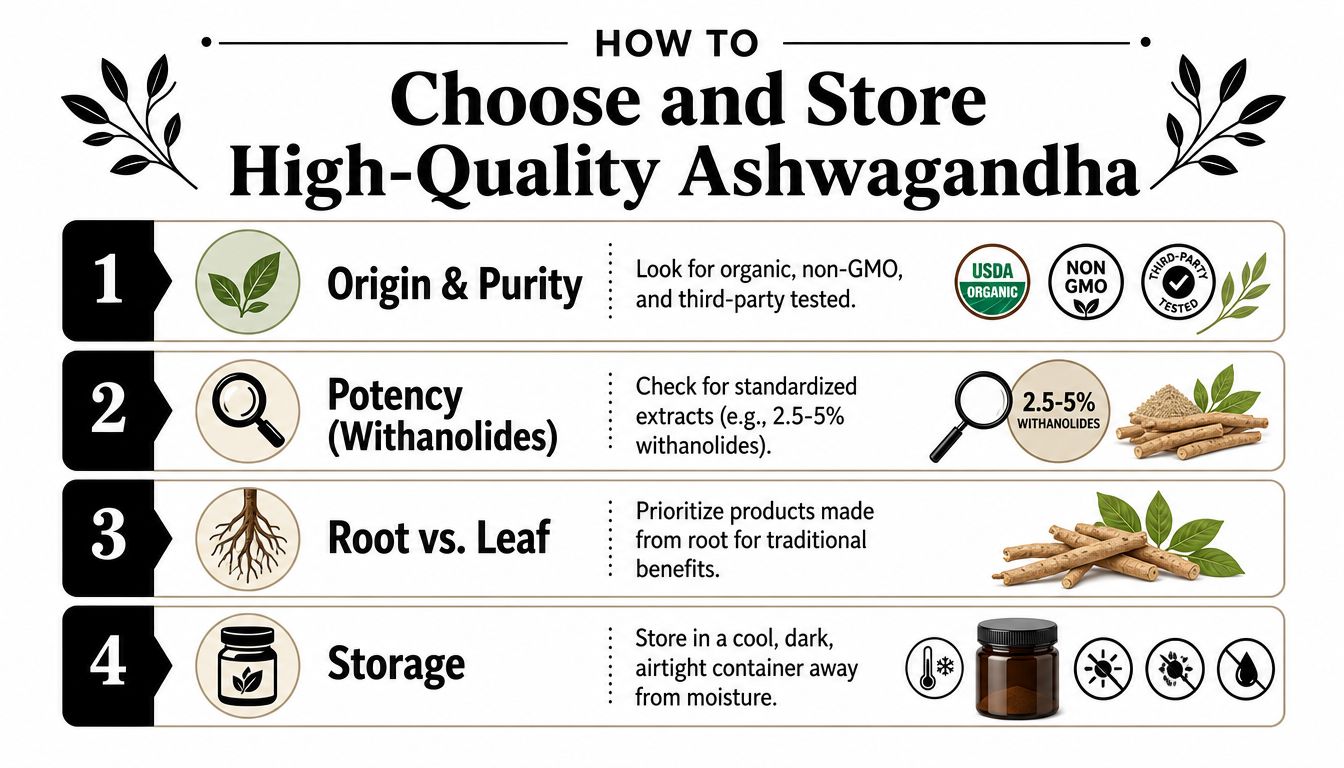
How to Choose and Store High-Quality Ashwagandha
Once you understand the powder-versus-extract issue, shopping gets easier. You stop looking for the loudest label and start looking for the most informative one.
What to check on the label
For Ashwagandha root powder, the first thing I want to know is whether it is root and whether the product gives any real potency clue. The USP-NF benchmark says quality root powder should contain not less than 0.3% withanolides, which gives you a meaningful floor for raw material quality.
Use this checklist:
Root-only labeling: Choose products that clearly identify the root, not a vague plant blend.
Potency details: If it's an extract, look for a declared withanolide standardization. If it's powder, look for quality markers rather than empty branding terms.
Third-party testing: This matters for identity and purity.
Straightforward ingredient list: Fewer mystery ingredients usually means fewer surprises.
A practical point many people miss is that raw powder and extract should not be judged by the same label logic. Powder buyers should focus on raw material quality and root identity. Extract buyers should focus on standardization and consistency.
How to store it so it stays useful
Storage doesn't need to be fancy, but it should be deliberate.
Keep it dry: Moisture degrades powders fast.
Keep it cool and dark: Heat and light are not your friends.
Seal it well: Air exposure can affect freshness and taste.
Use the original container if it protects well: If not, transfer to an airtight jar.
If your powder smells stale, clumps oddly, or has been sitting in a warm cabinet for too long, don't assume it's still at its best. Herbs are still plant material. Storage changes the experience.
Frequently Asked Questions About Ashwagandha
How long does it take to notice anything
Ashwagandha usually isn't a same-day herb. Users should think in terms of steady use, not immediate sensation. If you only take it sporadically, it becomes hard to tell whether the product suits you.
That's another reason the form matters. Standardized extracts are easier to evaluate because the dose is more predictable from day to day.
Can it help with energy and sleep
Yes, that combination confuses people, but it makes sense when you think in terms of stress regulation instead of stimulation or sedation. Some people feel more capable during the day because they feel less stress-fragmented. Some sleep better at night because they're less physiologically keyed up.
That doesn't mean everyone will feel both effects. Your pattern depends on why you're tired in the first place.
Is powder better because it is more natural
Not automatically. Whole-root powder is more traditional and less concentrated, but “more natural” doesn't always mean “more effective for your goal.” If you're trying to match the clinical stress-and-sleep research, standardized extract is often the more rational choice.
If you prefer a food-like herb experience and don't mind bulkier dosing, powder may still be a good fit.
Should you cycle it
There isn't one universal rule that fits everyone. In practice, many people do best by using one product consistently, assessing how they feel, and reviewing whether it still makes sense for them rather than taking it indefinitely on autopilot.
If you have a medical condition, take prescription medication, or notice any unusual response, reassessment matters more than any generic cycling advice.
What's the single biggest mistake buyers make
They buy an ashwagandha product based on a headline claim instead of checking the form. That's the core problem. A root powder, a standardized extract, and a blended capsule may all say “ashwagandha” on the front, but they can behave very differently in real use.
Who tends to do best with it
In day-to-day practice, the best candidates are usually adults dealing with stress-related strain who want a measured, consistent supplement plan and are willing to pay attention to safety. The worst candidates are people who want overnight results, ignore medication interactions, or assume every “natural calm” product is harmless.
If you want a simpler way to build ashwagandha into a daily routine, River of Life offers a capsule formula that combines ashwagandha root with turmeric extract, BioPerine black pepper, ginger, and bromelain for people looking for support around stress resilience, sleep quality, mental clarity, and joint comfort.